
During an environmental study of a former metal-working plant, a specialist finds chromium-impacted soil beneath an intact, thick concrete slab inside a fenced, unoccupied warehouse with no groundwater use nearby. Why does the specialist conclude there is currently no complete human exposure pathway?
Select an answer to reveal the explanation.
Short Explanation
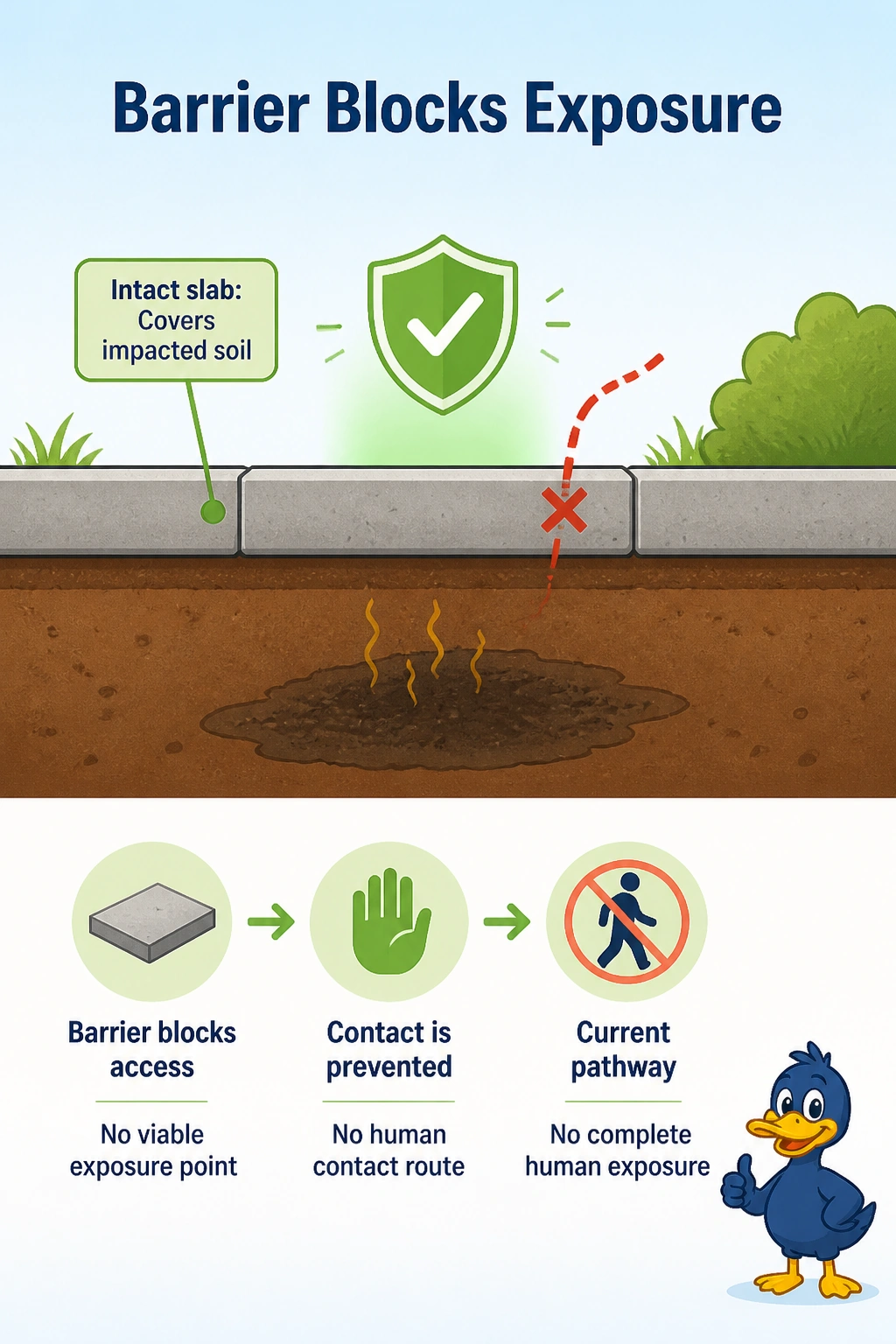
Contamination sitting in the ground does not automatically equal an active exposure risk. Think of an exposure pathway like a chain—if you break the link between the chemical and a person, no current exposure occurs.
Full Explanation
In environmental risk assessments, a complete exposure pathway requires five elements: a contaminant source, a release mechanism, a transport medium, an exposure point, and a receptor with a contact route. Because the warehouse is unoccupied and the slab seals off direct soil contact and dust generation, An intact barrier prevents a viable exposure point and contact route for human receptors. Without a receptor contacting the impacted soil through ingestion, inhalation, or dermal absorption, the pathway remains incomplete under current site conditions. Claiming that Chromium is a naturally occurring element that cannot migrate through any environmental medium is false because hexavalent chromium in particular can leach and migrate readily in groundwater. Stating that Laboratory method blanks automatically invalidate all heavy-metal soil detections on site misinterprets quality-control data; method blanks only flag potential laboratory cross-contamination for specific batches, not all field results. Asserting that Federal environmental studies only evaluate volatile organic compounds in indoor air is incorrect because environmental studies routinely assess metals, semivolatiles, and multiple media. As a caveat, an incomplete pathway today can become complete tomorrow if demolition cracks the slab or workers trench into the sub-slab soil. As an operational check, document the slab condition during periodic site inspections so any disturbance triggers immediate dust and exposure controls.
Prefer to study offline? Printable PDF study book + test engine ($7.50, unofficial). These questions stay free here.