
A chemical plant generates a spent aqueous scrubber solution containing dissolved sodium sulfide that is not on any RCRA listed-waste table. When evaluating the waste's characteristics under 40 CFR 261.23, which hazard causes this stream to be classified as D003 reactive hazardous waste?
Select an answer to reveal the explanation.
Short Explanation
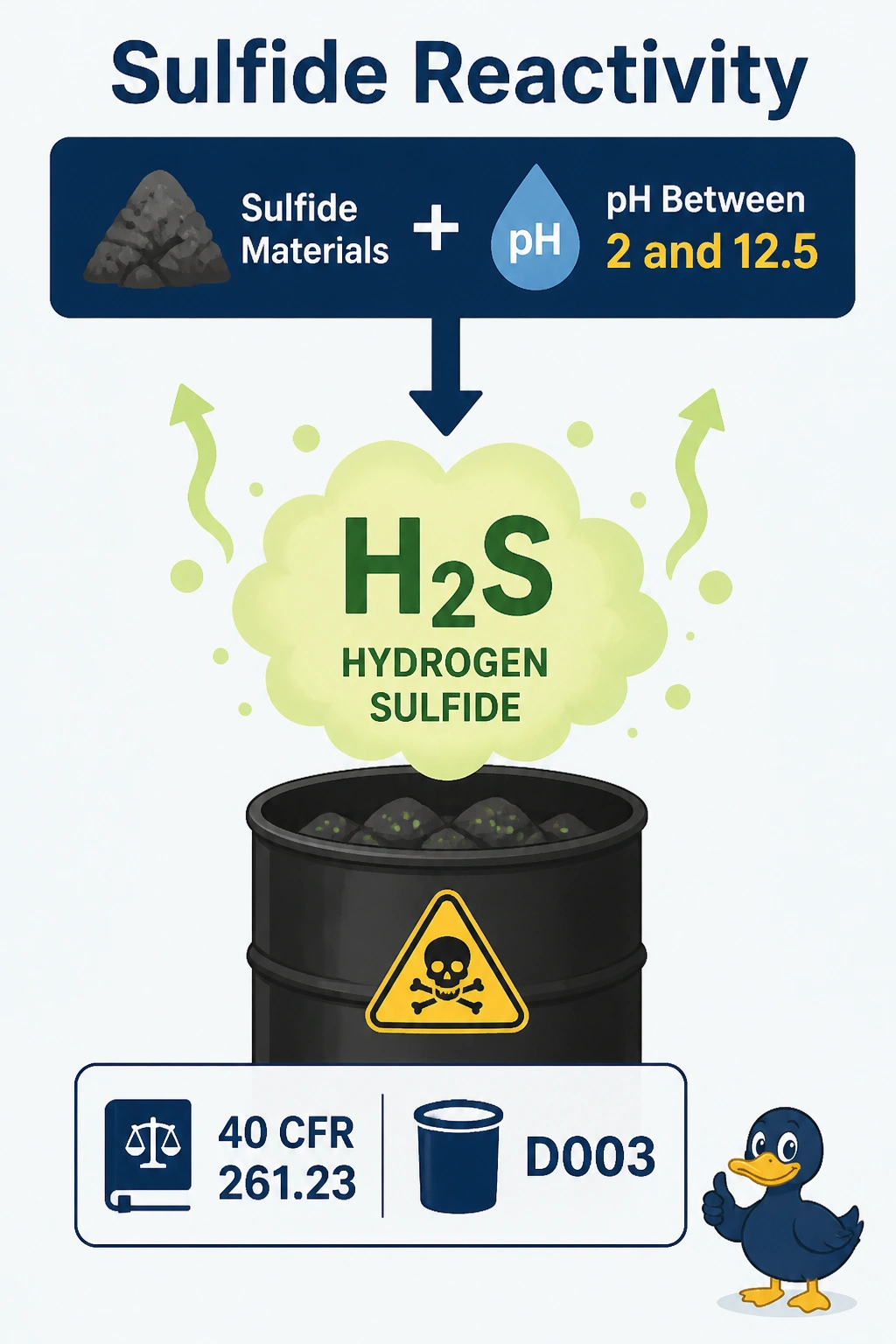
A waste does not have to explode to earn a RCRA reactivity code—sometimes the danger is the toxic gas it releases when mixed with mild acid or base. The trap is mixing up D003 reactivity with corrosivity, ignitability, or TCLP metal toxicity. When evaluating sulfide- or cyanide-bearing wastes, you must check whether they evolve toxic gas between pH 2 and 12.5.
Full Explanation
Under 40 CFR 261.23, a solid waste exhibits the RCRA characteristic of reactivity (D003) if it is a cyanide- or sulfide-bearing waste that, when exposed to pH conditions between 2 and 12.5, can generate toxic gases, vapors, or fumes in quantities sufficient to endanger human health or the environment. Choosing It can evolve toxic hydrogen sulfide gas when exposed to pH conditions between 2 and 12.5 accurately captures this specific D003 criterion for sodium sulfide scrubber solutions. In contrast, choosing It exhibits an aqueous pH at or below 2.0 or at or above 12.5 during standard corrosivity testing defines the D002 corrosivity characteristic under 40 CFR 261.22, not reactivity. Likewise, choosing It exceeds federal toxicity characteristic leachate thresholds for regulated metals during TCLP testing describes D004 through D043 toxicity characteristics under 40 CFR 261.24. A closed-cup flash point below 60 degrees C is the liquid ignitability criterion in 40 CFR 261.21 (D001). RCRA does not also require that the liquid sustain combustion. Sustained combustion is a DOT Class 3 concept, not the RCRA characteristic. As a classification caveat, generators must also check whether the waste carries multiple characteristic codes simultaneously, such as both D002 and D003. For an operational check, review process chemistry and confirm sulfide wastes are segregated from acidic streams before bulking.
Prefer to study offline? Printable PDF study book + test engine ($7.50, unofficial). These questions stay free here.