
You manage a $4 billion fund of funds that allocates capital across 22 underlying hedge funds. A due diligence review reveals that 15 of those funds now use proprietary AI models as their primary portfolio management engine, but none of these AI models appear in your aggregated model risk inventory. Which approach best addresses the layered AI model risk unique to a fund-of-funds structure?
Select an answer to reveal the explanation.
Short Explanation and Infographic
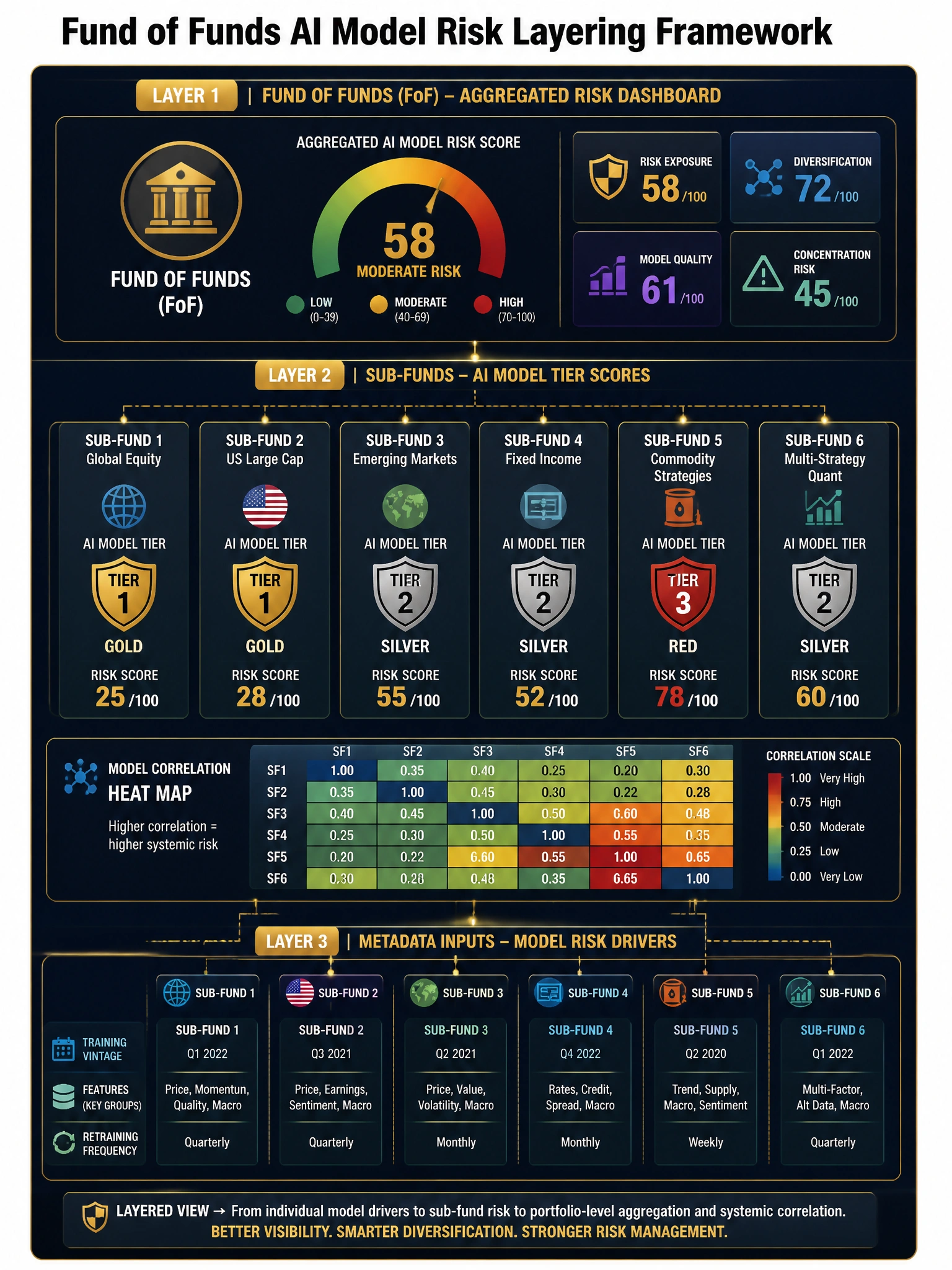
A fund of funds is like a portfolio of rivers feeding one lake — if several of those rivers share the same upstream source (similar AI models trained on the same data), a drought hits all of them at once. The layered risk framework collects standardized metadata from each sub-fund, spots hidden correlation, and lets you price model risk into capital allocation before that drought arrives. That's the answer.
Full explanation below image
Full Explanation
The fund-of-funds structure introduces a compounding AI model risk problem that does not exist in single-manager portfolios: the FoF manager typically cannot observe the internal workings of sub-fund AI models, yet bears fiduciary responsibility for the aggregate risk taken on behalf of end investors. When multiple underlying funds use AI models trained on similar market regimes, with similar feature engineering approaches (momentum, order-book depth, sentiment signals), the correlation of their failure modes can be dramatically underestimated by conventional portfolio construction tools.
Requiring source code access (option A) is impractical and legally fraught — sub-funds will refuse on trade secret grounds, and even if provided, reviewing 15 proprietary AI systems would require resources and expertise that few FoF managers possess. It also doesn't solve the aggregation problem.
A black-box risk premium (option B) is a blunt instrument that penalizes well-governed AI strategies equally with opaque ones, creating adverse selection — better-governed AI managers will find the hurdle rate unattractive and leave the platform.
Disclosure and consent waiver (option D) shifts legal liability but does nothing to identify, measure, or mitigate the underlying risk. Regulators including the SEC Division of Examinations have explicitly stated that disclosure alone is insufficient where fiduciaries have the capability to conduct due diligence.
The layered model risk framework (option C) is the correct approach because it operationalizes risk management without requiring proprietary IP disclosure. Standardized metadata — training data vintage, feature categories, retraining schedules, and degradation triggers — provides meaningful signal about model behavior without exposing trade secrets. Aggregating this data across 15 AI-managed sub-funds enables correlation analysis: if 10 sub-funds all use momentum-based AI models retrained monthly on equity data from 2015-2023, a regime shift (such as a sustained inflation spike not present in training data) may trigger simultaneous drawdowns. This framework aligns with the AIMA AI Due Diligence questionnaire standards, the ILPA AI in Private Markets guidance, and OCC Bulletin 2011-12 extended to fund-of-funds contexts.