
During the post-mortem of a flash crash event, your firm's AI-driven equity strategy lost 18% in four minutes before risk controls halted trading. The strategy had never been stress-tested against historical flash crash data. As Chief Investment Officer, which stress-testing framework best addresses AI strategy resilience in extreme liquidity events?
Select an answer to reveal the explanation.
Short Explanation and Infographic
Think of it like crash-testing a race car: you don't prove it's safe by driving laps on a dry track and multiplying the lap time by three — you put it through the exact conditions that break cars. Replaying real flash crash sequences through your live AI model is the only way to see how signal logic, order routing, and kill switches actually behave when liquidity evaporates in microseconds. That's the answer your regulators and your board want to see documented.
Full explanation below image
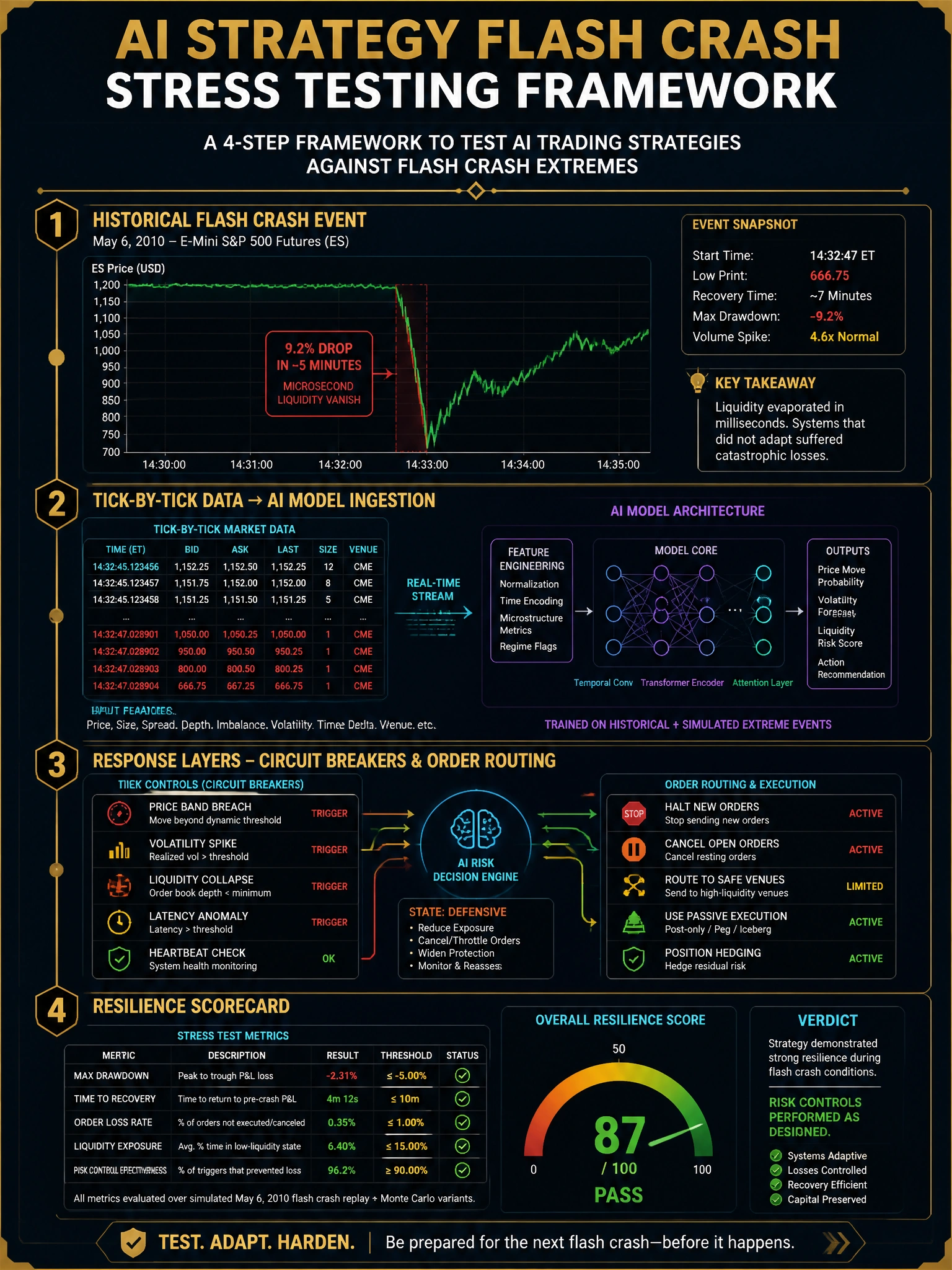
Full Explanation
Flash crashes present a category of market stress that is structurally different from conventional volatility spikes: liquidity disappears faster than most risk models can process, bid-ask spreads widen by orders of magnitude, and AI models trained on liquid-market data may generate signals that accelerate the crash rather than protect the portfolio. Standard VaR backtesting (option A) is inadequate because it assumes returns are drawn from a stationary distribution and ignores intraday microstructure breakdown — the very mechanism that makes flash crashes destructive.
The multi-regime historical replay approach (option B) is the industry-recognized best practice because it forces the AI model to process the exact tick-by-tick data from validated flash crash events, exposing how the model's signal generation, position sizing, and order-routing logic interact with real liquidity voids. This methodology aligns with the Basel Committee on Banking Supervision's guidance on stress testing for algorithmic trading, the SEC's Market Risk Management framework post-2010, and ESMA's guidelines on algorithmic trading controls under MiFID II Article 48.
Monte Carlo simulation with a fixed stress multiplier (option C) is a common shortcut that fails because it does not capture the sequential, correlated nature of liquidity withdrawal during a flash crash — a single 3x multiplier applied to a normal-regime simulation will not reproduce the feedback loops between AI-driven sellers and absent buyers that define these events.
Vendor certification (option D) represents a model governance failure: relying on a vendor's attestation rather than conducting independent, firm-specific stress testing violates SR 11-7 model risk management guidance from the Federal Reserve and OCC, which explicitly requires firms to validate models themselves rather than delegating validation to the model developer.
From a governance standpoint, the CIO should also ensure that flash-crash stress test results are documented in the model risk register, reviewed by the investment risk committee quarterly, and that circuit-breaker thresholds are calibrated against the observed AI behavior in replay scenarios before the strategy is returned to live trading.