
A research team compares two NLP pipelines for extracting sentiment from earnings calls: Pipeline A processes the official transcript text using a financial BERT model; Pipeline B processes the audio recording directly using a multimodal speech model that captures prosodic features (pitch variation, speech rate, pause duration). In which specific scenario does Pipeline B MOST likely provide incremental alpha beyond Pipeline A?
Select an answer to reveal the explanation.
Short Explanation and Infographic
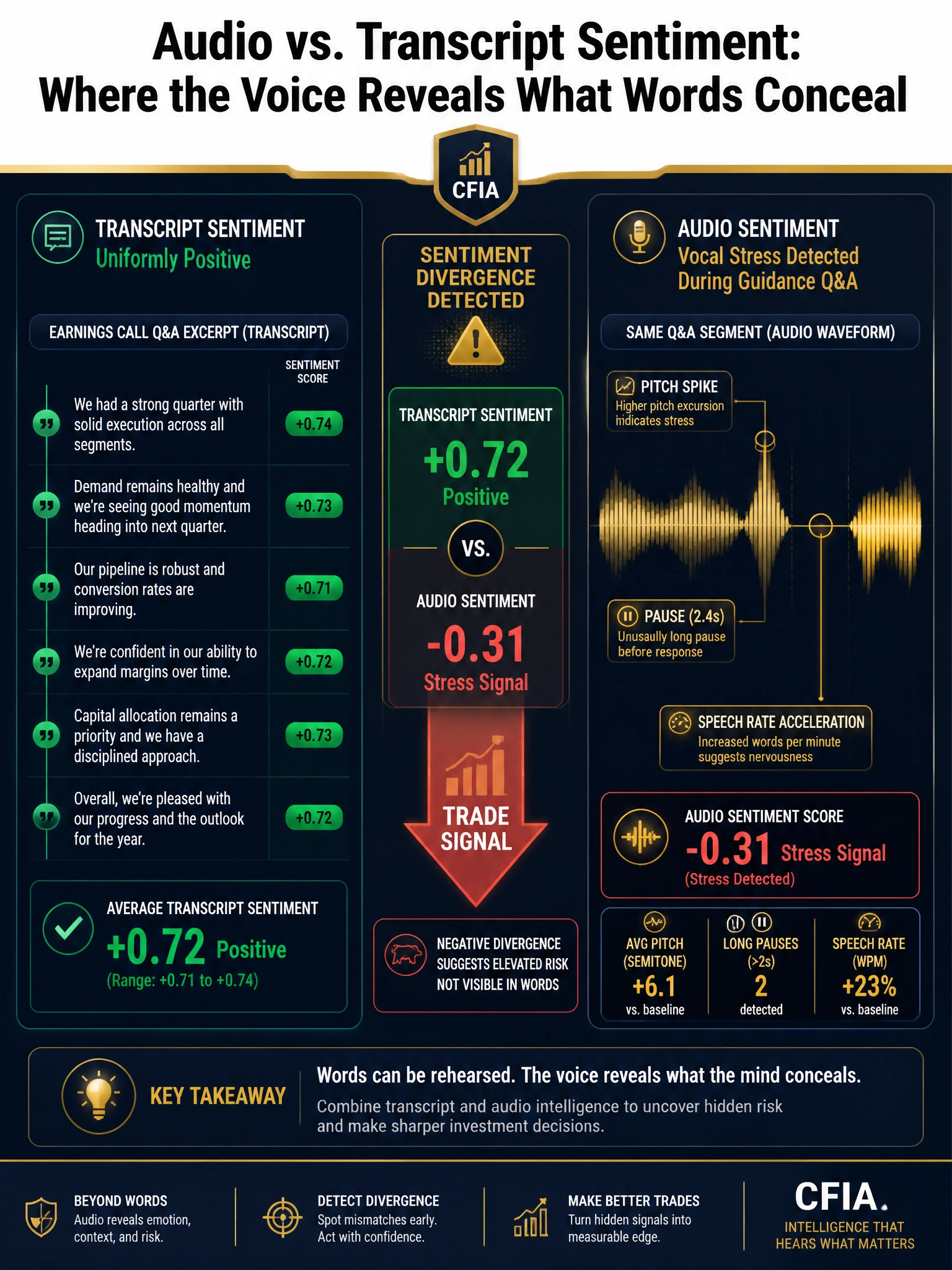
The words are what management wants you to hear — the voice tells you what they actually feel. When a CFO says 'we remain confident in our full-year guidance' but their voice tightens, their speech rate accelerates, and they pause longer before key numbers than in the previous four calls, the audio layer is catching a signal the transcript will never reveal.
Full explanation below image
Full Explanation
Option B is correct because audio-derived prosodic features capture paraverbal communication — the 'how' of speech rather than the 'what' — and this channel is much harder for management to consciously control than word choice. Research in deception detection and organizational psychology (Mayew and Venkatachalam, 2012; Hobson, Mayew, and Venkatachalam, 2012) documents that vocal cues in earnings calls carry incremental predictive content for future earnings performance beyond what text sentiment models capture. Specifically, elevated cognitive load during Q&A (where management cannot rely on scripted responses) manifests as increased fundamental frequency variance, longer response latency, and reduced speech fluency (more disfluencies, filler words).
The key scenario where audio outperforms transcript is precisely when lexical content is controlled — when management teams use investor relations coaching to maintain consistent, measured language across calls regardless of underlying business conditions. In this case, the transcript-based model sees stable positive sentiment across all quarters, while the audio model detects the divergence between practiced language and unconscious vocal stress markers during probing analyst questions.
A sophisticated pipeline fuses both signals: when transcript sentiment and audio sentiment align, the combined signal confidence increases; when they diverge (calm language, stressed voice), the divergence itself becomes the trading signal, often the more valuable one.
Option A is implausible — current speech models do not reliably distinguish authorship from prosodic features of scripted reading. Option C describes a valid edge case for multilingual calls but does not represent the primary incremental value of audio processing. Option D is a false absolute — transcripts of earnings calls are produced in near-real-time by third-party services and are not subject to systematic post-call editing by the company before public dissemination.