
A fundamental equity PM at a large-cap growth fund wants to systematically compare risk factor disclosures across 200 10-K filings within a single sector. She deploys an LLM-based pipeline to extract and normalize language around supply chain concentration, regulatory exposure, and competitive moat language. Which architectural choice BEST ensures that cross-company comparisons are semantically consistent rather than superficially lexical?
Select an answer to reveal the explanation.
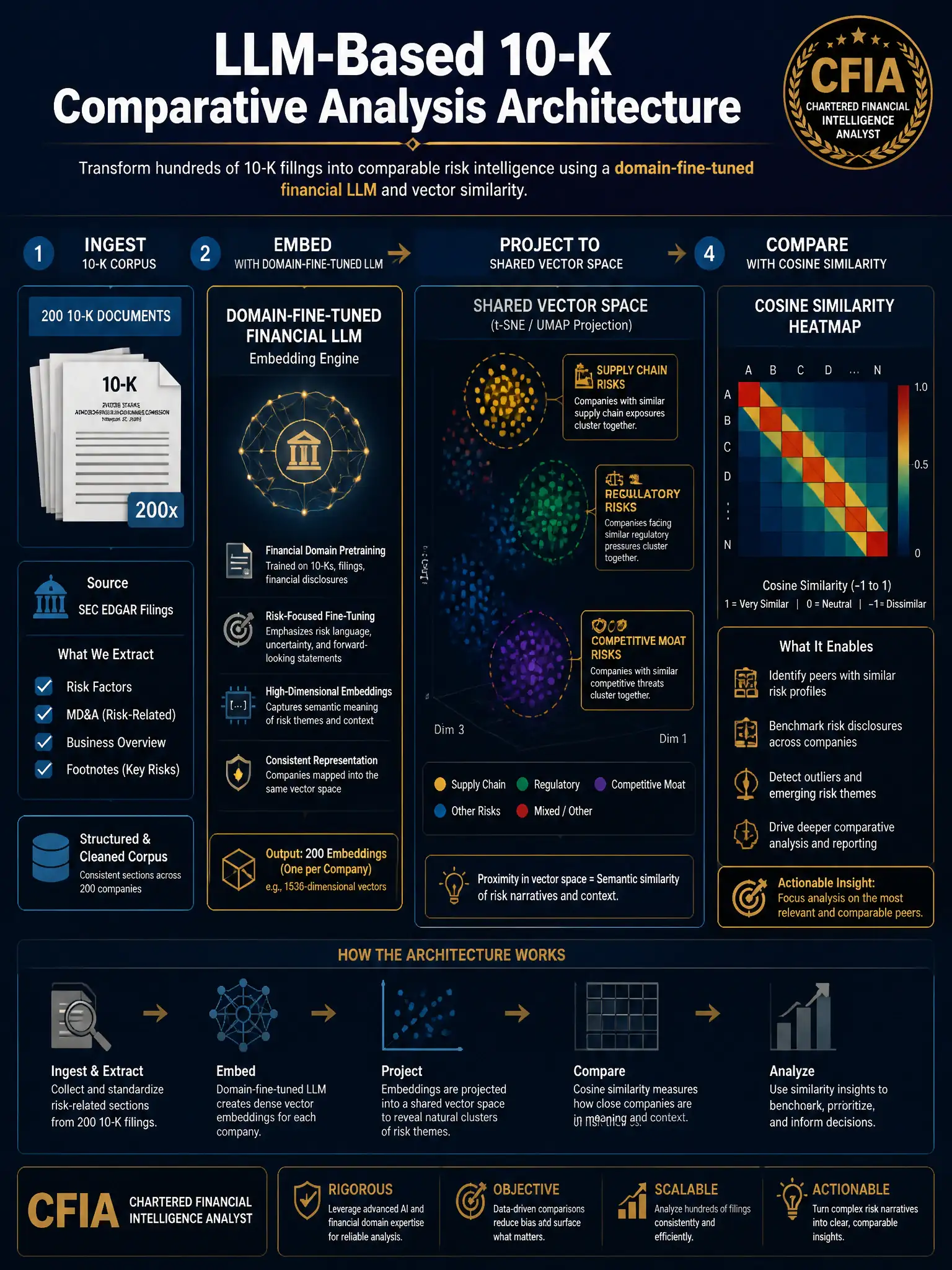
Short Explanation
You want the embedding approach because it puts every company's risk language on the same semantic coordinate grid. That way, 'concentration risk' described in five different ways by five different CFOs lands in the same neighborhood of meaning, not just matching words.
Full Explanation
The embedding approach is correct because semantic consistency in cross-company NLP analysis requires a shared representational space. A domain-fine-tuned financial language model, such as one pre-trained on SEC filings, earnings calls, or Bloomberg corpora, learns the nuanced vocabulary of capital markets, so terms like 'sole-source supplier,' 'single customer concentration,' or 'supply chain dependency' map close together even though they differ lexically. Cosine similarity in this embedding space measures conceptual proximity, not word overlap. The keyword-frequency approach is wrong because it is a bag-of-words approach that treats language as counts of tokens rather than meaning. Two companies disclosing the same risk with different vocabulary will score very differently, producing false signal. It also suffers from boilerplate inflation, because attorneys often use dense legalese that raises word counts without increasing actual risk. The movie-review sentiment approach is wrong because it is a domain mismatch error. General-purpose sentiment models are calibrated for consumer language. Financial disclosures use hedging language, passive voice, and legalistic understatement that will be misclassified at high rates. The SEC's EDGAR filings are specifically known to use tonal consistency that fools out-of-domain models. The manual-tagging-then-LLM-summary approach is wrong because it inverts the workflow. It uses expensive human labor for the classification step and the LLM only for output generation. This defeats the purpose of scalable AI-driven comparative analysis across 200 filings and introduces inter-rater variability in the manual tagging phase. Best practice follows the CFIA framework for AI alpha pipelines: embed with a financially domain-adapted model, structure output into a normalized schema such as risk theme, severity qualifier, and geographic scope, and apply clustering or retrieval-augmented comparison to surface cross-sectional patterns invisible to human analysts reviewing filings sequentially.