
A CIO at a $20B multi-strategy asset manager is preparing an AI progress report for the board of directors. The firm has deployed AI tools across research, risk, and operations over the past 18 months. Which set of KPIs most effectively communicates the business value of AI adoption to a board-level audience?
Select an answer to reveal the explanation.
Short Explanation
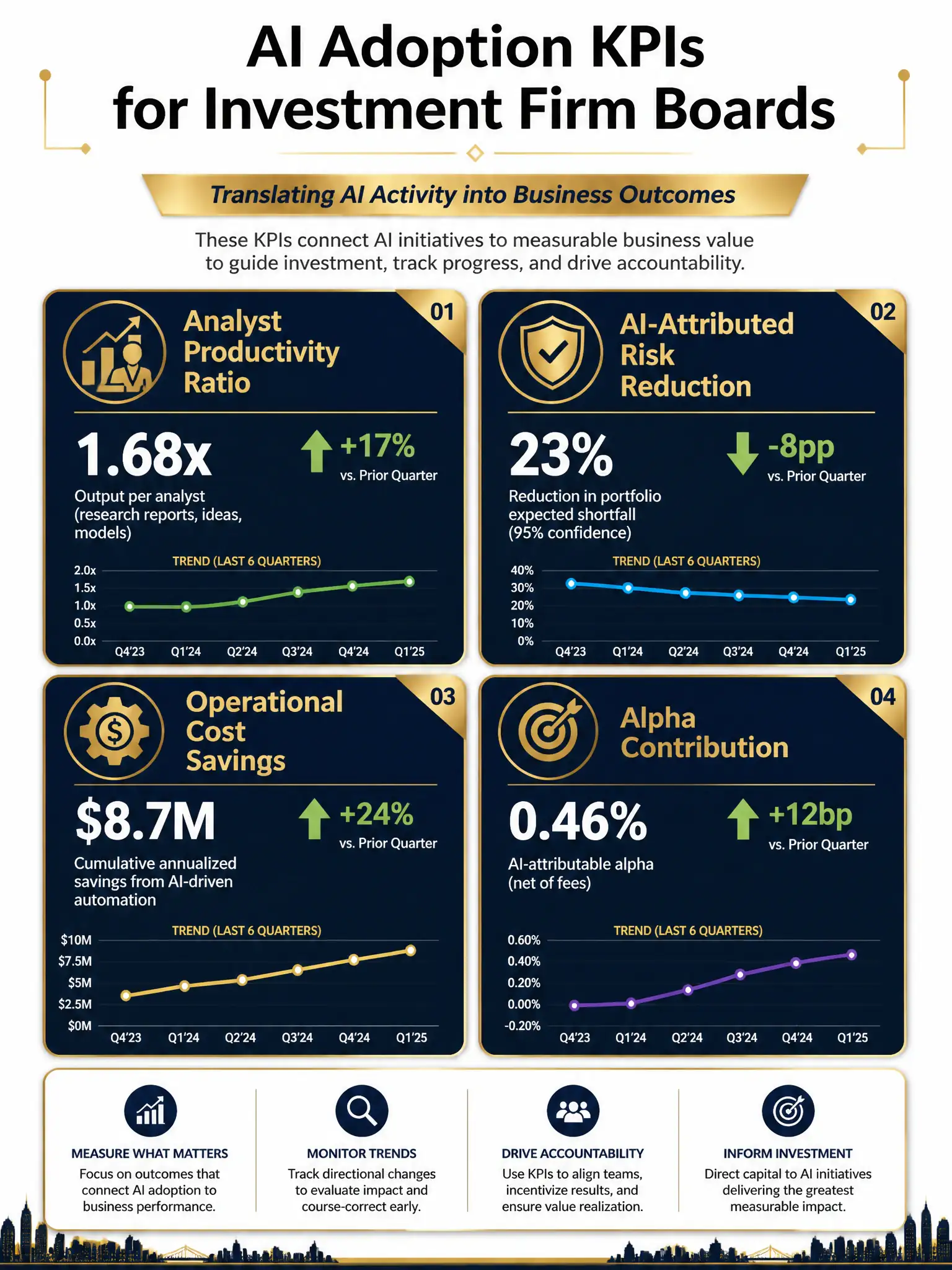
Boards speak in business outcomes, not technical specs. You need KPIs that translate AI activity into the language the board already uses: more coverage per analyst, lower risk, reduced operating costs, and identifiable alpha. Those four metrics tell a complete value story without a single mention of model accuracy.
Full Explanation
Board-level AI reporting requires translating technical progress into financial and strategic outcomes that directors can evaluate against capital allocation decisions and fiduciary obligations. Technical metrics — model accuracy, compute hours, inference latency — are operational inputs, not business outputs, and they do not help a board assess whether the firm's AI investment is generating returns commensurate with its cost and risk.
The set using analyst productivity ratio (coverage per FTE before vs. after AI), AI-attributed risk reduction in basis points, operational cost savings from AI-automated workflows, and estimated alpha contribution from AI-generated signals is the strongest board-level framing. Analyst productivity ratio (coverage per FTE) is a defensible, auditable metric that captures capacity expansion without headcount growth — a direct efficiency gain attributable to AI tool deployment. This matters to boards because it shows that AI is increasing the return on human capital. AI-attributed risk reduction in basis points quantifies the portfolio-level impact of AI-driven risk monitoring tools — model-estimated drawdown reduction, improved factor diversification, or more timely margin exposure alerts. Operational cost savings from AI-automated workflows (compliance document review, reconciliation, client reporting generation) convert to direct P&L impact and can be compared against AI infrastructure spend to calculate return on investment. Estimated alpha contribution from AI-generated signals, though methodologically complex to isolate, is the highest-order metric and requires a transparent attribution framework to be credible to a sophisticated board.
The set counting AI models deployed, total compute hours consumed, and lines of code written by the data science team measures activity, not value — lines of code and compute hours are inputs with no inherent business meaning. The set using model training accuracy on internal validation datasets, number of data science hires, and average model inference latency in milliseconds presents data science operational metrics that are meaningful to engineers but unintelligible to investment and finance directors who cannot contextualize 95% validation accuracy or 12ms latency. The set using number of AI vendor contracts signed, percentage of staff who completed AI training modules, and total spend on AI tools and infrastructure conflates spending and activity with achievement — vendor contracts and training completion are process checkboxes, not evidence of business impact. The AIMA (Alternative Investment Management Association) and ILPA guidance on GP reporting to LPs both emphasize outcome-based AI reporting frameworks consistent with the set using analyst productivity ratio, AI-attributed risk reduction, operational cost savings, and estimated alpha contribution.