
A quantitative fund is building an ML system to extract directional signals from real-time options order flow. The system must distinguish informed trading from hedging activity to generate actionable equity signals. Which feature engineering approach most effectively isolates informed options flow?
Select an answer to reveal the explanation.
Short Explanation and Infographic
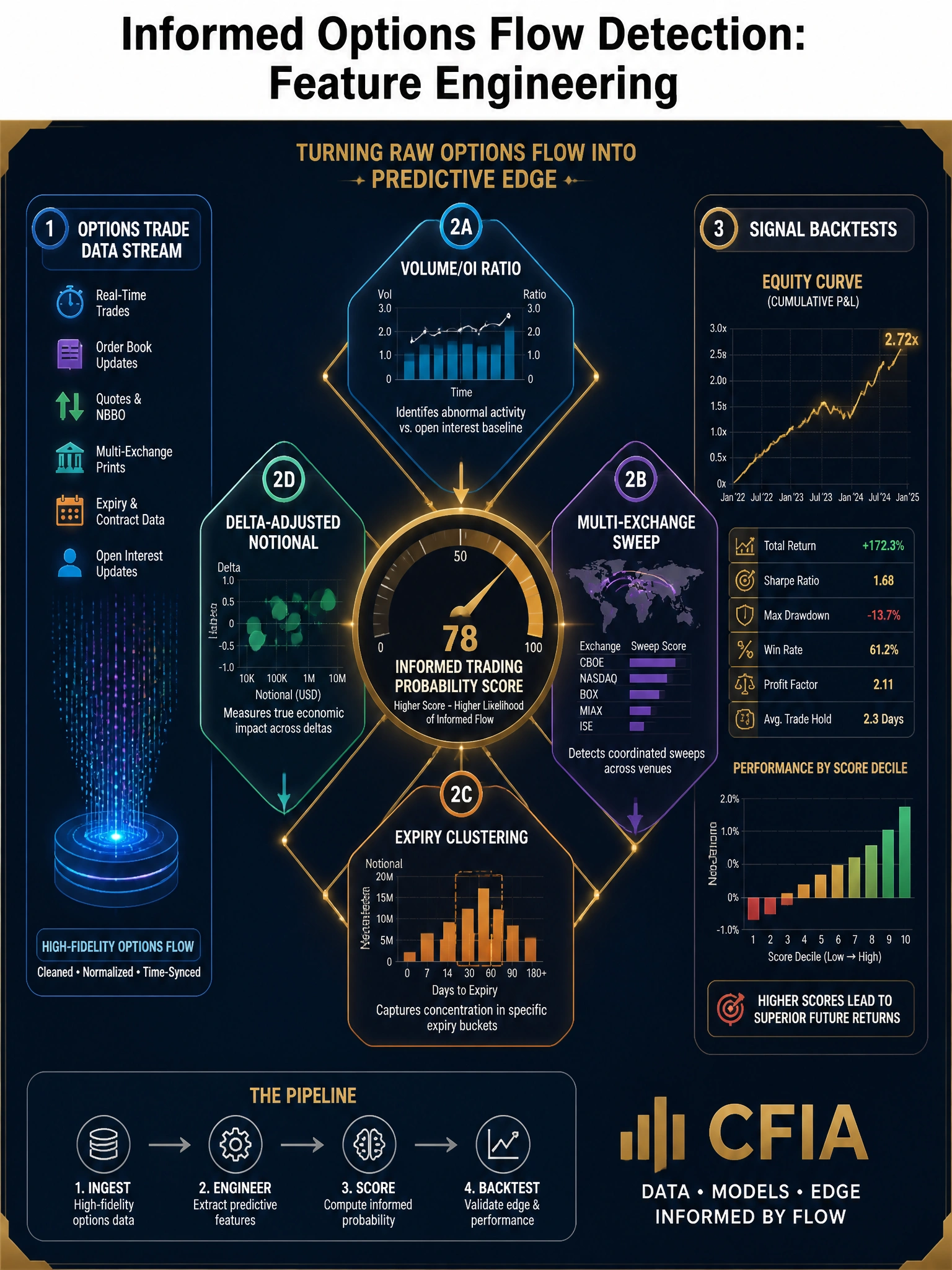
Options flow is like trying to hear a whispered conversation in a crowded room — most of the noise is hedging, market-making, and retail speculation, and the informed trader is trying hard not to be noticed. You find them by looking for the tells: sweeping multiple exchanges at once, clustering near key expiry dates, and placing bets too large to be casual. Combining those features into a single probability score is how you separate the whisper from the crowd.
Full explanation below image
Full Explanation
Options market microstructure research (Easley, O'Hara, and Srinivas; Pan and Poteshman) consistently demonstrates that informed traders prefer options over equities because options provide leverage, limited downside risk, and — critically — a degree of anonymity. Detecting informed flow is therefore a signal extraction problem: the majority of options activity reflects market-making, retail speculation, and portfolio hedging, and the fund must isolate the minority that reflects genuine directional information.
Option A's total open interest threshold is a blunt instrument that captures high-hedging periods (such as around major index rebalances or FOMC meetings) as frequently as informed positioning. Open interest accumulation and composition are not equivalent signals.
Option B's focus on deep in-the-money options is counterproductive for detecting informed traders. ITM options are typically purchased by investors seeking leveraged delta exposure with low time-premium risk — a relatively common hedging and income strategy. Informed traders more often use slightly out-of-the-money options where the cost basis is low and the asymmetric payoff is highest if their directional thesis is correct.
Option D's put/call ratio is a well-known and broadly followed sentiment indicator. As such, it is largely arbitraged by the time it reaches a threshold signal level. Academic research consistently finds that simple put/call ratio strategies have near-zero alpha net of transaction costs in modern markets.
Option C constructs the multi-factor informed trading probability score supported by academic literature and institutional practice. Volume-to-open-interest ratio identifies contracts being newly initiated (high volume on low OI) rather than liquidated. Sweep orders crossing multiple exchanges in milliseconds indicate institutional urgency. Expiry clustering near specific dates (earnings, FDA decisions, known catalysts) links the position to a specific informational event. Delta-adjusted notional size filters out small retail trades. ML models trained on these features — particularly gradient boosting architectures given the tabular data structure — have demonstrated statistically significant Sharpe ratios in out-of-sample testing at institutions including Citadel and Jane Street.