
An investment research team is building an alternative data pipeline that uses corporate job postings to generate economic and company-specific signals. Which methodology most accurately extracts forward-looking intelligence from this dataset?
Select an answer to reveal the explanation.
Short Explanation
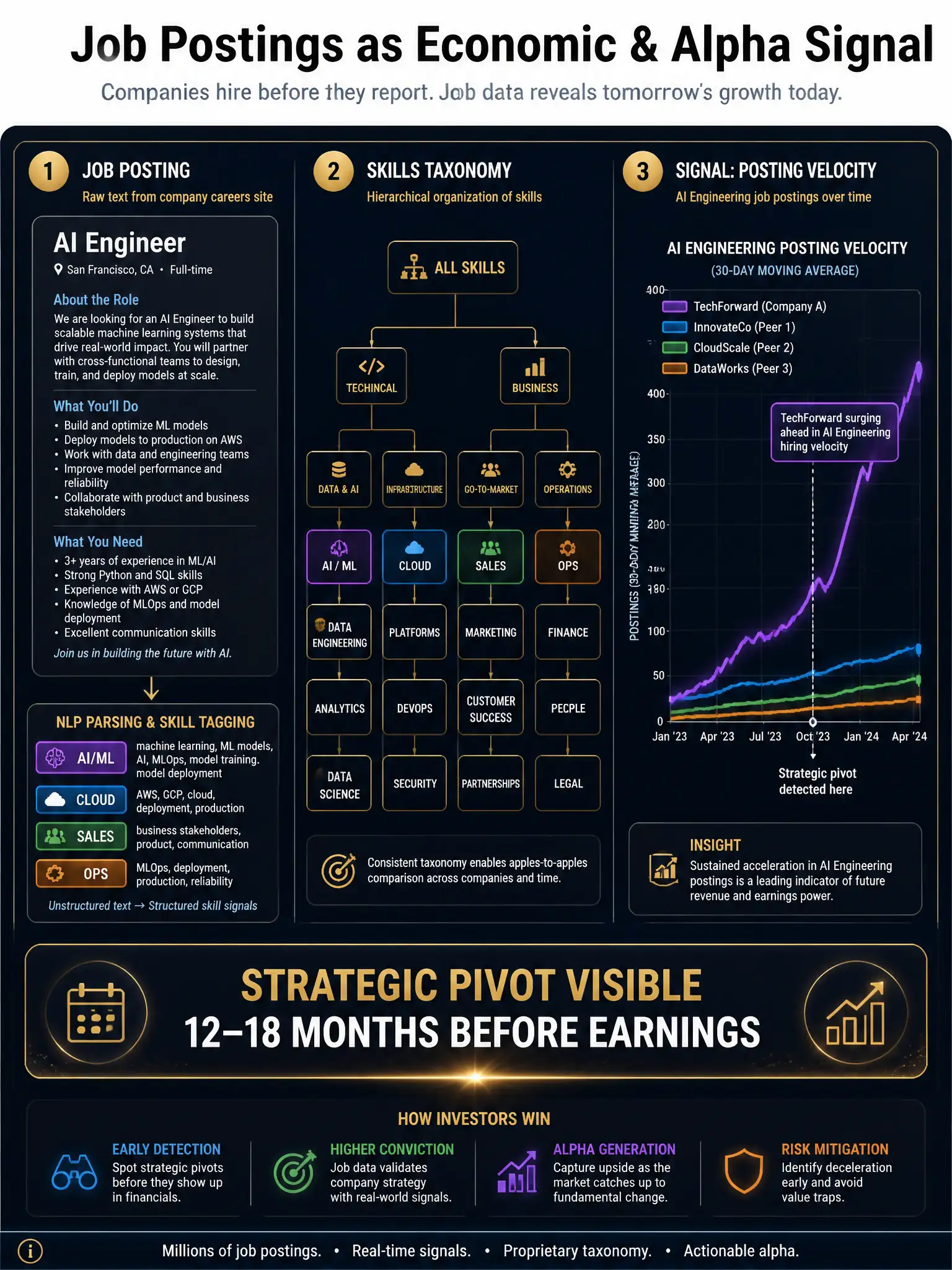
Job postings are a company's roadmap written in plain English. You get the real signal by classifying roles by skills, function, and seniority, then watching how AI, engineering, and sales hiring velocity shifts versus peers. That tells you where they're investing before the earnings call.
Full Explanation
Job posting data, sourced from platforms like Revelio Labs, Thinknum, or direct scrapes of LinkedIn and Indeed, has emerged as one of the highest-value alternative datasets in fundamental investment research because hiring decisions are forward-looking capital commitments. When a company posts 200 machine learning engineer roles in a quarter, it is signaling a strategic investment in AI capabilities that will take 12 to 18 months to manifest in products and revenue, a lead time no earnings release provides.
The simple total-openings growth-rate approach ignores composition entirely. A company may be hiring aggressively in low-margin call-center roles while cutting R&D headcount, producing a positive total growth rate that masks deteriorating future competitiveness. Composition matters as much as count.
The C-suite and VP-only approach creates a noisy, low-volume signal. Executive searches happen for many reasons including normal attrition, and the posting-to-fill timeline for senior roles is too long and irregular to generate reliable quarterly signals.
The national-aggregate GDP/JOLTS approach is a category error. National aggregate job postings are coincident, or coincident-to-lagging, indicators of GDP and essentially replicate what BLS JOLTS already measures. The alpha in job posting data comes from company-specific and sector-specific decomposition, not macro replication.
The skills-taxonomy NLP approach implements classification of each posting into a standardized ontology, such as O*NET or proprietary taxonomies from vendors like Burning Glass/Lightcast, allowing apple-to-apple comparison across companies and time. By classifying postings by function and seniority as well as skills, and tracking velocity shifts, the rate of change in postings for specific skill clusters like generative AI engineering, supply chain technology, or enterprise sales, against sector peers, it reveals strategic pivots and headcount investment priorities that management teams are not yet discussing publicly. This approach is used by leading quant funds including Two Sigma and Point72's data science teams as an input to their fundamental factor models.