
A large-cap equity fund is deploying an LLM-based pipeline to automate fundamental research. The model ingests earnings transcripts, 10-K filings, and industry reports to generate initial investment memos. Which architectural approach best preserves analytical rigor while scaling research throughput?
Select an answer to reveal the explanation.
Short Explanation
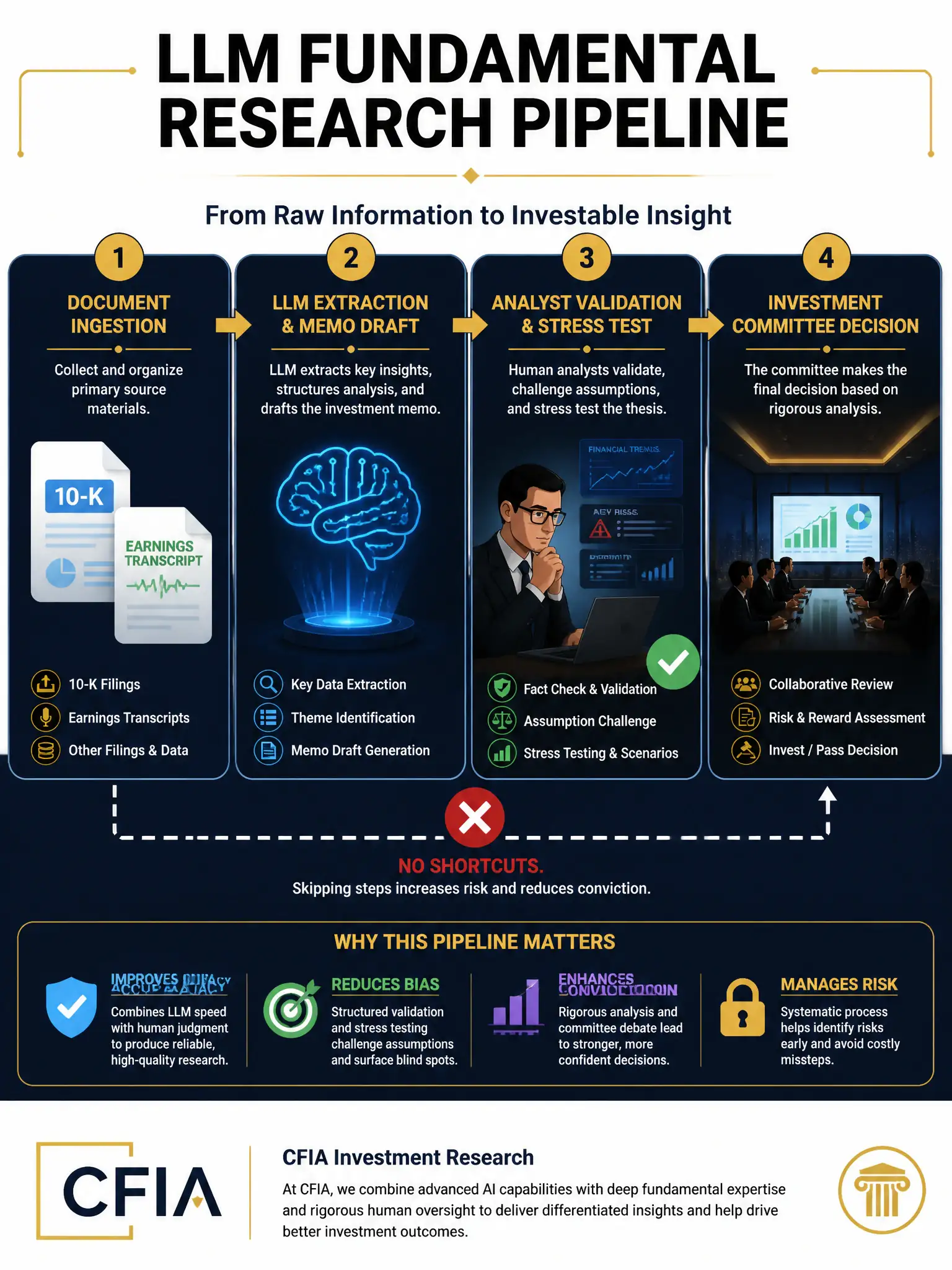
Think of it like a well-run kitchen: the LLM is the prep cook who chops, measures, and assembles, but the head chef still tastes before the dish goes out. You use a multi-stage pipeline so the model does rapid structured extraction and draft memos, while analysts validate, stress-test, and own the capital decision. That catches hallucinations, preserves fiduciary rigor, and scales throughput without unsupervised recommendations.
Full Explanation
Fundamental research automation with LLMs offers enormous scalability benefits — an LLM can read and synthesize hundreds of pages of filings in seconds — but raw model output carries well-documented risks: hallucination, date confusion, and over-reliance on statistically common phrasing rather than genuine analytical insight. The best approach implements a multi-stage pipeline where the LLM performs structured extraction and drafts hypothesis memos, followed by analyst validation and model-agnostic stress-testing before any capital deployment decision. This separates the tasks where LLMs excel — structured extraction, pattern matching, and first-draft synthesis — from the tasks where human judgment remains essential: hypothesis validation, qualitative assessment of management credibility, and capital allocation decisions.
The single general-purpose LLM approach that produces final investment recommendations directly from raw filings and bypasses human analyst review fails on fiduciary grounds. Bypassing analyst review violates both GIPS standards and prudent investor norms; regulators including the SEC have signaled that AI-generated recommendations require human oversight before acting on them in client accounts. The fine-tuning-only-on-historical-winning-trades approach introduces severe look-ahead bias and overfitting — training only on past winners ignores market regime changes and creates a model that cannot generalize beyond historical patterns, especially without additional oversight. The verbatim-only retrieval-augmented generation approach is an overcorrection. Returning only verbatim passages eliminates the synthesis capability that makes LLMs valuable in the first place; analysts still face the same reading burden and gain no throughput benefit.
The multi-stage design aligns with frameworks like the CFA Institute's AI Principles for Investment Management, which emphasize explainability, auditability, and the clear delineation of human versus model responsibility at each decision node. Best practice also includes prompt versioning, output logging for compliance audit trails, and periodic blind backtests where LLM memos are compared against subsequent price action to quantify the model's informational value-add. This ensures the pipeline continuously earns its place in the research workflow rather than becoming an unexamined black box.