
A quantitative research team discovers that their backtesting results have been consistently inflated by look-ahead bias. Investigation reveals that their data warehouse stores only the most current version of fundamental data — when companies restate earnings, the restated figures overwrite the original reported values, making historical data appear as though the restated figures were known at the time of the original announcement. Which database design pattern specifically and completely solves this problem?
Select an answer to reveal the explanation.
Short Explanation and Infographic
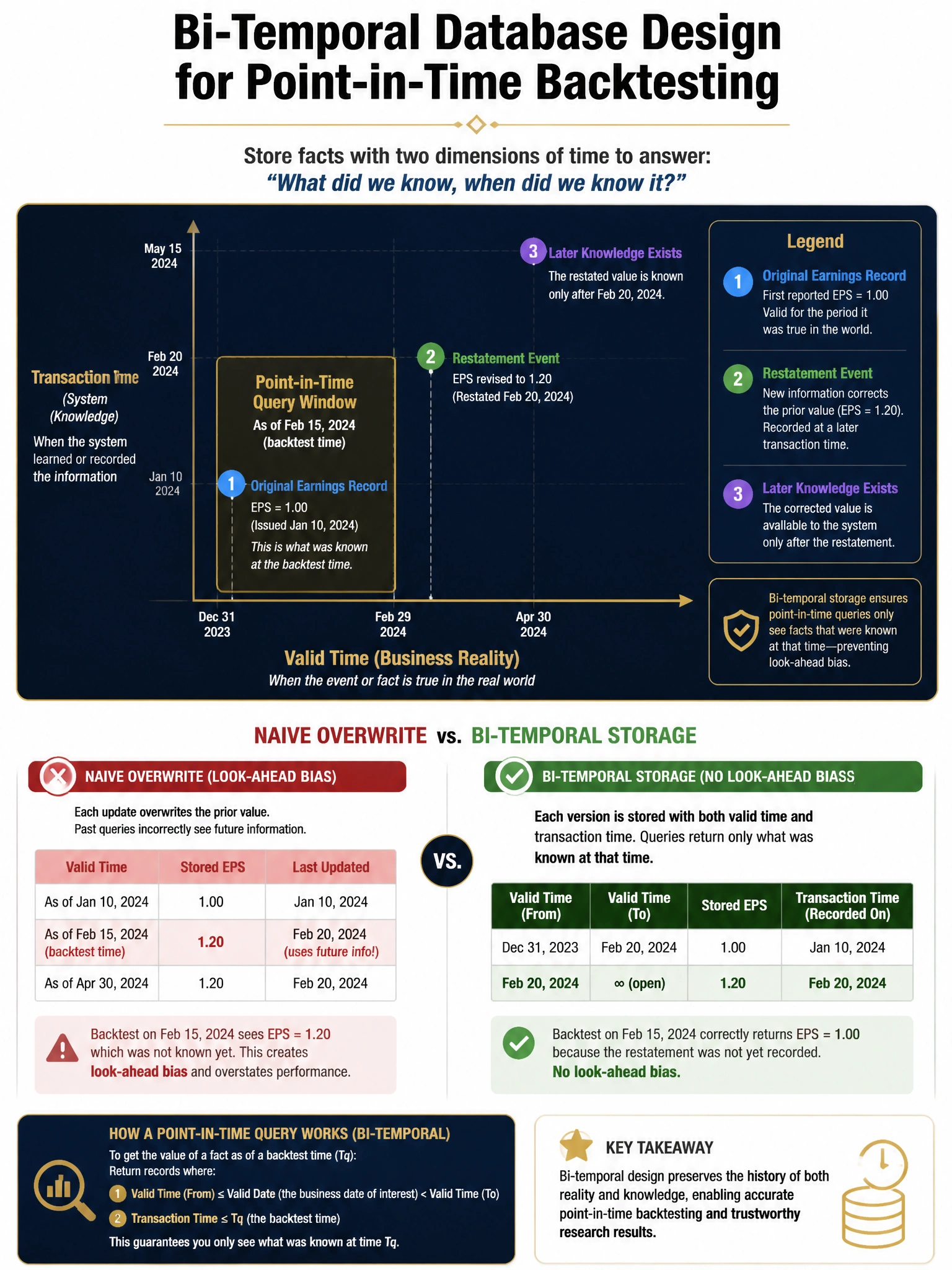
Imagine you kept a diary but also stamped each entry with both when the event happened and when you actually wrote it down. If you later crossed something out and rewrote it, you would still have the original entry with both timestamps intact. That is bi-temporal design. Option B is correct because it is the only pattern that maintains both the historical truth and the historical knowledge state simultaneously — which is the exact requirement for look-ahead-bias-free backtesting.
Full explanation below image
Full Explanation
Look-ahead bias is one of the most insidious sources of alpha inflation in quantitative research. When a company restates Q2 earnings in November, a naive database overwrites the original Q2 figure with the restated one. A backtest run against this data in January 'knows' the restated figure when constructing signals for Q2 — information that was impossible to have at that time. The result is a strategy that looks profitable in backtesting but fails in live trading.
Bi-temporal modeling, formalized in SQL:2011 through the PERIOD syntax, solves this by maintaining two independent time dimensions for every row. The valid time axis captures the business reality: Q2 earnings of $1.23/share were reported on August 15. The transaction time axis captures the system reality: this value was recorded in our database on August 15, then superseded by a restated value of $1.31/share recorded on November 3. A point-in-time query asking 'what did our database know about Q2 earnings as of September 1?' returns the original $1.23/share — because the restatement had not yet been recorded in the system at that date.
Industry implementations include CRSP (Center for Research in Security Prices) and Compustat, which are the gold-standard academic and institutional data sources precisely because they maintain point-in-time histories. kdb+/q, the time-series database widely used in high-frequency trading, supports temporal queries natively. Snowflake's Time Travel feature and PostgreSQL's temporal table extensions provide accessible implementations for firms building proprietary data infrastructure.
Option A's read replica approach only separates query loads — it does not prevent overwrite of historical values and provides no point-in-time capability. Option C's daily snapshots approximate bi-temporality but are storage-inefficient (full database copies daily) and provide only day-level granularity, missing intraday corrections. Option D's hash versioning has no standardized query interface for point-in-time retrieval and requires custom application logic that replicates what bi-temporal design provides natively. Bi-temporal design is the only pattern that solves both the valid-time and transaction-time dimensions of the problem simultaneously.