
A multi-asset investment firm receives daily data feeds from 12 different vendors covering equities, fixed income, and derivatives pricing. The Chief Data Officer wants to implement a formal data quality scoring framework to prioritize remediation efforts, drive vendor SLA negotiations, and demonstrate data governance maturity to regulators. Which foundational standard provides the most comprehensive and widely recognized framework for this purpose?
Select an answer to reveal the explanation.
Short Explanation and Infographic
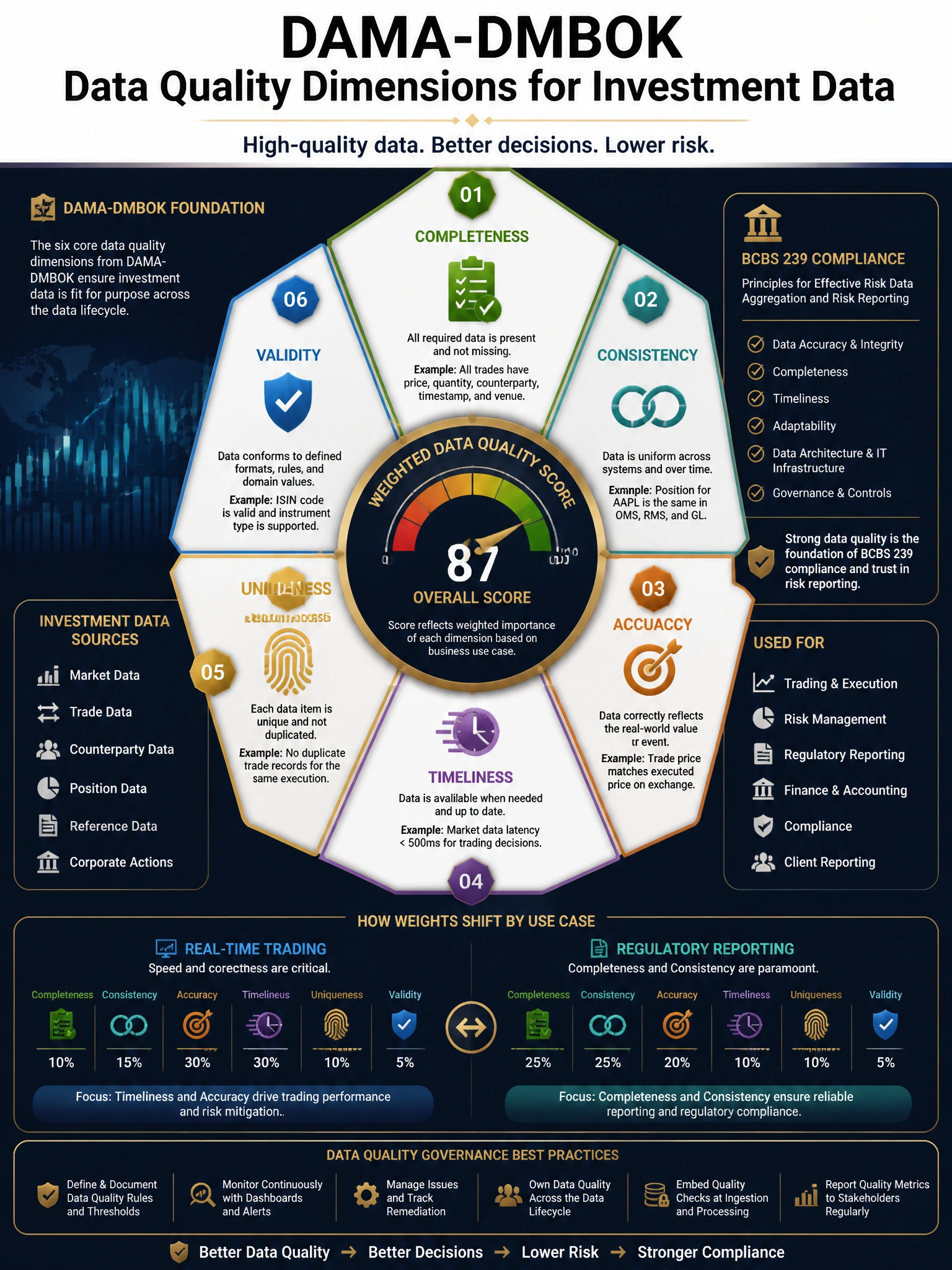
Think of data quality scoring like a restaurant health inspection — you do not grade a kitchen solely on whether the food is cold. An inspector checks temperature control, cleanliness, food storage, pest evidence, and staff hygiene simultaneously, because any one failure can cause harm. Option B is correct because the DAMA-DMBOK six-dimension framework provides the same multi-criteria rigor, ensuring no critical quality failure hides behind a passing score on a single metric.
Full explanation below image
Full Explanation
The DAMA-DMBOK (Data Management Body of Knowledge) framework defines six core data quality dimensions that have become the de facto standard across financial services data governance programs, regulatory frameworks including BCBS 239, and enterprise data management certifications. Each dimension captures a distinct failure mode that a single-metric approach would miss.
Completeness measures whether all required data fields are populated. Consistency checks whether the same entity (e.g., a security identifier) is represented uniformly across systems. Accuracy validates that values reflect the true real-world state — a security's closing price should match the exchange record. Timeliness confirms data arrives within acceptable latency windows for its use case; a derivatives pricing feed that is 90 seconds late during market open fails timeliness regardless of its accuracy. Uniqueness detects duplicate records that can double-count positions or distort risk calculations. Validity ensures values conform to defined domains and formats — a price cannot be negative for most asset classes.
Weighted scoring by asset class criticality is essential because not all dimensions matter equally in every context. For real-time derivatives pricing, Timeliness and Accuracy are critical; for end-of-month regulatory reporting, Completeness and Consistency carry higher weight. A well-designed framework maps dimension weights to business use cases and regulatory obligations like BCBS 239 (data aggregation for systemic risk) or SEC Rule 17a-4 (record accuracy).
Option A's null-rate-only approach is dangerously narrow — a dataset can have zero null values but contain stale prices, duplicate records, and cross-system inconsistencies. Option C's reliance on vendor self-reporting creates a conflict of interest; vendors optimize for their own SLA metrics, not the firm's actual quality needs. Option D is factually incorrect — Timeliness, Uniqueness, and Consistency are all operationally measurable with standard data pipeline tooling (Great Expectations, dbt tests, Monte Carlo). The DAMA-DMBOK framework provides a principled, measurable, and defensible foundation that regulators and auditors recognize.