
An equity research team is integrating an AI system that generates earnings estimate revisions, sentiment summaries, and sector rotation signals into their workflow. After six months, the CIO notices analysts are either over-relying on AI outputs without critical evaluation or dismissing them entirely. Which human-AI collaboration design principle best addresses this bifurcated adoption failure?
Select an answer to reveal the explanation.
Short Explanation
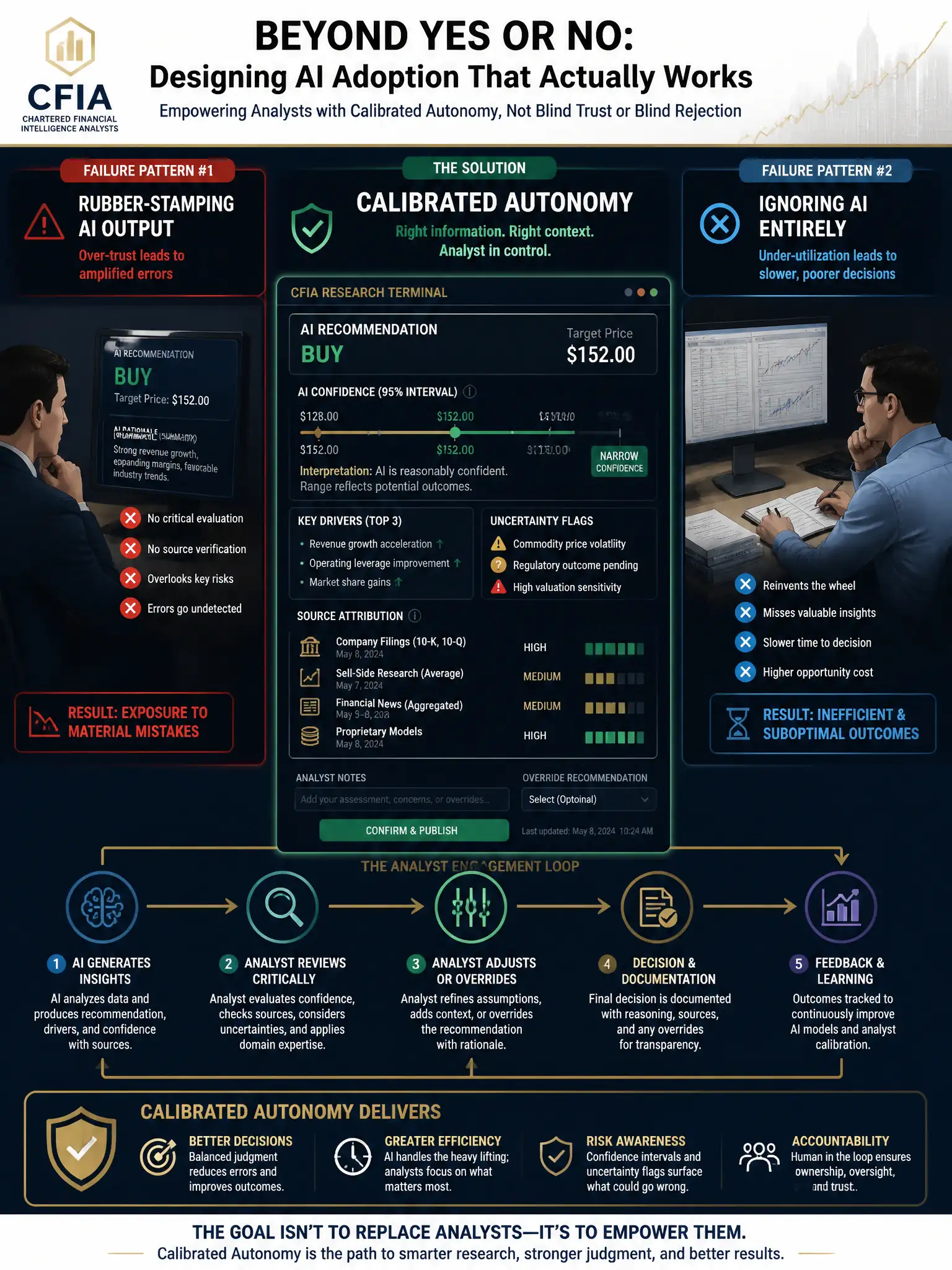
When your analysts either blindly trust or completely ignore AI, you've got automation bias and automation aversion. Calibrated Autonomy fixes this by making AI outputs earn their place in the analyst's reasoning process: confidence levels, evidence trails, and uncertainty flags force them to actually think about what the AI is saying rather than accept or reject it wholesale.
Full Explanation
The bifurcated adoption pattern described — over-reliance versus dismissal — is well-documented in human-automation interaction research and financial AI deployment. It reflects a design failure, not a talent or culture problem. When AI systems present outputs as finished conclusions without transparency into their derivation, they force binary responses: either the analyst trusts the black box or they don't.
The principle that best addresses this is Calibrated Autonomy, derived from human factors research and adapted to investment management contexts by MIT Sloan and industry practitioners. It restructures AI outputs to be decision-support artifacts rather than recommendations. Key design elements include probability distributions rather than point estimates, such as showing the 25th/75th percentile range on EPS estimates; source attribution showing which data inputs drove each conclusion; explicit low-confidence flags when input data quality is poor or market regime is atypical; and interactive drill-down allowing analysts to interrogate the reasoning chain.
This design forces productive cognitive engagement: analysts must evaluate the AI's evidence to incorporate it into their thesis, which prevents automation bias. Simultaneously, the structured uncertainty information gives AI-skeptical analysts a principled basis for evaluating specific outputs rather than rejecting the system wholesale.
Mandatory AI usage quotas requiring each analyst to incorporate a minimum number of AI-generated insights into each research report are the wrong lever because they enforce behavioral compliance without changing the cognitive engagement problem, and they create resentment that typically accelerates analyst departure.
Removing AI-generated signals from analyst screens and routing all AI outputs exclusively to the portfolio manager level to reduce analyst cognitive burden eliminates the research process integration where AI signal is most valuable and most needs human domain knowledge to interpret correctly.
Conducting a firm-wide survey to identify high versus low AI adopters and assigning AI-generated work exclusively to high adopters also misses the design problem. It entrenches the bifurcation by letting low adopters stay disengaged while giving high adopters more exposure without the confidence, attribution, and uncertainty cues needed to prevent over-reliance.
Exam caveat: For CFIA candidates, human-AI collaboration design is increasingly a regulatory consideration. The EU AI Act and SEC guidance on algorithmic decision-making both emphasize human oversight mechanisms — Calibrated Autonomy operationalizes this requirement while preserving analytical efficiency.