
A $200B multi-asset buy-side firm is redesigning its AI operating model after two high-profile model failures — one generating erroneous trade signals and another producing non-compliant client communications. Which operating model component most directly addresses the root cause of systematic model failures in production buy-side AI systems?
Select an answer to reveal the explanation.
Short Explanation
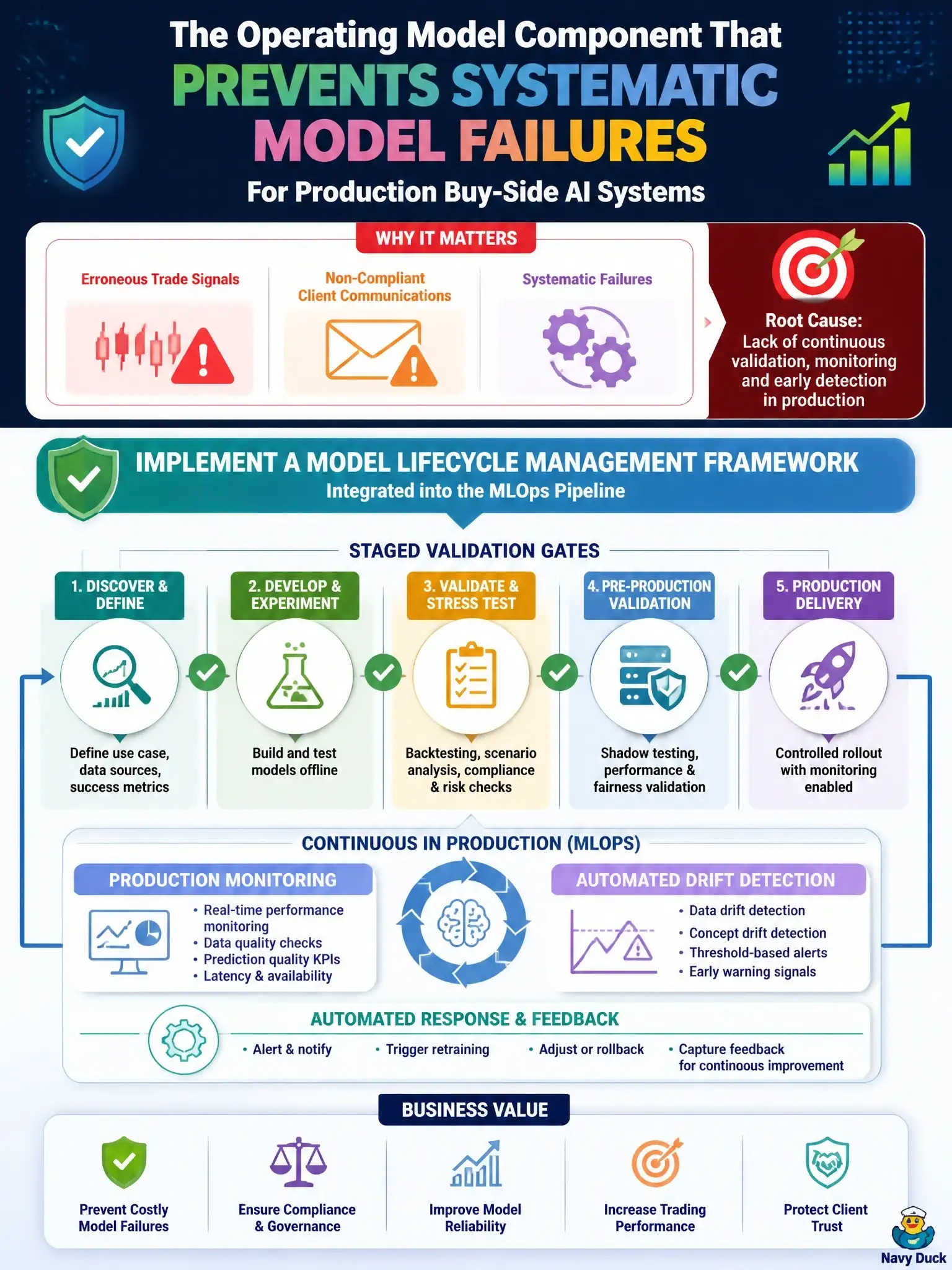
Model failures in production usually come from drift and missing governance after launch, not just the first build. You need a Model Lifecycle Management framework with staged validation gates, production monitoring, and automated drift detection in the MLOps pipeline. It’s the continuous airworthiness check for your AI systems.
Full Explanation
Systematic AI model failures in buy-side environments almost universally trace to lifecycle management gaps rather than initial model quality. SR 26-2 (which superseded SR 11-7 in April 2026), the Federal Reserve, OCC and FDIC model risk guidance, treats outcomes analysis and ongoing monitoring as core validation components because a model that performed well at approval can deteriorate as products, data or market conditions change. SR 26-2 excludes generative AI, so a tool drafting client communications falls under the firm's broader AI governance, but the same lifecycle discipline applies. Both failure modes described — erroneous trade signals and non-compliant communications — are classic production drift scenarios.
The correct operating model component is a Model Lifecycle Management framework with staged validation gates, production monitoring, and automated drift detection integrated into the MLOps pipeline. Such frameworks address this through four integrated components: (1) development-stage validation with out-of-sample testing, stress scenarios, and adversarial inputs; (2) staged deployment gates requiring sign-off from model risk, compliance, and the business owner before production; (3) real-time monitoring dashboards tracking prediction drift, data quality degradation, and business KPI deviation; and (4) automated retraining triggers and rollback procedures when drift thresholds are breached.
Increasing the AI talent budget to hire more senior data scientists who can build more accurate models from the start addresses talent supply but not process; a larger team building models without lifecycle governance simply creates more unmonitored failure points at greater scale. Migrating all AI workloads to a single cloud provider to eliminate infrastructure heterogeneity as a source of model failures reduces infrastructure complexity but doesn't address the fundamental governance gap; models fail due to distributional shift, not cloud heterogeneity. Requiring all AI outputs to receive manual analyst review before any downstream use, creating a human checkpoint at every decision point, is operationally unscalable and defeats the efficiency rationale for AI deployment; it also introduces inconsistent human judgment as a new failure mode. Regulators expect automated controls proportionate to model criticality, not blanket human override.
For CFIA candidates: the operating model must encode MLM as a continuous function, not a one-time deployment event. The investment in monitoring infrastructure typically prevents losses 10-100x the cost of implementation through avoided model-driven trading errors and regulatory penalties.