
A hedge fund's AI team wants to incorporate a new alternative data source: a dataset compiled by a third-party vendor from publicly scraped social media posts, including geotagged location data from users who visited retail locations. The vendor claims the data is anonymized and legally obtained. The fund's CFIA-credentialed Chief Data Officer is asked to approve the data source for use in consumer sentiment models. What is the MOST appropriate ethical and compliance review process before approving this alternative data source?
Select an answer to reveal the explanation.
Short Explanation and Infographic
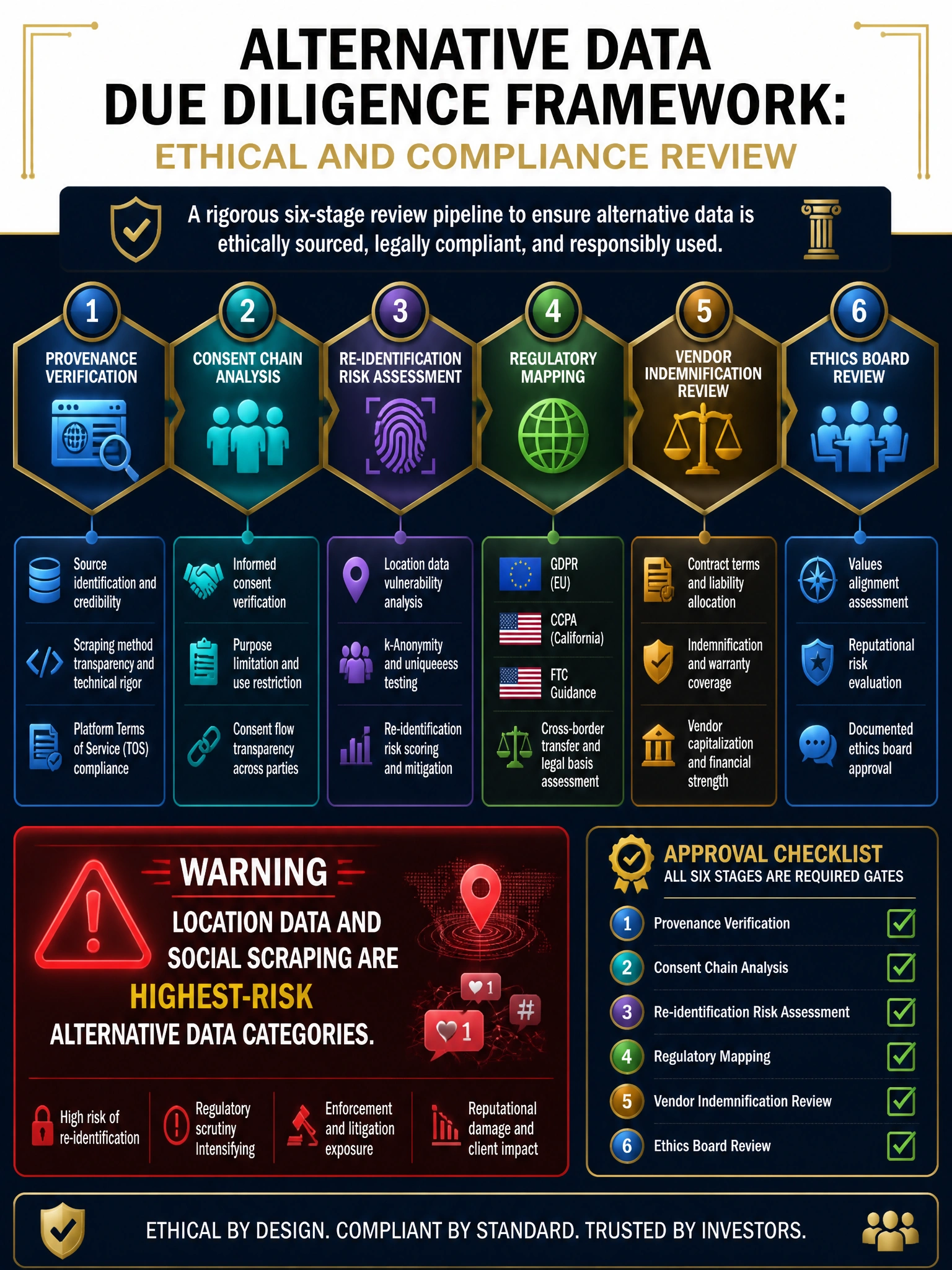
Vendor claims of 'legal and anonymized' carry about as much weight as a 'trust me' in due diligence — they're a starting point, not a conclusion. Option C is correct because the ethical and regulatory risk in alternative data is layered: you need to verify how data was collected, whether people meaningfully consented, whether 'anonymized' actually is, what your own liability exposure is, and whether your ethics framework endorses the use. Every layer matters.
Full explanation below image
Full Explanation
Alternative data is one of the highest-risk areas in AI-powered investment management from an ethical and regulatory compliance perspective. The investment management industry's use of alternative data has attracted increasing regulatory scrutiny from the SEC, FTC, and data protection authorities globally. A vendor's claim of legal compliance and anonymization is necessary but nowhere near sufficient for a fiduciary institution to rely upon.
Provenance verification means understanding exactly how the data was collected: which platforms were scraped, under what terms of service, and whether those terms of service permit commercial data resale. Many social media platform TOS explicitly prohibit data scraping for commercial purposes; a vendor that has built a business on such scraping carries legal risk that can transfer to the fund through use.
Consent chain analysis examines whether the individuals whose data appears in the dataset meaningfully consented to its commercial use for investment signal generation. GDPR's concept of 'purpose limitation' and CCPA's 'sale of personal information' provisions create specific obligations — users who geotagged a retail location visit may have consented to sharing that data with the platform for ad targeting, but almost certainly did not consent to having it resold as a financial signal to a hedge fund.
Re-identification risk assessment is critical for location data in particular. Geotagged location histories are among the most re-identifiable data types — academic research has demonstrated that as few as four spatiotemporal points uniquely identify 95% of individuals. A dataset described as 'anonymized' may fail basic re-identification resistance tests.
Regulatory mapping must trace the data's exposure under GDPR (if any EU residents' data is included), CCPA (California residents), and FTC Act Section 5 (unfair or deceptive practices). The fund should assess whether using this data could be characterized as benefiting from unfair data practices.
Vendor contractual indemnification must be reviewed by legal counsel — does the vendor indemnify the fund against legal claims arising from data collection practices? Is the indemnification adequately capitalized?
Finally, internal ethics board review (or equivalent governance body) should evaluate whether the use is consistent with the firm's stated AI ethics principles and client commitments — even if technically legal, a use case that surveillance-tracks retail consumers to profit from their behavior patterns may conflict with the firm's stated values and create reputational risk.