
A CFIA-credentialed Chief AI Officer at a $50B AUM asset manager is preparing to present a $4M AI transformation business case to the investment committee. The committee includes the CIO, General Counsel, CFO, and three senior portfolio managers — none of whom have a technical AI background. Early internal feedback suggests the committee is skeptical of AI hype and concerned about regulatory and fiduciary risk. Which approach BEST positions the business case for investment committee approval?
Select an answer to reveal the explanation.
Short Explanation
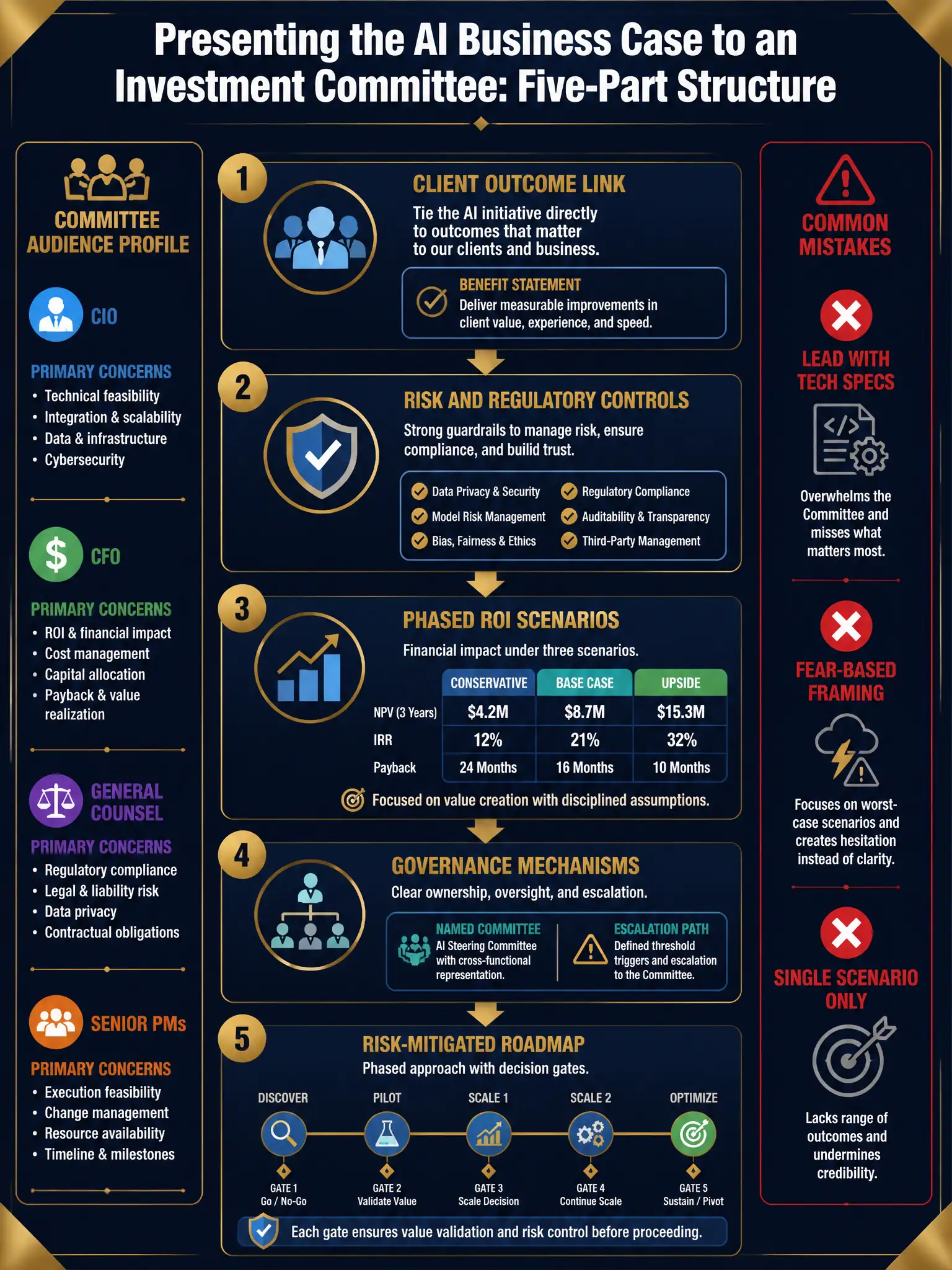
You're not pitching a tech project — you're making a fiduciary case to people responsible for client money. The approach that structures the presentation around fiduciary benefit and risk-managed deployment works because investment committees respond to the language of their mandate: client outcomes, risk controls, and governance. Lead with how the investment benefits clients and how risks are managed, then the financial case follows.
Full Explanation
Presenting an AI business case to an investment committee in asset management requires translating technology value into the language the committee uses to govern the firm: fiduciary duty, client outcomes, regulatory compliance, risk-adjusted returns, and governance accountability. Presenting technical architecture or model benchmarks signals a mismatch between the presenter's frame and the committee's frame — and skeptical committees will disengage quickly. The most effective structure for this audience follows this logic: (1) Client Outcome Link — open by connecting the AI investment directly to quantified improved client outcomes (for example, faster, more accurate portfolio reporting; better risk signal detection that has historically correlated with alpha). This anchors the investment in the firm's primary obligation. (2) Risk, Regulatory, and Operational Controls First — given the committee's stated concern about fiduciary and regulatory risk, address these before the financial case. Show the governance framework: data governance policies, model validation process, human oversight requirements, compliance review completed, legal sign-off on use cases. Skeptics need to see the guardrails before they'll engage with the upside. (3) Phased ROI with Multiple Scenarios — present conservative, base, and upside financial projections with explicit assumptions. Investment committees are trained to stress-test projections; single-scenario cases are automatically discounted. Phased implementation plans (for example, pilot in one asset class first, expand on demonstrated results) signal operational discipline. (4) Governance Mechanisms Named — include named AI governance committee, defined escalation process when the AI produces unexpected outputs, and review cadence tied to existing investment committee meeting rhythms. (5) Risk-Mitigated Roadmap — close with timeline that explicitly shows decision gates, pilot evaluation criteria, and the conditions under which the committee would expand or halt the program. The approach built around fiduciary benefit and risk-managed deployment is correct because it matches that logic. The approach that leads with technical architecture diagrams and model performance benchmarks to establish credibility before presenting financial projections fails because technical details are not the committee's evaluation frame. The approach that frames the investment as a competitive necessity, emphasizing that peer firms have already deployed AI and falling behind creates existential risk, fails because it creates urgency through fear (FOMO), which often backfires with experienced fiduciaries who are trained to resist pressure-based decision-making. The approach that presents only the cost savings case fails because it undersells the investment by ignoring revenue impact, which is typically the largest value driver and the most compelling element for a performance-oriented investment committee.