
A pension fund's investment technology committee is evaluating four AI platform vendors for a portfolio analytics use case. The CFIA-credentialed architect has been asked to develop a structured evaluation scorecard. The committee insists that the scorecard must address both technical capability and investment-industry-specific governance requirements. Which set of evaluation dimensions BEST constitutes a comprehensive AI platform scorecard for an institutional investment firm?
Select an answer to reveal the explanation.
Short Explanation
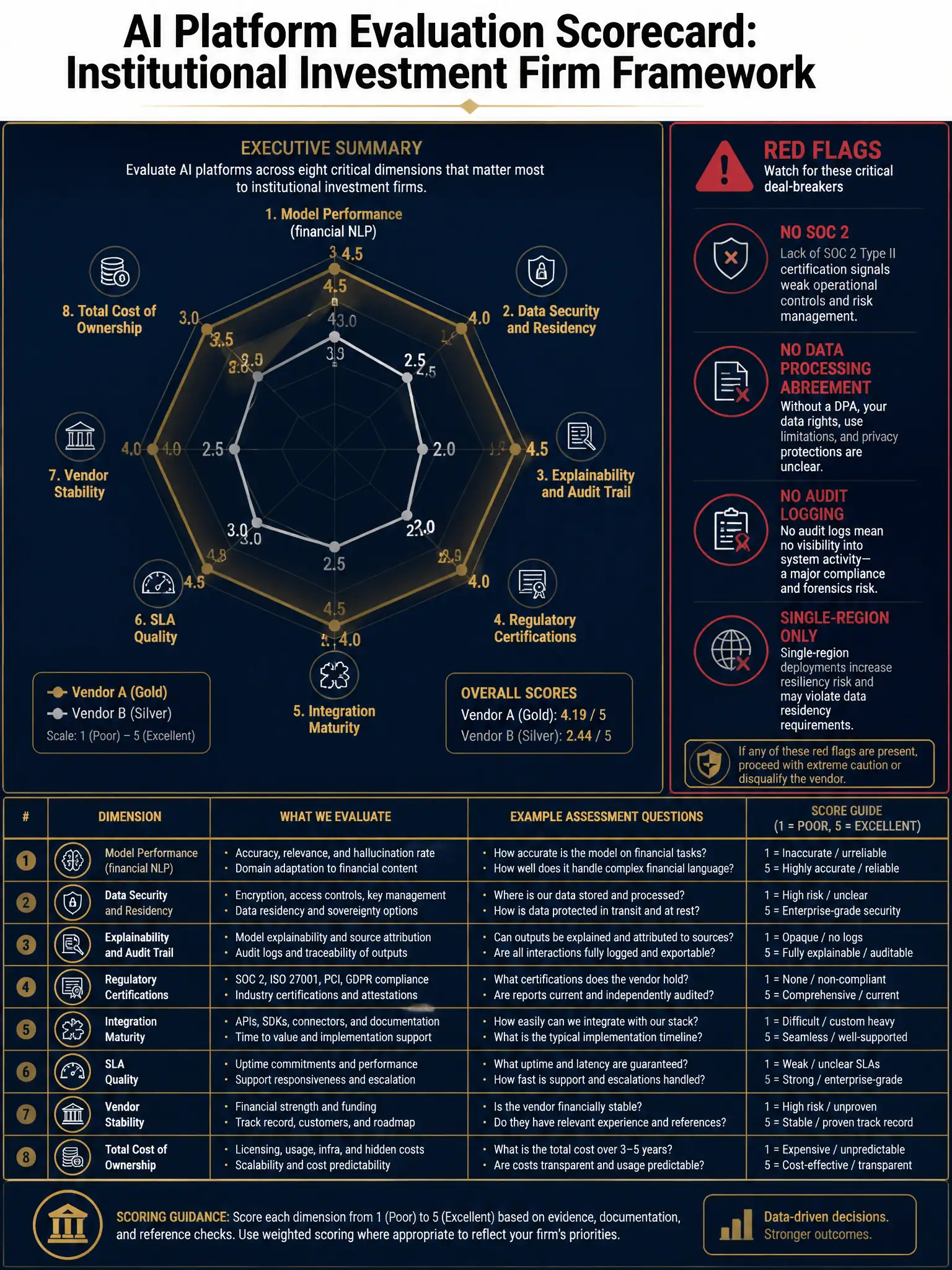
You need a scorecard that covers financial-domain model performance, security, explainability, compliance, integration, reliability, vendor risk, and three-year cost. If you buy on one flashy metric, you're walking into a building with no foundation.
Full Explanation
An AI platform evaluation scorecard for an institutional investment firm must reflect the multi-dimensional risk and capability requirements of a regulated, fiduciary environment. Unlike technology procurement in less regulated industries, investment firms must ensure that every AI tool they deploy can withstand regulatory scrutiny, protect client data, produce auditable outputs, and integrate into a complex existing technology stack. Model performance on financial NLP benchmarks, such as FinBench, Bloomberg FinNLP tasks, SEC filing comprehension, and earnings call summarization accuracy, measures whether the platform actually performs on the firm's domain-specific tasks. General-purpose benchmarks like MMLU are insufficient proxies. Data security and residency controls determine whether the platform can handle confidential portfolio data, client PII, and potentially MNPI without violating regulatory obligations or creating liability. The firm must verify data processing agreements, encryption standards in transit and at rest, and geographic data processing locations. Explainability and audit trail capabilities address a core institutional requirement: investment decisions must be documentable. An AI platform that generates outputs without logging the inputs, model version, prompt construction, and reasoning chain cannot support compliance review, regulatory exam response, or litigation defense. Regulatory compliance certifications, including SOC 2 Type II, ISO 27001, GDPR, CCPA compliance, and FINRA or SEC-adjacent controls, are minimum table stakes for institutional procurement. Integration ecosystem maturity determines how easily the platform connects to existing portfolio management systems, order management systems, and data warehouses. A powerful model on an island creates no value. SLA terms, vendor financial stability, and three-year total cost of ownership complete the scorecard by addressing operational reliability and financial sustainability of the vendor relationship. A scorecard built around price per API call, MMLU benchmark score, vendor funding stage, and number of enterprise customers collapses the evaluation to superficial commercial or general-purpose metrics and misses security, explainability, compliance, integration, reliability, and governance. A scorecard built around UI/UX quality, customer support rating, social media presence, and availability of pre-built financial templates is similarly superficial and does not address fiduciary, regulatory, or operational risk. A scorecard built around latency benchmarks only is wrong because even if speed matters for some workflows, portfolio analytics in an institutional setting still requires security, auditability, compliance, integration, vendor risk assessment, and total cost analysis.