
A $20B AUM institutional asset manager is finalizing a three-year enterprise agreement with a cloud AI provider to power its client reporting and portfolio commentary workflows. The procurement team sends the vendor's standard SLA to the CFIA-credentialed AI architect for review before signing. The standard SLA offers 99.5% monthly uptime with service credits capped at 10% of monthly fees. Given the firm's operational requirements — including month-end reporting deadlines and real-time client portal updates — which SLA provision should the architect prioritize negotiating?
Select an answer to reveal the explanation.
Short Explanation
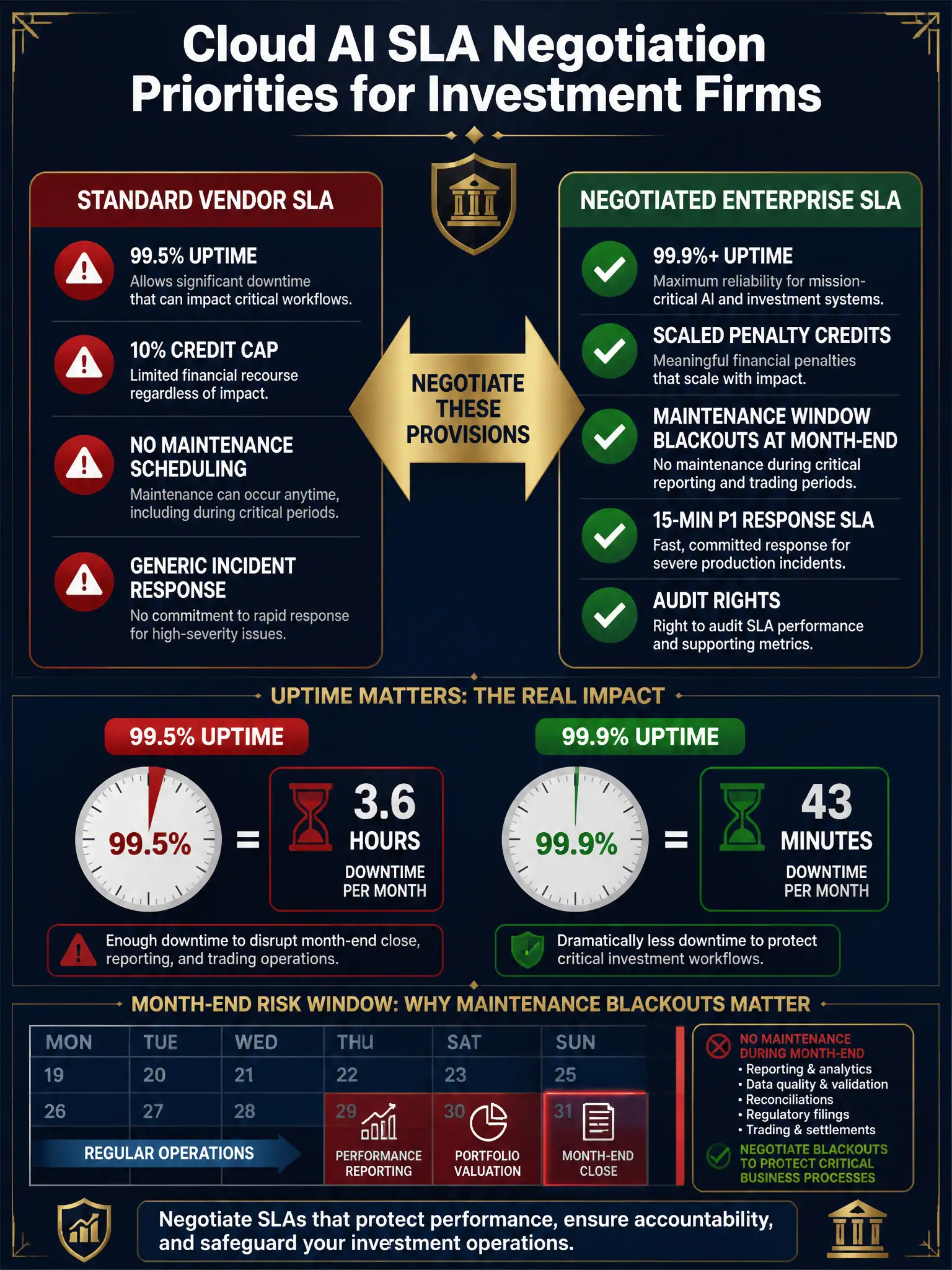
An SLA isn't just paperwork — it's your operational safety net. You need uptime, real penalties, and maintenance windows that dodge month-end crunch, because 99.5% can still bite you for hours when reporting deadlines hit.
Full Explanation
SLA negotiation for cloud AI services requires the same rigor applied to prime brokerage agreements or custody arrangements — the standard form contract is the starting point, not the final word. For an institutional asset manager, the core SLA provisions that drive operational risk are uptime commitments, penalty adequacy, maintenance scheduling, and incident response. Uptime at 99.5% allows approximately 3.6 hours of downtime per month. For a firm with hard quarter-end and month-end client reporting deadlines, a multi-hour outage on a reporting date could trigger client SLA breaches, reputational damage, and regulatory scrutiny. Negotiating to 99.9% (4.4 minutes/month) or 99.95% with specific carve-outs during critical reporting windows is standard practice for enterprise financial services clients and is achievable with major providers. Service credit caps of 10% of monthly fees provide minimal financial deterrent to a large vendor and do not compensate the firm for downstream business losses. Negotiating credits that scale with duration of outage and that cover consequential loss periods (e.g., elevated credits during month-end windows) creates stronger vendor accountability. Maintenance windows should be explicitly scheduled to avoid peak reporting periods. The firm should require 72-hour advance notice for planned maintenance and ban maintenance windows during the final three business days of each month. Additionally, the CFIA architect should negotiate a defined P1 incident response time (e.g., acknowledgment within 15 minutes, senior engineer engaged within 30 minutes); a dedicated customer success and technical account manager with escalation rights; and audit rights to inspect uptime measurement methodology. The correct approach is negotiating enhanced uptime commitments (99.9%+) with financial penalties that scale meaningfully relative to business impact, explicit exclusions for scheduled maintenance windows aligned to non-peak periods, and a defined incident response SLA with escalation paths, because it directly addresses those availability, penalty, maintenance, and incident-response risks. The lower per-token price tier option is incorrect because cost optimization, while important, is a secondary SLA concern compared to availability for mission-critical workflows. The model version stability option addresses an important but different risk (model drift/deprecation) and is a valid supplementary clause, not the primary negotiation priority. The accept-the-standard-SLA option is incorrect because enterprise clients of major cloud AI providers routinely negotiate custom SLA terms, and accepting standard terms without review is a procurement governance failure.