
A large hedge fund has built its AI-powered signal generation pipeline entirely on a single proprietary LLM provider's API. The vendor announces a 40% price increase and a policy change that restricts financial output caching — a feature the fund relies on for latency optimization. The Head of Technology asks the CFIA-credentialed architect to present a vendor lock-in mitigation strategy to the risk committee. Which approach BEST reduces strategic dependency while maintaining operational continuity?
Select an answer to reveal the explanation.
Short Explanation and Infographic
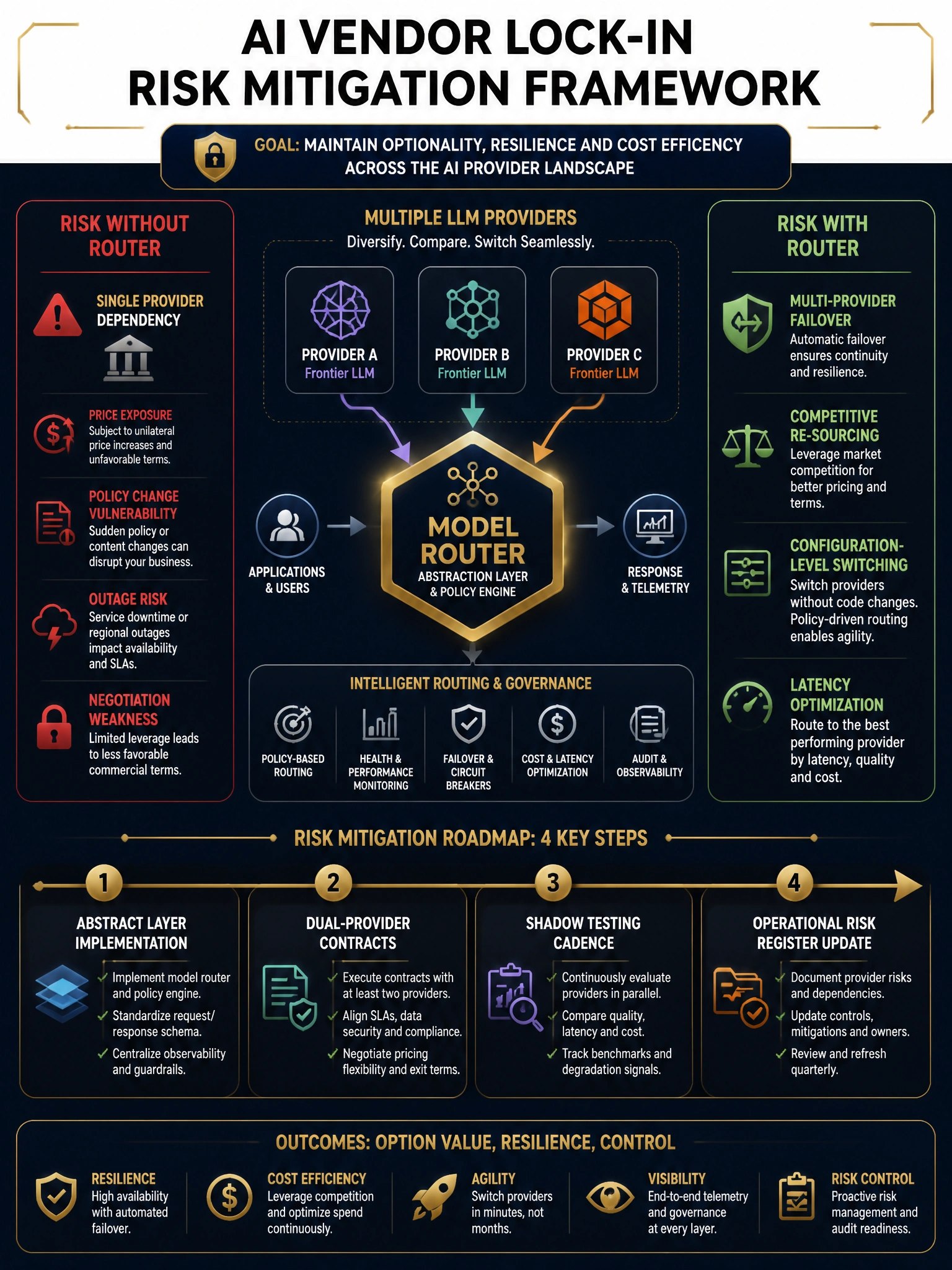
Just like a trading desk routes orders through multiple prime brokers to avoid concentration risk, the right AI architecture routes inference requests through an abstraction layer that decouples your business logic from any one vendor. Option C is correct because a model router lets the firm switch providers — or use them in parallel — without rewriting the entire pipeline. Lock-in risk is an architectural problem, and the solution is architectural.
Full explanation below image
Full Explanation
Vendor lock-in in AI infrastructure is structurally similar to single-counterparty concentration risk in a portfolio — it creates asymmetric downside with limited upside. When a firm's entire signal generation pipeline depends on one provider's API, it loses negotiating leverage, becomes exposed to unilateral policy changes, and faces operational disruption if the provider experiences outages or changes its terms. For a hedge fund where latency and reliability directly affect alpha generation, this is a material operational risk.
The gold-standard mitigation is a provider-agnostic abstraction layer — often called a model router or LLM gateway (examples include LiteLLM, PortKey, or custom-built orchestration layers). This layer standardizes how prompts are constructed, how responses are parsed, and how errors are handled, regardless of which underlying model provider fulfills the request. The firm's application code calls the router, and the router handles provider-specific API formats, authentication, and retry logic. Switching from Provider A to Provider B becomes a configuration change, not a pipeline rewrite.
Effective lock-in mitigation also includes: maintaining parallel contracts with at least two providers; running periodic shadow-testing of alternative models against production workloads so the team understands performance parity before a crisis forces a switch; and including AI vendor concentration as a named risk category in the firm's operational risk framework.
Option A is incorrect because an immediate migration without testing introduces new operational risk and ignores the performance validation required for a signal generation system. Option B is incorrect because a discount negotiation addresses pricing but does nothing to reduce dependency — the fund remains fully locked in. Option D is factually wrong; while switching costs exist, they are manageable with proper abstraction layer architecture and are far lower than the long-term cost of vendor-imposed constraints.