
A mid-sized asset management firm is evaluating whether to deploy an open-source LLM (e.g., Llama 3) on-premises or license a proprietary model via API (e.g., GPT-4o) for its equity research summarization workflow. The CTO highlights that the firm handles MNPI-sensitive data and has strict data residency requirements. The CIO wants to understand the full trade-off before committing budget. Which assessment BEST captures the strategic trade-off between open-source and proprietary LLMs for this use case?
Select an answer to reveal the explanation.
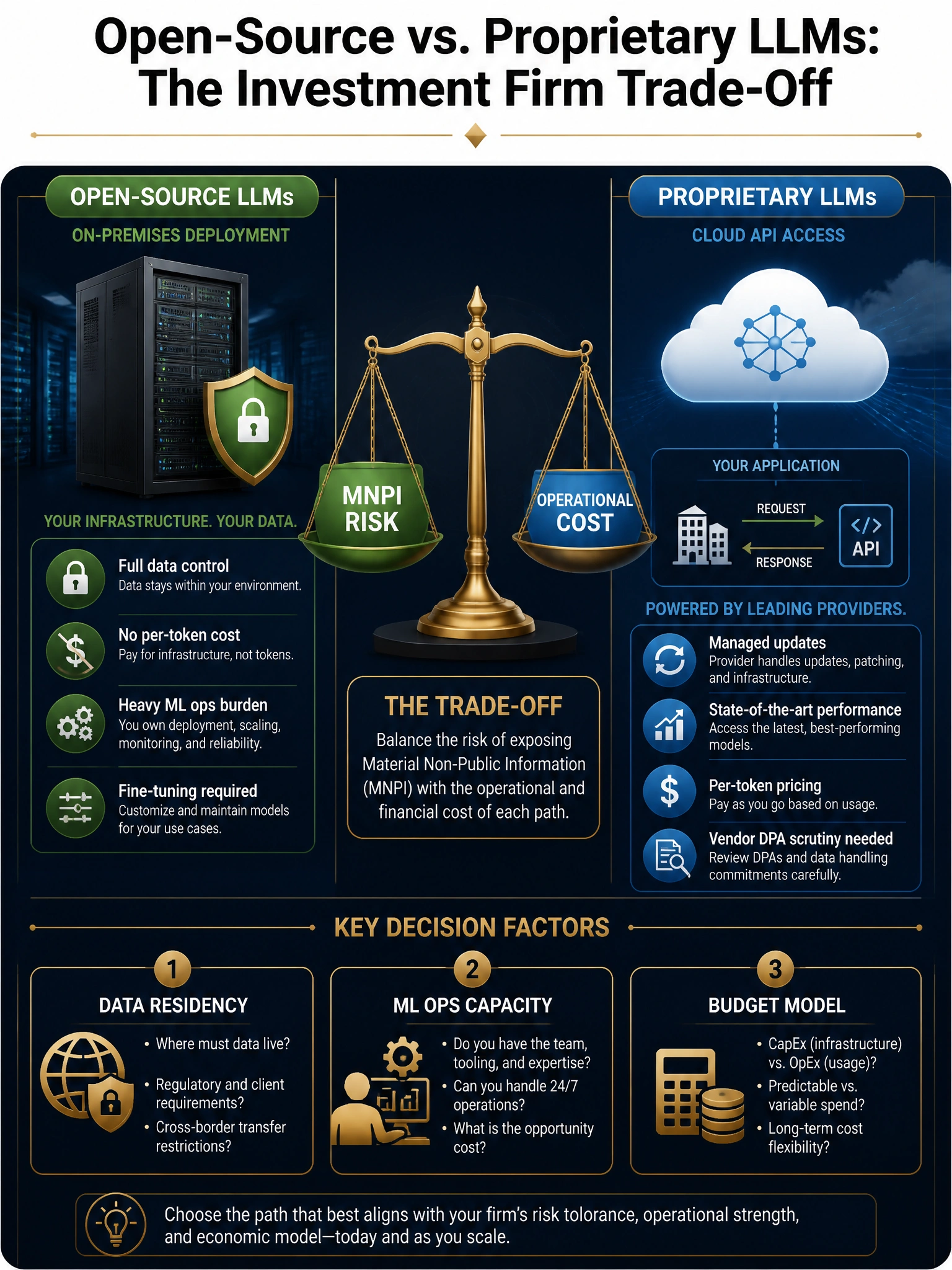
Short Explanation and Infographic
Think of it like choosing between building your own trading desk vs. renting space on an exchange floor — open-source gives you control and privacy, but you own every problem. The correct answer captures both the data residency advantage and the real operational cost of running your own inference stack. Firms handling MNPI data must weigh the regulatory upside of on-prem deployment against the substantial ML ops overhead that comes with it.
Full explanation below image
Full Explanation
The open-source versus proprietary LLM decision is one of the most consequential 'build vs. buy' choices an investment firm makes in its AI roadmap. For firms dealing with material non-public information (MNPI), data residency is not a preference — it is often a legal and compliance mandate. Sending sensitive research notes through a third-party API exposes the firm to data leakage risk, vendor data-use policy ambiguity, and potential SEC scrutiny if MNPI travels outside controlled environments. Open-source models like Llama 3, Mistral, or Falcon can be deployed entirely within the firm's own infrastructure, eliminating these concerns.
However, the operational cost of open-source deployment is substantial. The firm must provision GPU infrastructure (cloud or on-prem), manage model versioning and updates, build fine-tuning pipelines to adapt the model to financial language, monitor inference latency and throughput, and maintain security patching. These tasks require ML engineers, DevOps resources, and ongoing capital expenditure — costs that are often underestimated in initial business case projections.
Proprietary models accessed via API (GPT-4o, Claude, Gemini) offer state-of-the-art performance with minimal infrastructure overhead. The vendor handles model updates, safety tuning, and scaling. However, per-token pricing can become material at enterprise scale, and the firm must scrutinize vendor data processing agreements carefully. Many top-tier providers now offer private deployment options (Azure OpenAI, Anthropic's enterprise tier, Bedrock) that address data residency while retaining the operational simplicity of managed services — a middle path worth evaluating.
Option A is incorrect because benchmark performance alone is never sufficient justification; compliance and operational fit must drive the decision. Option C is incorrect because no commercial API automatically satisfies all financial data regulations — the firm's compliance team must validate each vendor's DPA. Option D is a false generalization; open-source models like Llama 3 70B demonstrate competitive performance on financial NLP benchmarks and are a serious enterprise option when properly resourced.