
A mid-sized asset manager is designing its next-generation cloud data platform to support three use cases simultaneously: (1) raw alternative data ingestion and exploration by quant researchers, (2) structured SQL analytics for performance reporting, and (3) training ML models on multi-year historical datasets. The CTO must choose between a pure data warehouse, a pure data lake, or a hybrid lakehouse architecture. Which architecture best serves all three use cases?
Select an answer to reveal the explanation.
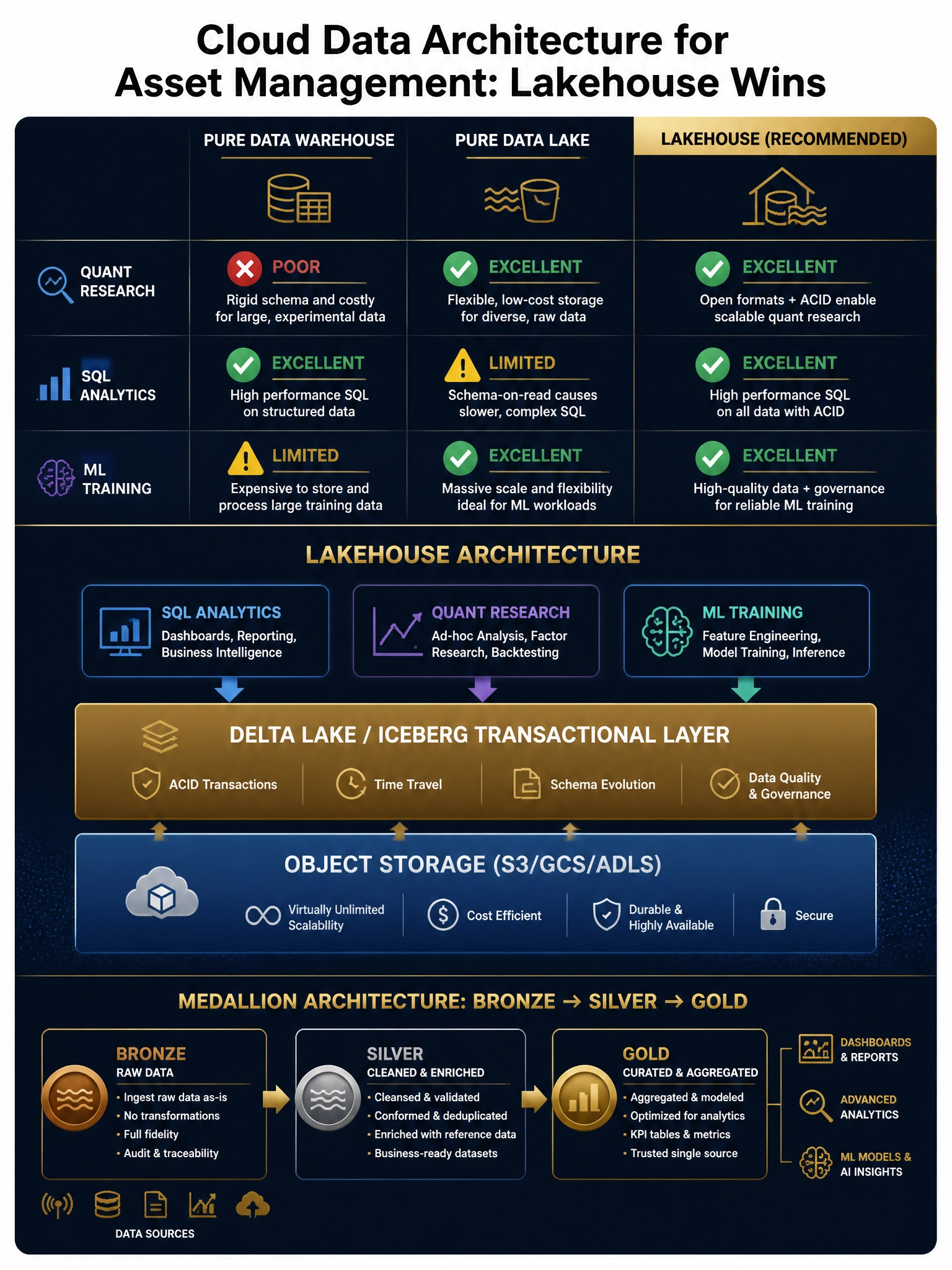
Short Explanation and Infographic
The lakehouse is like having one kitchen that serves both the formal dining room and the test-cook lab: the same ingredients (your raw data on object storage) can be served as a precise, structured meal (SQL reports from the Delta table layer) or used experimentally (Spark notebooks for quant research and ML). Pure warehouses demand ETL before you can touch raw data, and pure lakes lack the ACID transactions you need for reliable performance reporting. The lakehouse eliminates that tradeoff.
Full explanation below image
Full Explanation
The three use cases in this scenario represent distinct data access patterns that have historically required separate architectures: raw data exploration favors schema-on-read flexibility, SQL analytics favors schema-on-write reliability with ACID consistency, and ML model training favors large-scale sequential scans of historical data in efficient binary formats. Building separate siloed systems for each (option D) creates three copies of the same underlying data, triples the storage cost, and creates data consistency problems when updates to a source propagate through independent pipelines at different cadences.
The lakehouse architecture resolves this by adding a transactional metadata and versioning layer on top of object storage (S3, GCS, or ADLS Gen2) without requiring data to leave the lake. Delta Lake (open-sourced by Databricks) and Apache Iceberg (backed by Netflix, Apple, and now broadly adopted) provide: (1) ACID transaction guarantees via optimistic concurrency control at the file level — append and overwrite operations are atomic, enabling reliable performance reporting without ETL into a separate warehouse; (2) schema enforcement and evolution — quant researchers can ingest new alt data fields without breaking existing SQL consumers; (3) time travel queries — researchers can query any historical snapshot of the data, which is invaluable for point-in-time backtesting that avoids look-ahead bias; and (4) native open Parquet format compatibility — ML frameworks (PyTorch, TensorFlow, XGBoost) and distributed compute engines (Spark, Dask, Ray) can read the same files directly without format conversion.
A pure data warehouse (option A) forces all data through an ETL pipeline before it is queryable, which is unworkable for quant researchers who need to explore raw, uncleaned alternative datasets in hours rather than weeks. The ETL bottleneck and schema rigidity make it unsuitable as the primary platform for research workflows. A pure data lake (option B) lacks ACID consistency — concurrent writes without transactional control create partial-read states that corrupt performance reports, and the absence of schema enforcement means data quality issues propagate silently.
Leading asset managers including BlackRock (Aladdin Data Cloud), State Street (Alpha Data Platform), and Vanguard have publicly disclosed migrations toward lakehouse architectures, citing exactly the multi-workload flexibility that the scenario requires. The Medallion architecture pattern (Bronze/Silver/Gold layers) within a lakehouse provides a well-documented implementation path for progressive data quality refinement.