
A fundamental long/short equity fund is evaluating a new alternative data product: anonymized consumer credit card transaction data aggregated by merchant category. Before signing a data license and integrating the feed into its research process, the Chief Data Officer must conduct due diligence. Which vetting dimension most directly determines whether the dataset creates material legal and reputational risk for the fund?
Select an answer to reveal the explanation.
Short Explanation and Infographic
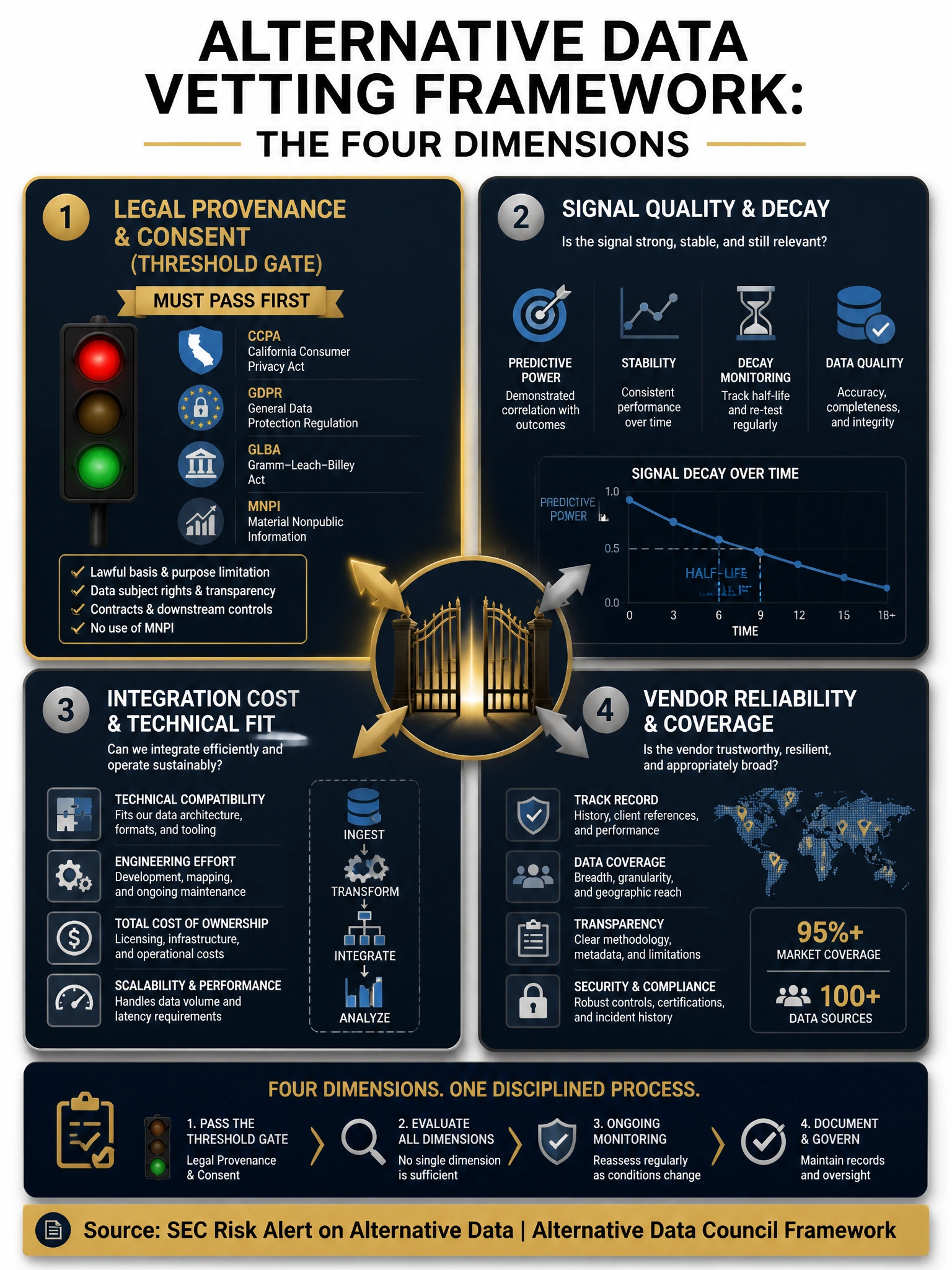
Think of alt data like finding a wallet — the important question isn't whether it has good cash in it, but whether it's legally yours to pick up. The provenance and consent framework is the legal foundation: if consumers didn't validly consent to their transaction data being sold to hedge funds, or if anonymization is insufficient under CCPA or GDPR, the fund becomes a downstream party to a privacy violation. Signal decay and integration costs matter, but they don't land you in an SEC enforcement action.
Full explanation below image
Full Explanation
Alternative data due diligence has evolved from a purely investment-quality question (is the signal real?) to a multi-dimensional legal, regulatory, and reputational analysis. The SEC's Division of Examinations has explicitly flagged alternative data as a priority area, and enforcement actions have been brought against funds and data vendors for material non-public information (MNPI) violations and improper use of personal financial data.
The provenance and consent dimension is the threshold legal question. Consumer credit card transaction data is particularly sensitive because it constitutes personally identifiable financial information subject to the Gramm-Leach-Bliley Act (GLBA), the California Consumer Privacy Act (CCPA), and if any EU subjects are included, the General Data Protection Regulation (GDPR). The fund's CDO must verify: (1) the legal basis on which consumers provided their financial institution consent to share transaction data — consent language buried in terms of service may not satisfy CCPA's requirement for clear disclosure of commercial sharing; (2) whether the anonymization methodology is robust enough that re-identification is not feasible given publicly available linking datasets; (3) whether the vendor obtained proper data-sharing agreements from the financial institutions that are the original data controllers; and (4) whether any subset of the data constitutes MNPI — for example, if the dataset captures real-time spending at a public company that has not yet reported quarterly results.
Signal decay (option A) is an investment quality concern and is addressed during the alpha evaluation phase after legal clearance — it has no bearing on legal risk. Computational cost (option C) is a technology budgeting question. Vendor SLA and coverage (option D) relate to operational reliability. None of these create SEC examination risk, class action exposure, or reputational harm if the answer is unfavorable. The legal and regulatory assessment is the prerequisite gate that determines whether the fund should proceed to any further evaluation.
The Alternative Data Council's due diligence framework and the SEC's 2021 Risk Alert on alternative data both enumerate provenance, consent, and MNPI risk as the primary dimensions that compliance programs must evaluate before any alternative data integration.