
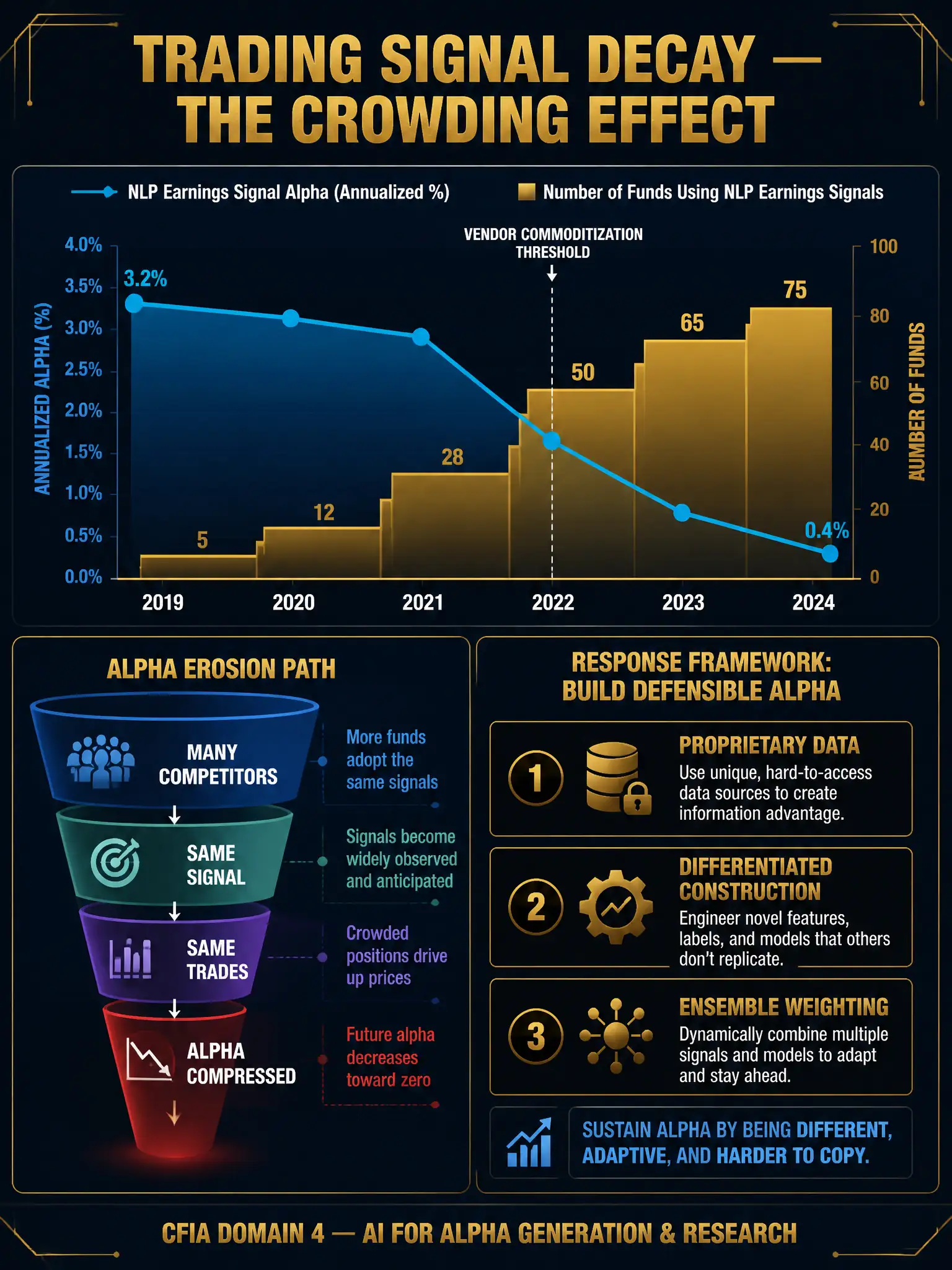
A hedge fund discovers that its NLP-based earnings surprise signal, which was generating annualized alpha of 3.2% from 2019 to 2021, has seen alpha decline to 0.4% annualized since 2022. The signal uses the same methodology and has not been altered. Which of the following is the MOST LIKELY primary cause of this signal decay, and what is the appropriate institutional response?
Select an answer to reveal the explanation.
Short Explanation
Alpha is like a fishing spot — once everyone on the lake knows about it, the fish disappear. You're seeing a crowded earnings-surprise NLP signal get arbitraged away as transcript data and sentiment tools became common. Move up the information food chain with proprietary data and more differentiated signal construction.
Full Explanation
Signal decay from competition crowding is the most common and well-documented cause of systematic alpha erosion in quantitative strategies. The answer identifying arbitrage through competing funds adopting similar NLP approaches and widely available transcript data is correct because the timeline described — strong alpha 2019–2021, rapid decay from 2022 — aligns precisely with the period during which NLP-based earnings analysis transitioned from a competitive advantage to a widely available commodity. Multiple data vendors, including Refinitiv, Bloomberg, Sentieo, and Kensho, introduced pre-built earnings sentiment scores between 2020 and 2022, democratizing access and compressing the alpha available to any individual user. The answer blaming one-day settlement changes and recommending higher-frequency trading is incorrect. The U.S. moved to one-day settlement in May 2024, after the question's decay period, and settlement cycle changes affect post-trade operations rather than reducing the information content of signals available at trade execution. Earnings-call NLP signals are already acted upon at market open on the same day, making one-day versus two-day settlement irrelevant to signal profitability. The answer blaming changes to GAAP accounting standards that altered how companies report non-recurring items is incorrect. While non-GAAP reporting has evolved, no major GAAP change between 2021 and 2022 would uniformly invalidate an NLP earnings surprise signal, because the signal captures tone and language patterns, not just GAAP line items. The answer blaming post-COVID macroeconomic volatility making earnings-call sentiment less informative has some empirical basis, because idiosyncratic stock volatility was compressed during certain periods, but this is a second-order effect. The magnitude and persistence of the decay from 3.2% to 0.4% is more consistent with competition crowding than a macro-volatility regime shift, particularly because macro-dominant regimes are cyclical. The institutional response to crowding-driven signal decay involves identifying proprietary data sources with restricted access, moving to more granular signal construction such as speaker-level sentiment within earnings calls rather than call-level aggregates, combining signals in ensemble models to reduce any single signal's weight, and reducing position size in decaying signals in proportion to observed information coefficient decay.