
A systematic equity team is integrating a gradient boosting model (GBM) to enhance a traditional five-factor model (market, size, value, momentum, quality). The GBM is trained on 200 fundamental and technical features to predict 1-month forward returns. The team observes that training accuracy is 82% while out-of-sample accuracy drops to 58%. Which of the following BEST explains this outcome and prescribes the correct remediation?
Select an answer to reveal the explanation.
Short Explanation
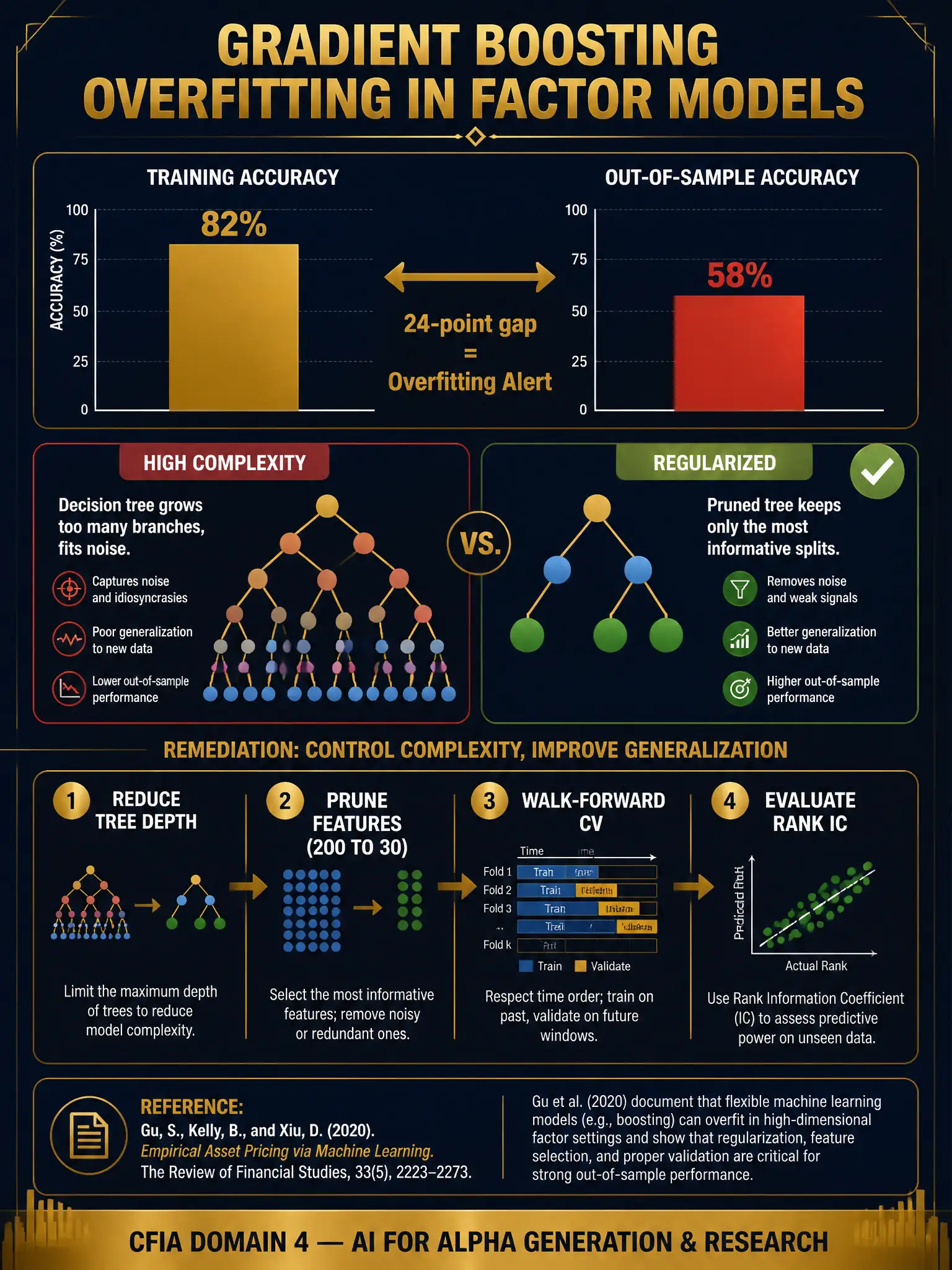
You've got a 24-point gap, so your model is memorizing training data instead of learning patterns. In finance, too many features and too few independent observations make gradient boosting overfit. Simplify the model, prune features, and add regularization.
Full Explanation
The 24-percentage-point accuracy gap between training and out-of-sample performance is the hallmark of overfitting, not underfitting. Gradient boosting models are high-variance learners that can memorize idiosyncratic noise in training data, particularly when the feature-to-sample ratio is high. In financial time series, an effective independent sample is far smaller than the raw data row count because returns are serially correlated; a five-year daily history of 500 stocks might appear to be 650,000 data points but contains far fewer truly independent observations. The underfitting explanation that recommends adding interaction terms between fundamental and technical factors is wrong because the 82% training accuracy demonstrates the model has ample expressive capacity, and adding more features to an already overfitted model amplifies the problem. The view that the 58% out-of-sample accuracy is expected and requires no intervention before deployment is incorrect without context. While equity return prediction is inherently noisy, deploying a model with a known 24-point train-test gap without investigation is imprudent portfolio management; the gap itself is the red flag, independent of the absolute out-of-sample number. The recommendation to replace the model with a deep neural network is counterproductive. Deep networks are higher-complexity models with even greater overfitting risk on tabular financial data at typical dataset sizes, and the research literature, including Grinold and Kahn and Gu et al. in the Review of Financial Studies, consistently shows regularized tree models outperform untuned neural networks on cross-sectional equity prediction with moderate feature sets. The correct remediation includes reducing tree depth and the number of estimators, applying regularization that penalizes absolute feature weights or using feature-importance pruning to cut the 200 features to a parsimonious set of 20–40, using walk-forward cross-validation appropriate for time series to properly estimate generalization, and evaluating information coefficient and rank information coefficient rather than raw accuracy.