
A quantitative investment team is evaluating an agentic AI system to automate their nightly pre-market research workflow, which involves: (1) pulling overnight macro data from three APIs, (2) scanning 200+ earnings releases for specific financial metrics, (3) cross-referencing findings against the firm's internal position book, and (4) generating a prioritized morning briefing for the PM team. The system must complete this workflow reliably within a two-hour overnight window. Which AI agent architecture is best suited for this use case?
Select an answer to reveal the explanation.
Short Explanation
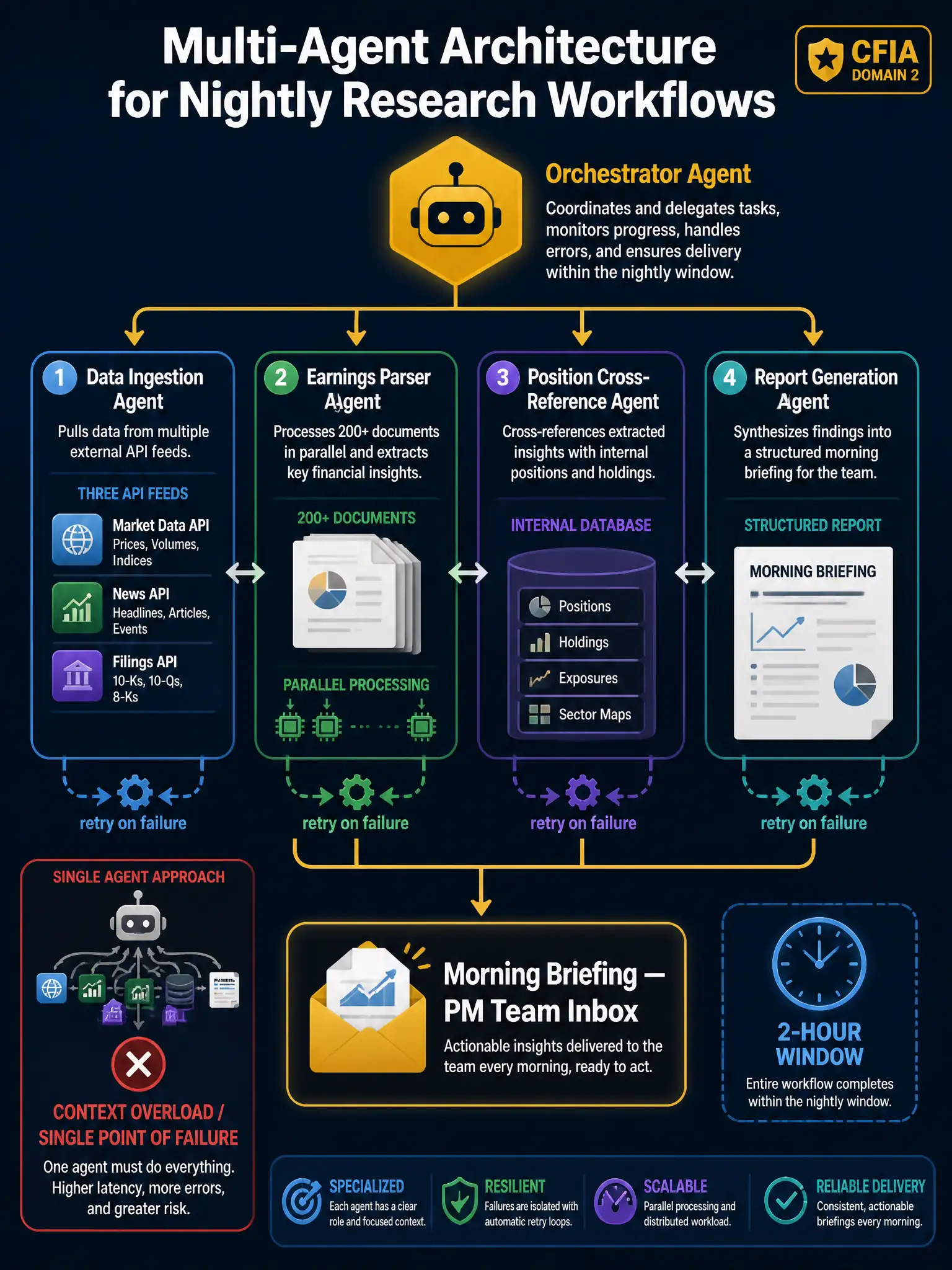
Think of this like a surgical team, not a solo surgeon. The complex four-stage nightly workflow with API calls, document parsing, database lookups, and report generation is exactly the use case that breaks single-agent approaches — too much context, too many failure modes, no specialization. You need multi-agent orchestration with an orchestrator because each agent can fail, retry, and hand off cleanly.
Full Explanation
The selection of AI agent architecture is a critical decision in deploying autonomous AI systems in financial workflows. The key design variables are: task complexity, the presence of distinct subtasks with different tool requirements, the need for error isolation and retry logic, the acceptable latency window, and the auditability requirements of financial systems.
This scenario has a four-stage pipeline with distinctly different subtasks: API-based structured data ingestion, which requires rate limit management, API authentication, and data validation; document parsing across 200+ earnings releases, a parallelizable high-throughput task; relational cross-referencing against an internal database, which requires secure data access patterns and schema knowledge; and natural language report generation from synthesized inputs, an LLM reasoning task. These stages have fundamentally different computational profiles, tool requirements, and failure modes.
The multi-agent orchestration framework with specialized sub-agents for each workflow stage, coordinated by an orchestrator agent that manages sequencing, error handling, and output consolidation, handles this by decomposing the workflow into specialized sub-agents, each optimized for its stage. The orchestrator agent manages sequencing, ensuring data ingestion completes before parsing begins, error handling, retrying failed API calls and flagging missing earnings releases, and output consolidation, passing structured outputs between agents in a typed contract. This architecture provides the reliability required for a production nightly workflow because failures are isolated to individual sub-agents and can be retried without restarting the entire pipeline. It also produces auditable intermediate outputs at each stage, which is critical for investment compliance.
The single general-purpose LLM agent with access to all tools and APIs, relying on chain-of-thought prompting to self-direct the full workflow from a single prompt, fails in production for complex multi-step workflows for well-documented reasons: context window limitations constrain how much information can be processed simultaneously; a single agent hitting four different tool types accumulates compounding failure probability; and chain-of-thought self-direction without explicit orchestration produces inconsistent sequencing behavior across runs.
The fine-tuned LLM trained specifically on the firm's historical morning briefings, deployed as a single inference call that generates the briefing based on a structured data dump input, confuses the generation task with the full workflow. It can write the final report but cannot perform API calls, document parsing, or database lookups. It is also static relative to changing data.
The rule-based automation system that handles the data ingestion and formatting steps, with an LLM called once at the end to generate natural language commentary, is a valid hybrid for simpler use cases but breaks down here because RPA systems lack the contextual reasoning needed to handle the variance in earnings release formats, and a single final LLM call cannot compensate for the loss of intermediate reasoning across stages.