
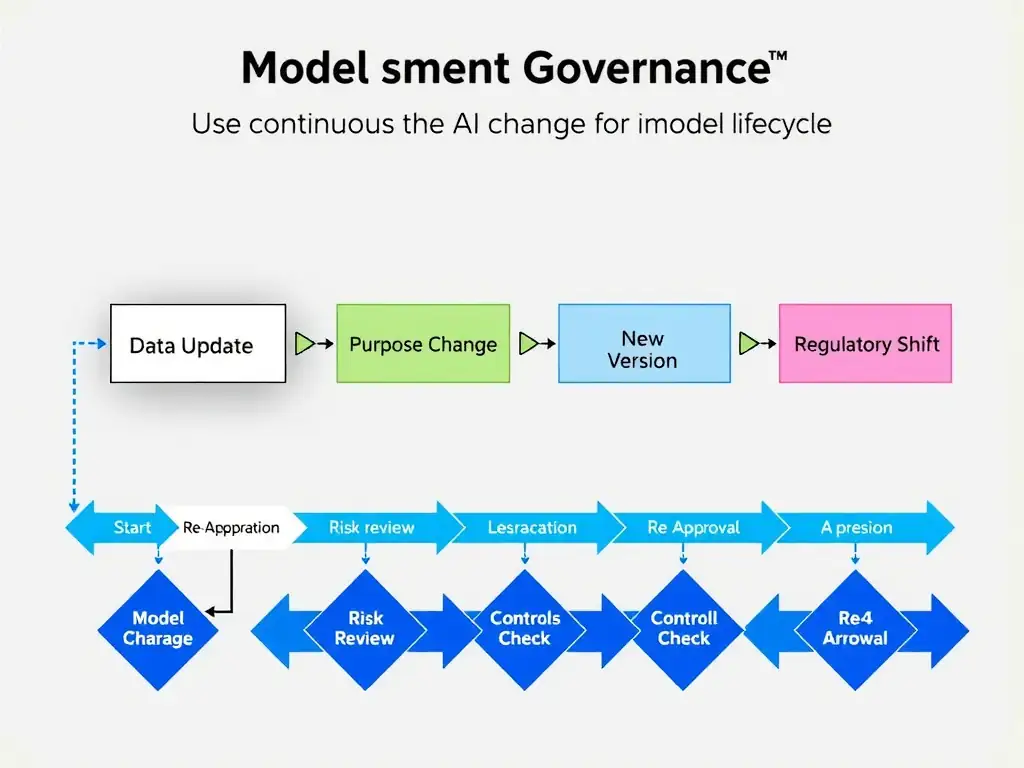
A newer dataset is proposed as a straight swap for the model's training data source, with nothing else changing. Does this require reassessment?
Select an answer to reveal the explanation.
Short Explanation
A new dataset can change what a model learns even if you never touch the version number or the code. If the data source is materially different, you need to reassess the model's behaviour and risk profile.
Full Explanation
The correct answer is the option stating that a materially different data source can change the model's behaviour and risk profile even if the model architecture and version label stay the same. Data is one of the explicit triggers for reassessment, and a materially different training source can shift model behaviour regardless of what the version label says.
The option saying no because the model's version number has not changed is incorrect because a version number is a label, not proof that behaviour is unchanged.
The option saying no because the model's code has not been modified is incorrect because code being unmodified does not mean the trained model's behaviour is unchanged.
The option saying reassessment is needed only if the new dataset is larger than the original one is incorrect because dataset size is not what determines whether the change is material; its content and distribution are.
For the exam, remember that a data change alone, independent of code or version, is sufficient to trigger reassessment.