
Monitoring only application server CPU comes up as insufficient for a deployed model. What is missing from that approach?
Select an answer to reveal the explanation.
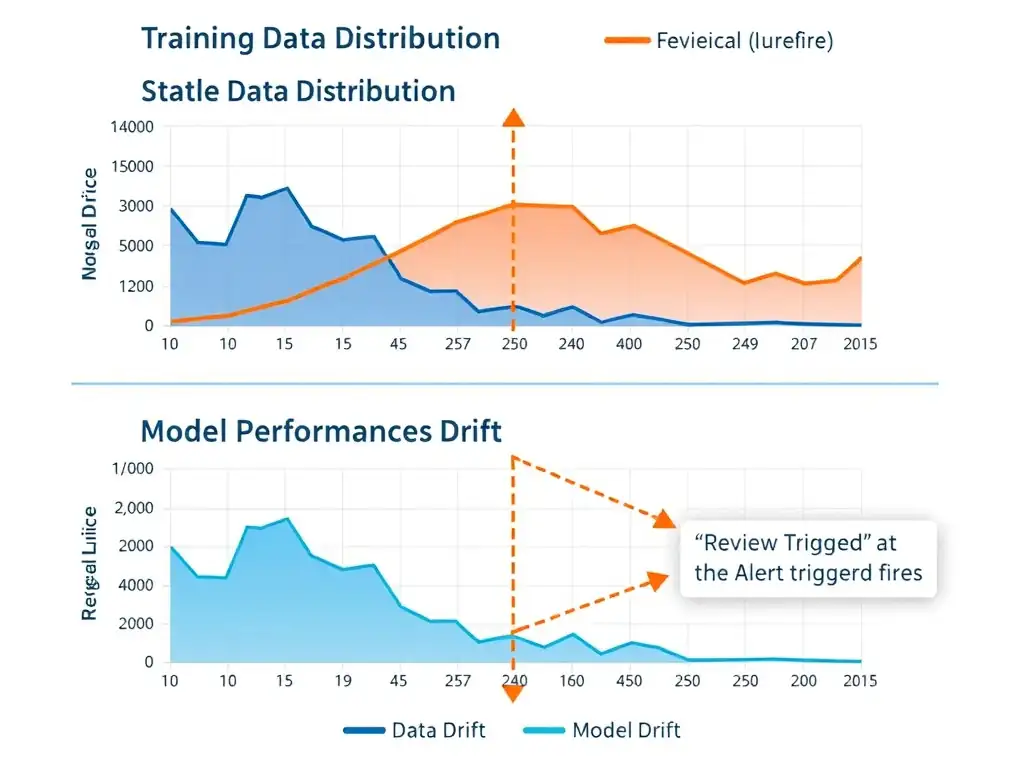
Short Explanation
CPU tells you the server is busy. It tells you nothing about whether the model is still right. You need drift monitoring to catch changes in input data or outputs.
Full Explanation
The correct answer is the option stating that CPU monitoring says nothing about whether incoming data or model outputs have drifted from what was validated, only about infrastructure load. Server CPU is an infrastructure health metric; it does not reflect whether the statistical properties of incoming data or the model's predictions have shifted, which is what drift monitoring is designed to catch. The answer claiming CPU monitoring is more expensive to run than drift monitoring is incorrect because relative cost is not the reason CPU monitoring is insufficient; the issue is what it measures. The answer claiming CPU monitoring cannot be automated and requires manual checks is incorrect because CPU monitoring is routinely automated, just like drift monitoring. The answer claiming CPU monitoring interferes with the model's inference latency is incorrect because passively observing CPU usage does not affect inference latency. For the exam, distinguish infrastructure monitoring from behavioural drift monitoring; a deployed model needs both, and one cannot substitute for the other.