
A customer needs guidance on how to structure workflow requirements for model approvals. Which structure best matches how governance obligations actually work?
Select an answer to reveal the explanation.
Short Explanation
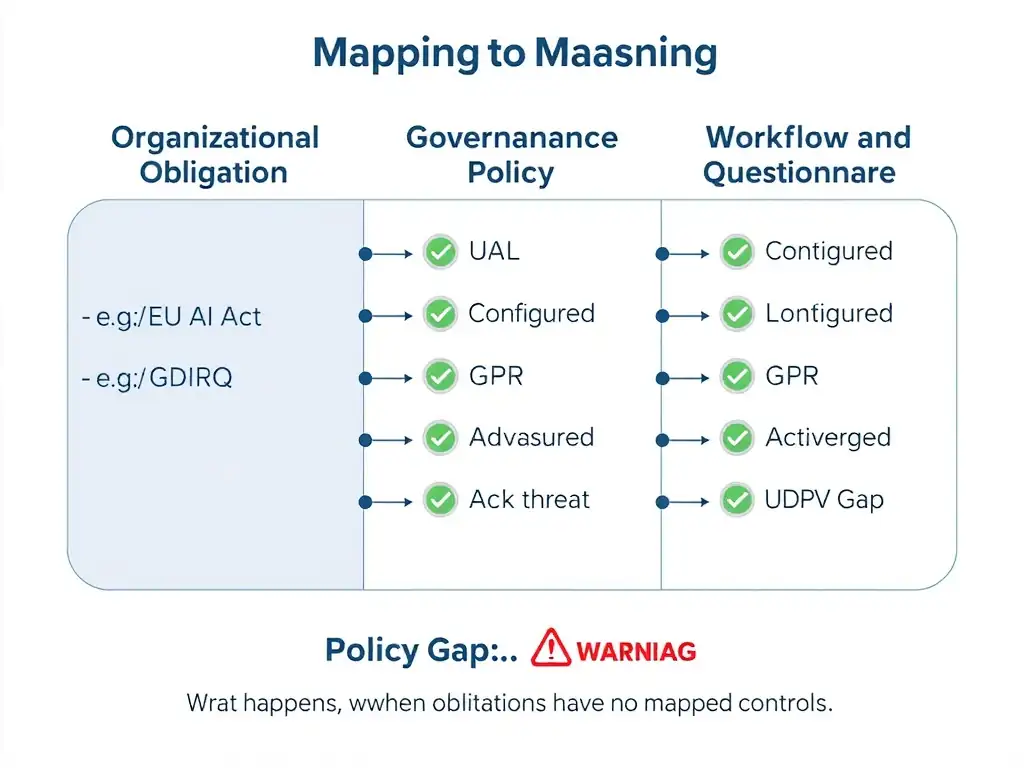
You need approval routing that matches each asset’s obligations, like risk tier and regulatory context. Treating a low-risk internal tool the same as a customer-facing high-risk model isn't matching obligations—it's ignoring them.
Full Explanation
The correct answer is workflow routing and approval requirements tailored to each asset's obligations, such as its risk tier and regulatory context. Different assets carry different obligations, so the approval path, and who needs to sign off, should reflect that variation rather than force every asset through the same steps.
The uniform approval workflow for every asset is incorrect because a uniform workflow either over-burdens low-risk assets or under-scrutinises high-risk ones; it cannot fit both.
The no-formal-workflow approach, relying on informal email approval from whoever is available, is incorrect because informal approval leaves no auditable record and no consistent enforcement of the obligations that apply.
The post-deployment routing workflow is incorrect because approval routed after deployment can no longer function as a gate; the decision it is meant to inform has already been acted on.
For the exam, expect workflow configuration to vary with the asset's obligations, not to be one-size-fits-all.