
In the watsonx.governance monitoring configuration workflow, which action must be completed before configuring drift detection?
Select an answer to reveal the explanation.
Short Explanation
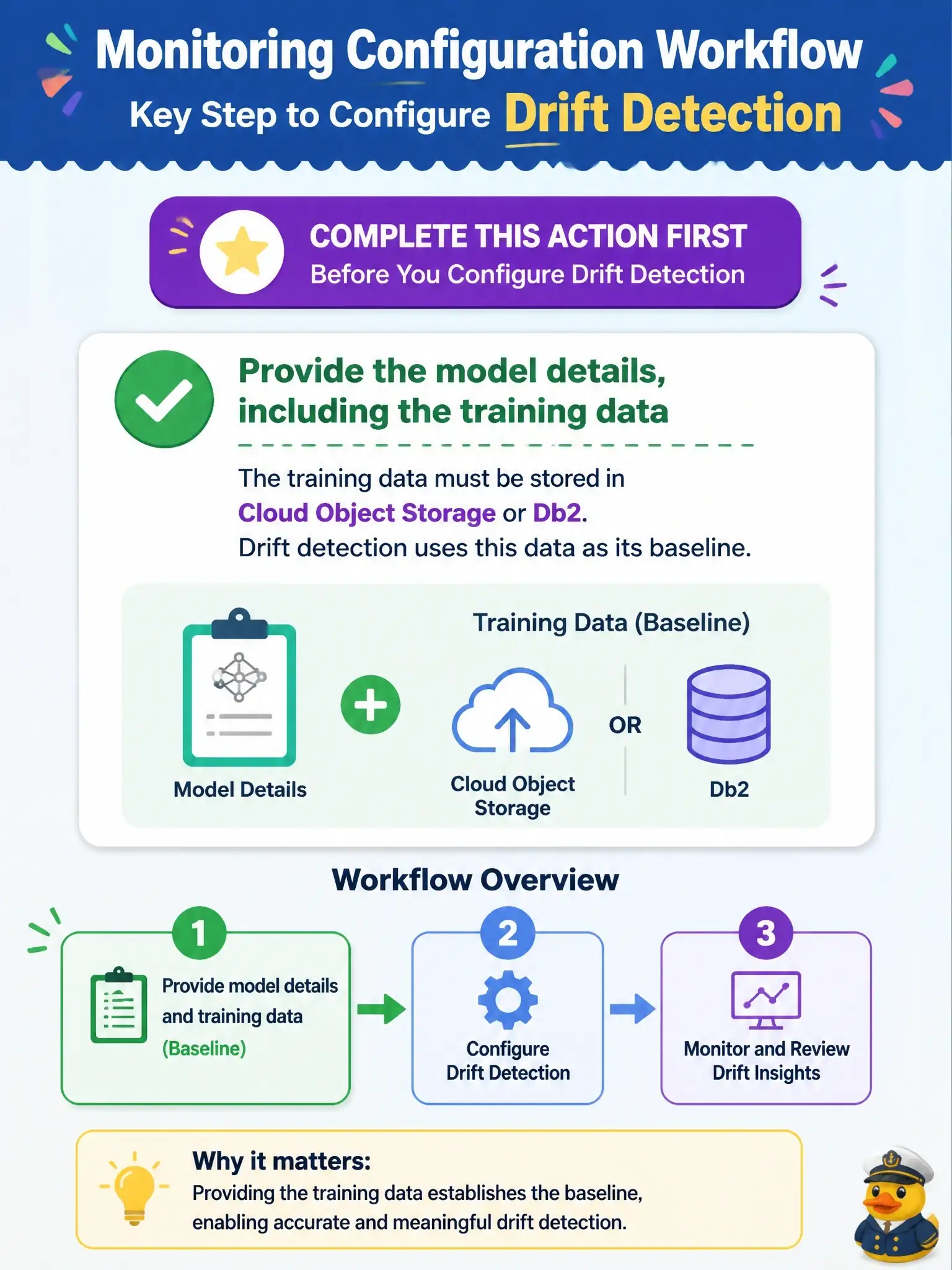
Drift is a comparison, and you can't compare against nothing. Before you configure drift in watsonx.governance, you provide the model details and the training data it'll use as a baseline, sitting in Cloud Object Storage or Db2. Everything else, like feedback data or alert rules, can wait.
Full Explanation
Drift detection in watsonx.governance measures how production payloads move away from the data the model learned from, so it cannot be configured until that reference is available. The configuration therefore begins with model details, including the prediction and label columns, and with labeled training data whose prediction column type matches the payload data. For the online configuration method, that training data must be hosted in IBM Cloud Object Storage or Db2; a notebook is the documented alternative when it cannot be shared that way. After the baseline is in place, the drift threshold and minimum sample size can be set. Configuring the feedback dataset is wrong because feedback data supplies ground truth for quality metrics, and drift does not depend on it. Selecting an explainability algorithm is wrong because explanations describe individual predictions and are independent of drift. Defining alert suppression rules and notification groups is wrong because alerting sits on top of evaluations and is not something a drift monitor requires before it can be configured. For the exam, tie each monitor to the data it consumes: drift uses training data, quality uses feedback data. A practical check is to open the model's details and confirm the training data connection and column types before enabling the drift evaluation.