
When configuring a drift evaluation in watsonx.governance, what must be supplied as the reference before you can set the drift alert threshold?
Select an answer to reveal the explanation.
Short Explanation
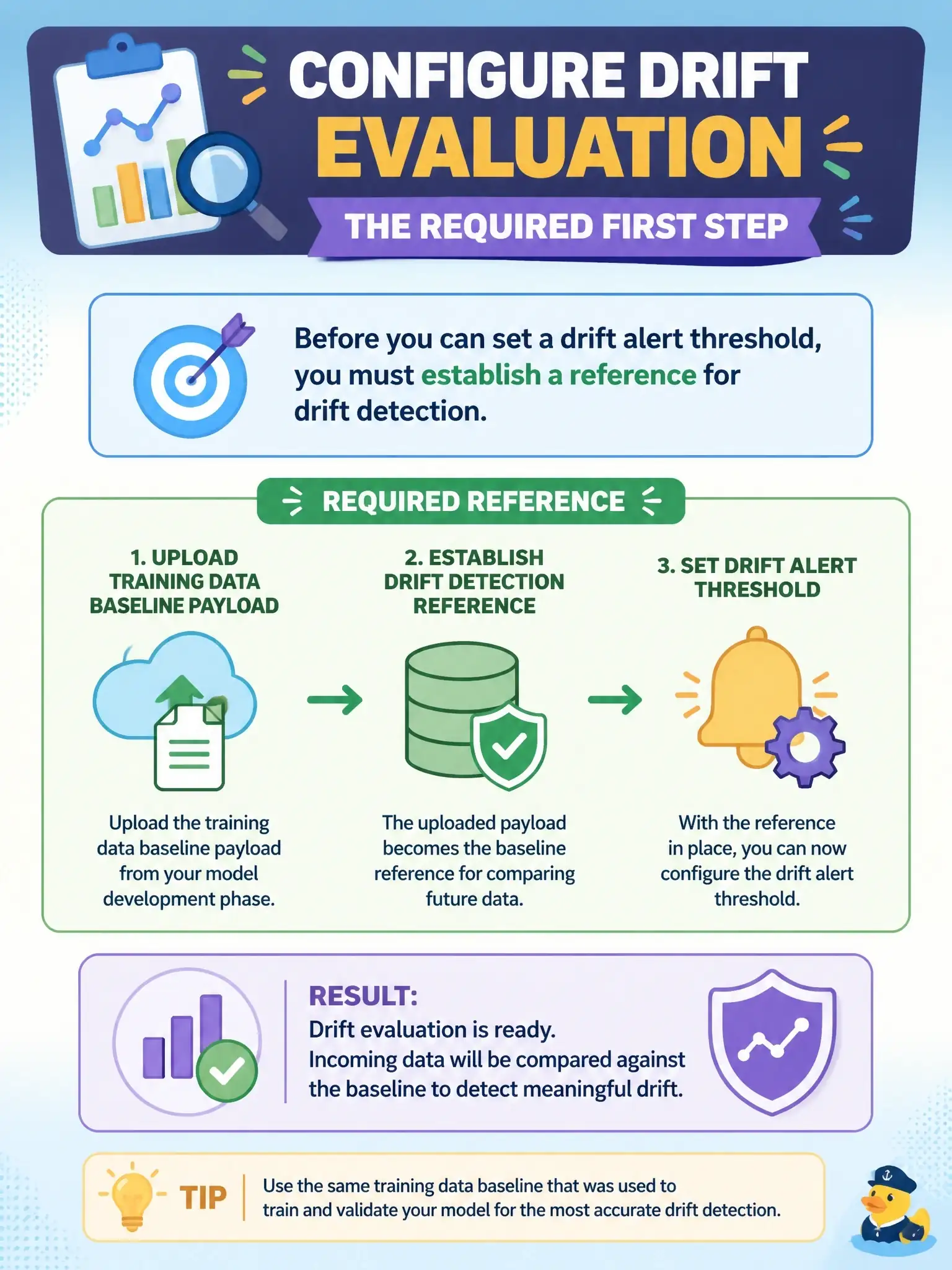
You can't say something has drifted until you know where it started, like marking the waterline before a flood. For a drift evaluation, you upload the training data first so watsonx.governance has a baseline, and only then do you set the drift alert threshold and minimum sample size.
Full Explanation
A drift evaluation compares production data against the data the model was trained on, so the training data is the reference the evaluation needs. In watsonx.governance, configuring drift starts by uploading labeled training data and confirming model details such as the prediction and label columns, whose data types must match the payload data. Only after that baseline exists can the drift threshold be set, which for classification models must be at least 5 percent, together with a minimum sample size that holds off measurement until enough records are available. Defining a protected attribute and reference group is wrong because those settings belong to fairness evaluations, which check outcomes across groups rather than change over time. Configuring the feedback dataset is wrong because feedback data with ground-truth labels drives quality metrics such as accuracy, not the drift baseline. Setting a monitoring schedule and notification recipients is wrong because those decide when evaluations run and who hears about them, not what they compare against. For the exam, note that IBM describes thresholds inside each monitor's configuration rather than as one global step sequence. As a check, verify that the training data is reachable in Cloud Object Storage or Db2 and that its column types match the payload before saving the drift settings.