
Which requirement most strongly indicates that federation is the right choice rather than ingestion?
Select an answer to reveal the explanation.
Short Explanation
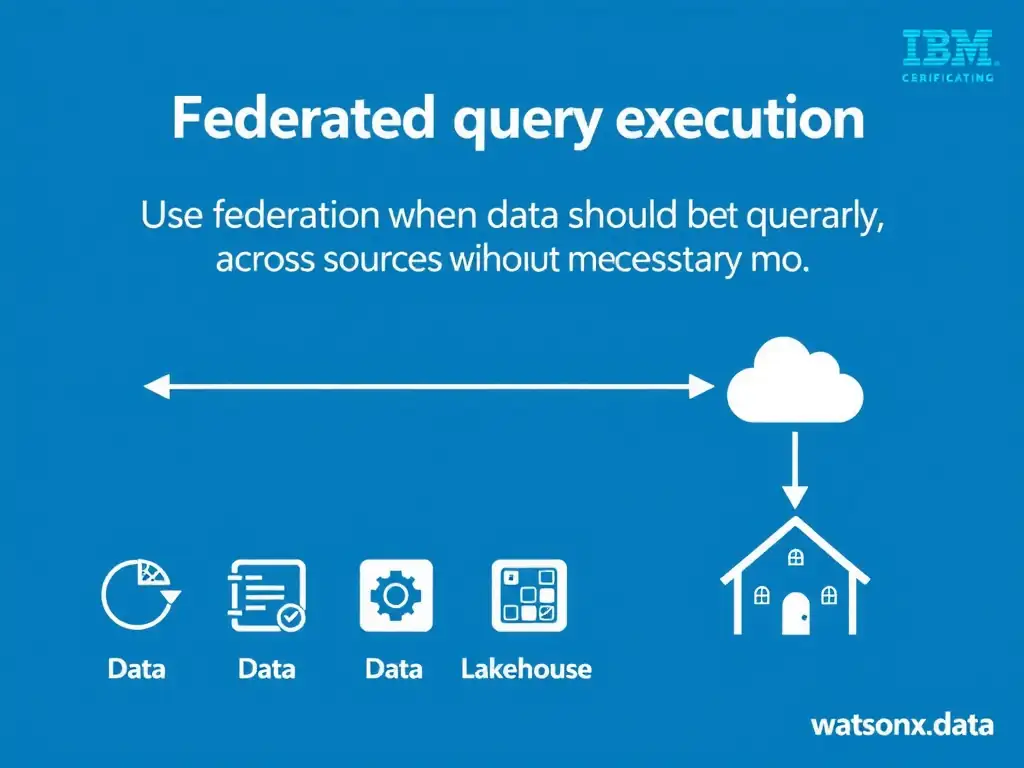
Federation wins when you need a small, constantly changing reference source to show its current state without building a sync pipeline. If the data is large, hot, or bulk-processed, you ingest it instead.
Full Explanation
Federation is strongest when the volume crossing the network is modest and the value of seeing the source's current state is high. The requirement to join a small, frequently changing reference source that must always reflect its current state fits both conditions, and avoiding a synchronisation pipeline is a genuine simplification. Heavy concurrent access to a large historical fact table is incorrect because it is the case where federation performs worst: every dashboard refresh pushes work onto the source system, and the query engine cannot use the optimised layout it would have for a lakehouse table. The seven-year unchanged retention requirement is incorrect because it argues for the data being held durably under the lakehouse's own governance and lifecycle rules, not for depending on a remote system to preserve it. The nightly batch job that reprocesses the full source table end to end is incorrect because full-table batch reprocessing is by definition bulk movement, which is what ingestion is for. For the exam, read the size of the data and the freshness requirement first; they decide the answer more often than anything else in the scenario.