
Which layering correctly describes a data lakehouse?
Select an answer to reveal the explanation.
Short Explanation
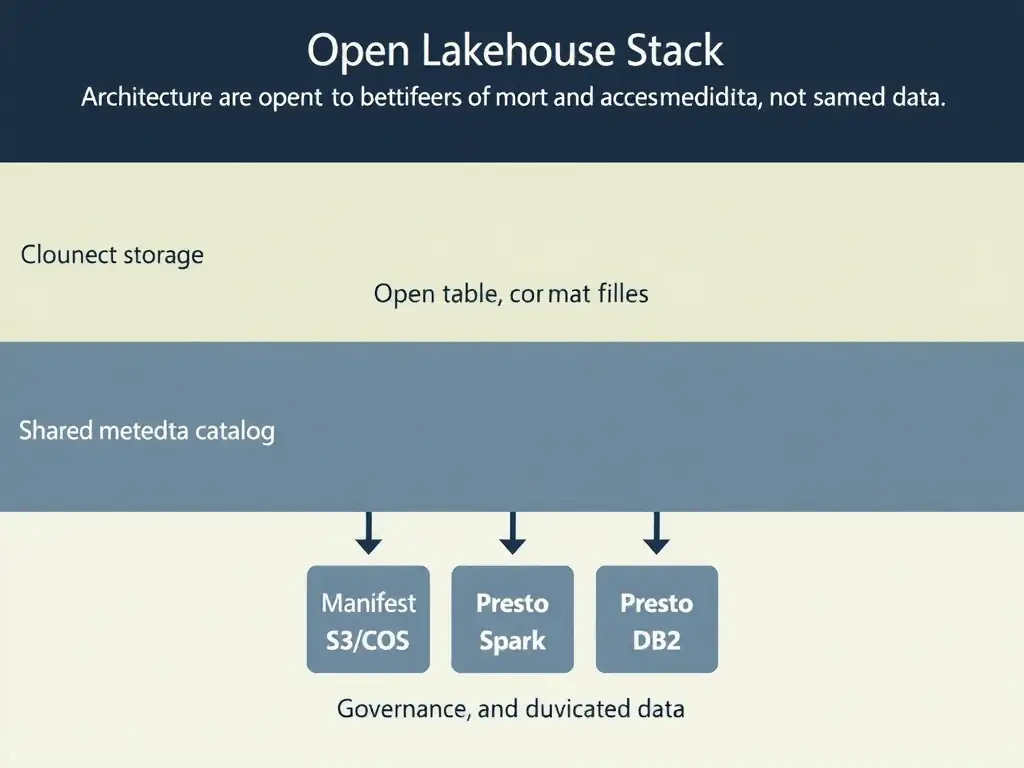
You stack a lakehouse from cheap object storage up through open table formats, catalog metadata, governance, and query engines. That order matters because each layer adds the capability the lower layer doesn't have.
Full Explanation
The correct layering places object storage at the base, open table formats defining tables over it, catalog metadata, governance, and query engines above. The lakehouse stacks capability over inexpensive scalable storage: open table formats add transactional table semantics, the catalog supplies discoverable metadata, governance enforces entitlement, and engines execute queries against the shared data.
The relational database at the base, with object storage used to archive older partitions, is incorrect because it inverts the model; a database owning the data with storage as an archive is the warehouse architecture the lakehouse replaces.
The query engines at the base, each maintaining the storage for the tables it owns, is incorrect because engine-owned storage is precisely what the design removes. Engines are stateless compute over shared data.
The data lake and separate warehouse running side by side, with a synchronisation job between them, is incorrect because that two-system arrangement is the one the lakehouse consolidates, and it carries exactly the copies and drift being avoided.
For the exam, memorise the layer order and be ready to identify which layer supplies a given capability.