
What most clearly distinguishes a controlled transformation pipeline from ad hoc transformation work?
Select an answer to reveal the explanation.
Short Explanation
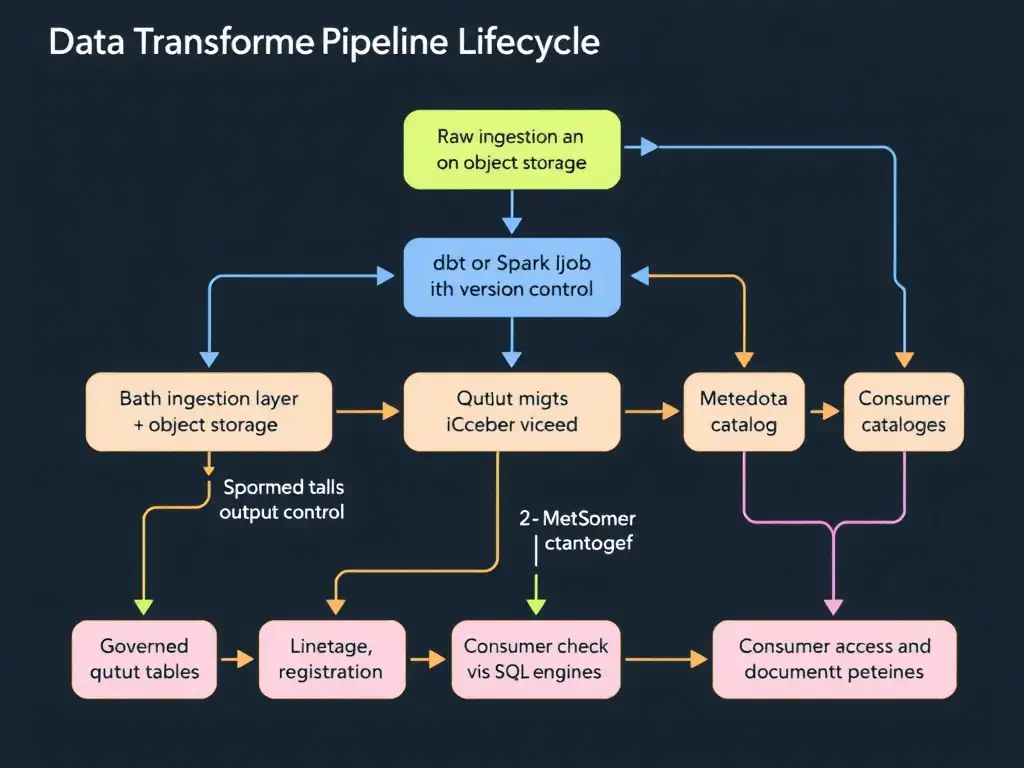
You distinguish controlled transformation work by its engineering properties, not by language, engine, or volume. If the logic is versioned, runs are scheduled and monitored, output is validated and documented, and lineage is traceable, then the pipeline is controlled.
Full Explanation
The correct answer is the option stating that the pipeline's logic is versioned, its execution is scheduled and monitored, its output is validated and documented, and its lineage is traceable to sources. Control is a set of engineering properties. Versioned logic makes changes reviewable and reversible. Scheduling and monitoring make execution predictable and failures visible. Output validation prevents bad data reaching consumers. Documentation and lineage let anyone understand what a table means and where it came from. The option about using SQL rather than a programming language is incorrect because language choice is orthogonal to control. An unversioned ad hoc SQL script is no more controlled than an ad hoc Python script. The option about running on a dedicated engine that no interactive query may use is incorrect because engine dedication is a workload isolation decision. Sharing an engine does not make a pipeline uncontrolled. The option about processing more data per run than ad hoc work does is incorrect because volume is unrelated to control. A small nightly reference-data refresh can be fully controlled. For the exam, answer this one with the engineering properties, not with tooling or role.