
Analysts report that a watsonx.data Presto engine returns results acceptably for small queries but times out on large joins that scan several months of Iceberg data. The engine has been running on its original small configuration since the pilot. Which change in Infrastructure Manager addresses the cause?
Select an answer to reveal the explanation.
Short Explanation
Small queries pass, big joins die. That's a compute ceiling, not a storage or metadata problem, and the engine is still sized for a pilot that ended months ago. Scale the workers.
Full Explanation
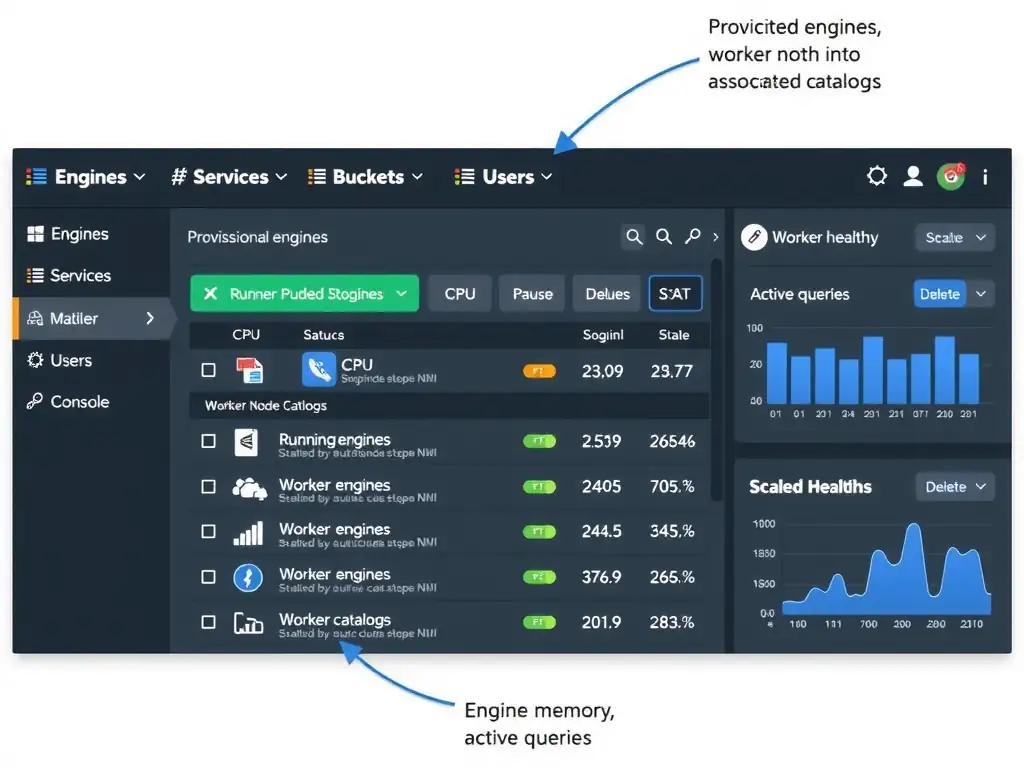
The correct choice is scaling the engine by increasing its worker node count or node size to match the workload. A Presto engine in watsonx.data is sized by node type and worker count, and Infrastructure Manager is where that sizing is changed. Large distributed joins consume worker memory and CPU in proportion to the data scanned; when a pilot-sized engine meets production-sized joins, the symptom is exactly what is described: small queries succeed and large ones time out. Adding workers or moving to a larger node size raises the ceiling that is actually being hit.
The pause-and-resume choice is incorrect because pause and resume is a cost-control mechanism, not a tuning one. It will clear the engine's state, but the next large join will consume the same resources and fail the same way.
The second-catalog choice is incorrect because catalogs supply metadata about where tables live; they do not add compute. Associating another catalog gives the engine more to see, not more capacity to process what it already sees.
The faster-storage-tier choice is incorrect because the bottleneck described is query execution, not object retrieval. A faster storage tier is worth considering for genuinely I/O-bound scans, but it does not give an undersized engine the memory a large join needs.
For the exam, map the symptom to the layer: sizing to the engine, tiering to storage, association to metadata.