
During a capacity review, a team asks whether adding a second query engine to watsonx.data will require duplicating the data those queries read. What is the correct answer?
Select an answer to reveal the explanation.
Short Explanation
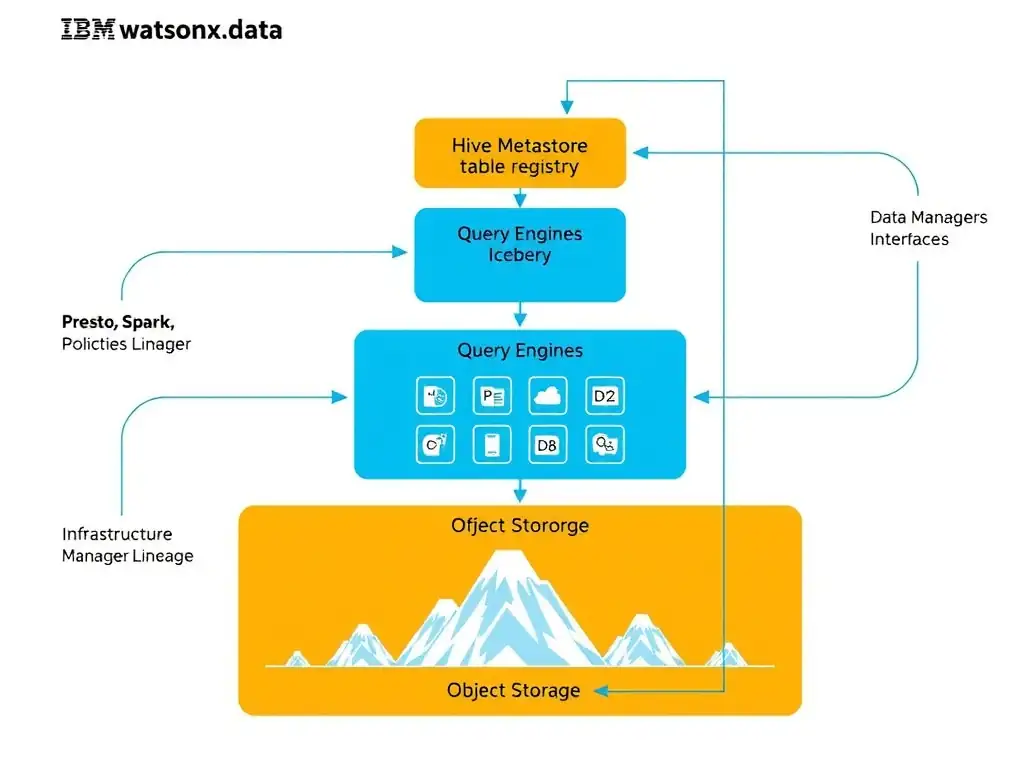
Add engines freely—the data doesn’t move. That’s the payoff of separating storage from compute: several engines, each suited to a different workload, all reading one governed copy through the same catalog. No duplication, no sync job, no drift between them.
Full Explanation
The correct answer is that no copy is created because engines share the same governed data through the catalog. The multi-engine model in watsonx.data exists so that different workloads can use different compute while sharing one governed copy of the data. Associating another engine with the same catalog gives it access to the same tables on the same object storage; nothing is copied. The answer claiming each engine maintains its own materialised copy for performance isolation is incorrect because it describes per-engine materialisation, which would reintroduce the copies and the drift that the architecture removes. Engines may cache for performance, but that is transient and is not an authoritative copy. The answer claiming sharing is possible only when both engines are of the same type is incorrect because sharing does not depend on engines being the same type. Open table formats on object storage are exactly what allows engines of different types to read the same tables. The answer claiming no duplication only if the other engine is external rather than provisioned by the platform is incorrect because both native and external engines participate in the same model. Whether the platform provisioned the engine has no bearing on whether the data must be duplicated. For the exam, connect the multi-engine design to shared governed data - the absence of copies is the benefit being tested.