
Two teams report different totals for the same monthly revenue figure. Investigation shows one team queries the governed lakehouse table through a Presto engine and the other maintains its own copy loaded into a departmental database. What is the sustainable fix?
Select an answer to reveal the explanation.
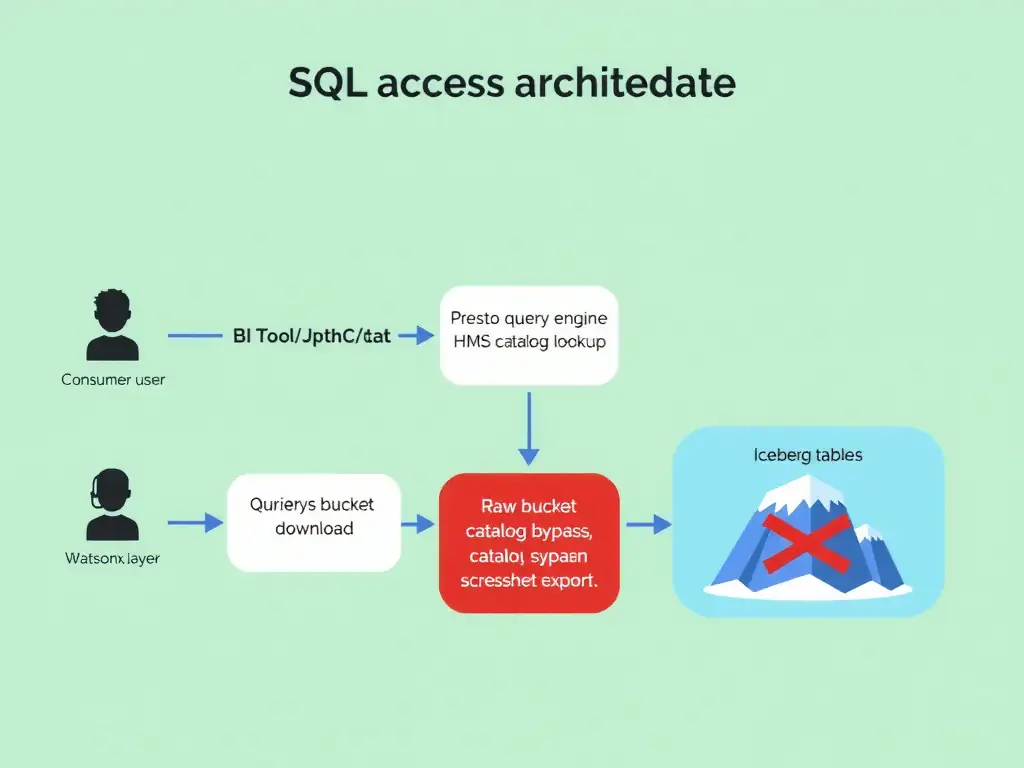
Short Explanation
Two numbers for one metric means you’ve got two sources of truth. Reconciliation just tells you the gap exists more promptly. The sustainable fix is to retire the departmental copy and have both teams consume the same governed table through a supported engine, so the discrepancy has nowhere to come from.
Full Explanation
The sustainable fix is retiring the departmental copy and having both teams consume the same governed table through a supported engine. The lakehouse pattern keeps one governed copy of the data on object storage and lets multiple engines query it in place. The discrepancy here exists only because a second copy exists; removing the copy and consuming the governed table through a supported engine removes the class of problem, not just this instance of it.
The reconciliation-job approach is wrong because reconciliation detects divergence rather than preventing it. It institutionalises the two-source design and adds a standing job whose output is a variance report nobody can act on without doing the consolidation anyway.
The declare-departmental-database-authoritative approach is wrong because proximity to a team does not confer authority. It also leaves the governed table unused for this metric while an ungoverned database becomes a system of record, inverting the platform's design.
The publish-definitions-for-consumers-to-choose approach is wrong because offering consumers a choice of conflicting totals is the failure, not the remedy. Definitions can legitimately differ, but that is resolved by agreeing one governed definition, not by publishing both.
For the exam, tie shared governed tables to consistent consumption across teams and tools.