
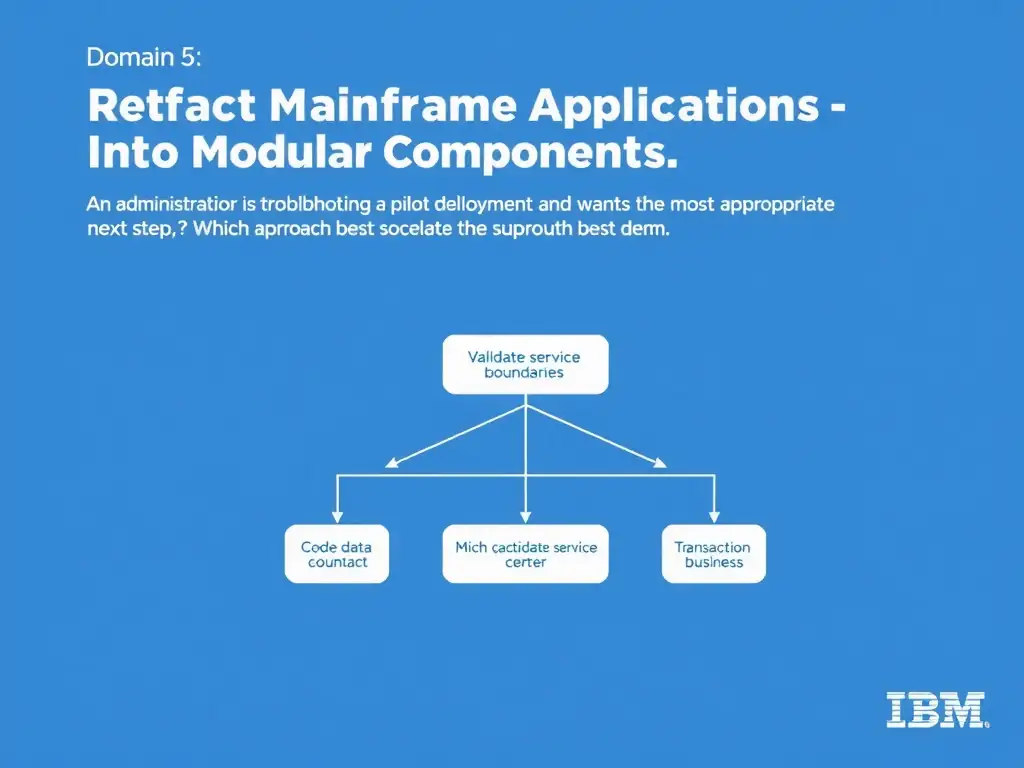
An administrator troubleshooting a pilot deployment finds that services were split purely by following the legacy screen flow. Why does this approach fail?
Select an answer to reveal the explanation.
Short Explanation
Screen flow tells you how users moved through old screens, not where the data ownership and atomic transactions live. If you split services by that sequence, you'll usually carve boundaries in the wrong places.
Full Explanation
Screen sequence reflects historical presentation choices, not the code's actual data ownership or the transactions it must keep atomic, so the resulting services rarely align with either. Presentation order is an artefact of how a terminal application was navigated, and it carries no information about which records a piece of logic owns or which operations must commit together.
The statement that screens cannot be mapped to services at all is incorrect because screens can inform boundary discussions; the problem is treating them as sufficient on their own.
The statement that screen-based splits always produce more services than the business needs is incorrect because the count of resulting services depends on the split, not on the fact that screens were the starting point.
The statement that legacy screens do not exist in a format that transformation tooling can read is incorrect because tooling can read screen definitions; the objection is to what they validate, not whether they can be read.
Exam caveat: use screen flow as context, never as the boundary criterion itself.