
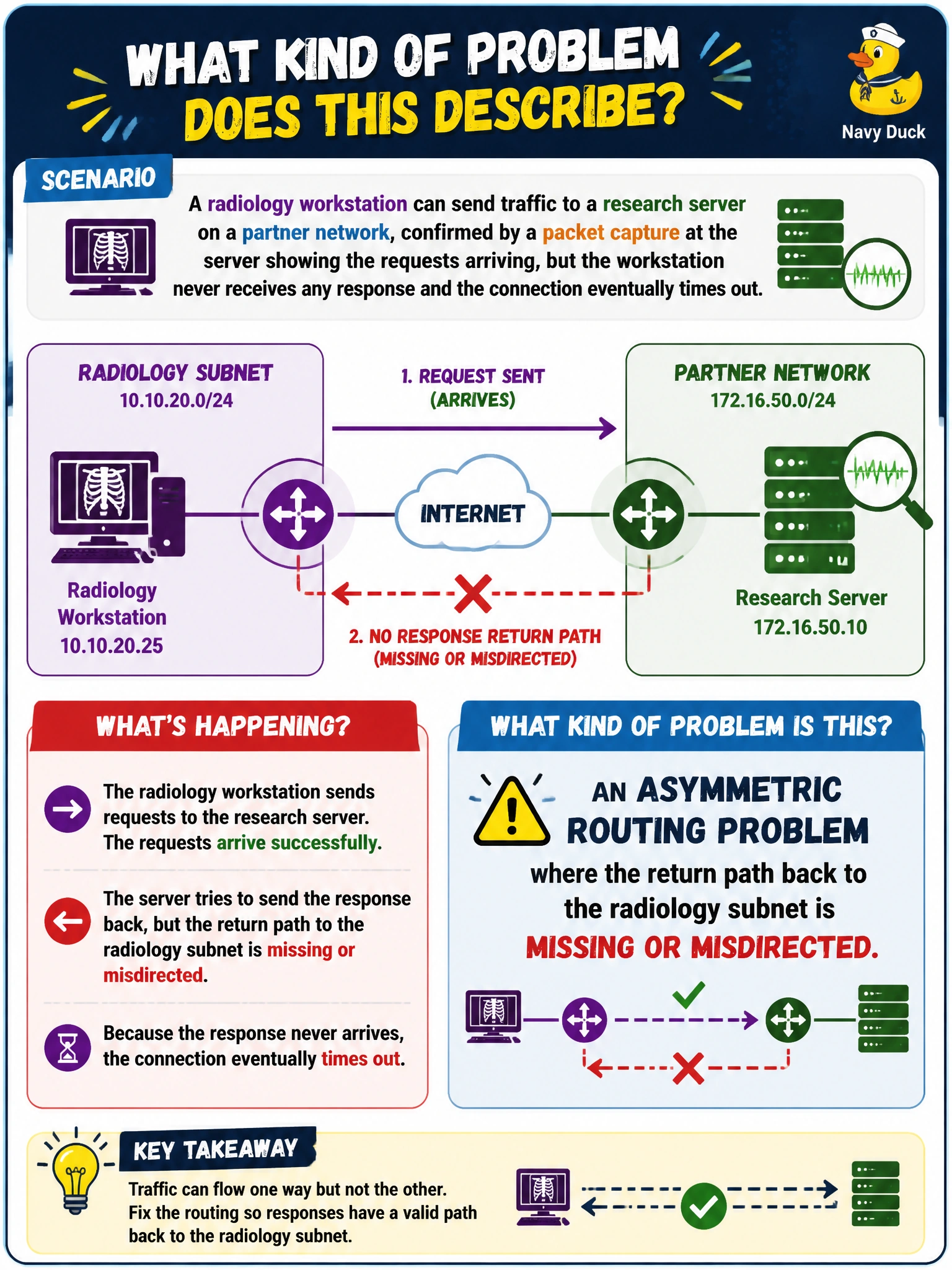
A radiology workstation can send traffic to a research server on a partner network, confirmed by a packet capture at the server showing the requests arriving, but the workstation never receives any response and the connection eventually times out. What kind of problem does this describe?
Select an answer to reveal the explanation.
Short Explanation
Getting there is only half the trip. If the server's replies take a different road home than the requests took getting there, and that road hits a dead end, the workstation just sits there waiting forever for an answer that's already been sent and lost. That's a one-way street, not a dead network.
Full Explanation
The packet capture confirming arrival at the server rules out anything blocking the outbound path — DNS, the local gateway, and forward-direction routing are all clearly working. The failure is specifically on the return leg: something between the partner network and the radiology subnet either lacks a route back, sends the reply out a different interface than expected, or is filtered asymmetrically, so the response never makes it home even though the request got through fine. This is distinct from a duplicate IP address, which typically produces intermittent, erratic connectivity for both directions rather than a clean one-way failure, and different from an expired DHCP lease, which would prevent the workstation from having a usable address at all rather than letting it successfully send traffic. A Layer 2 loop would generally manifest as broad instability or flooding across the whole VLAN, not a clean, isolated failure between two specific endpoints. The operational check is to trace the return path from the server back toward the radiology subnet and compare it against the outbound path the request took, looking specifically for a missing route, an asymmetric firewall rule that only inspects one direction, or a device dropping reply traffic it considers unsolicited. A caveat is that stateful firewalls along an asymmetric path are a very common root cause, since they may see only the reply half of a session and drop it as unexpected traffic.