
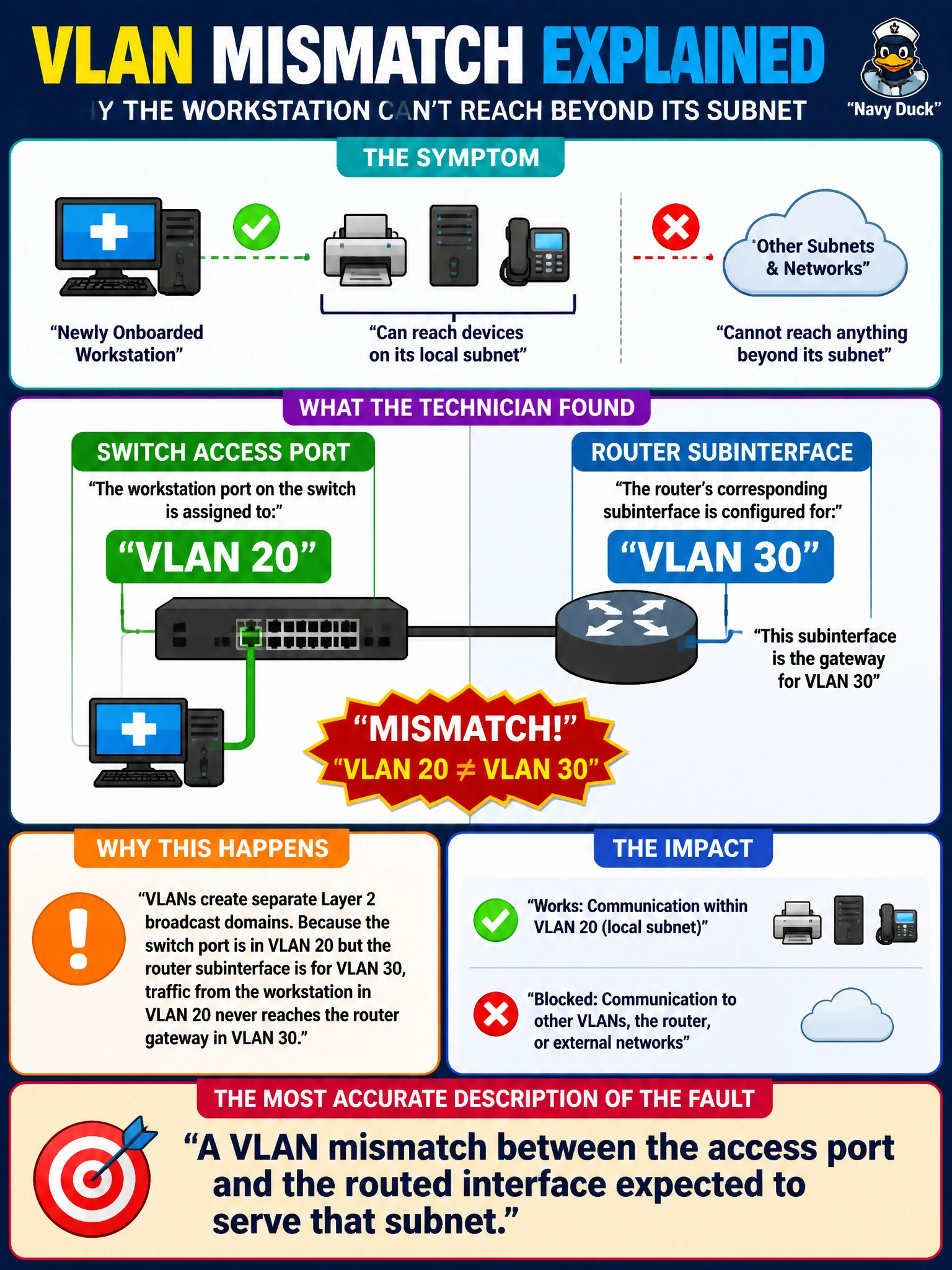
A newly onboarded workstation in a hospital billing office can reach devices on its local subnet but cannot reach anything beyond it, and the technician confirms the switch port is assigned to VLAN 20 while the router's corresponding subinterface is configured for VLAN 30. What is the most accurate description of this fault?
Select an answer to reveal the explanation.
Short Explanation
Local traffic works, but nothing beyond the subnet does, and that pattern lines up exactly with a VLAN pointing the wrong direction. The workstation's port and the router interface that's supposed to route for it simply aren't on the same VLAN, so routed traffic has nowhere consistent to go. Line those VLAN numbers up and the workstation should suddenly see the rest of the network.
Full Explanation
A VLAN mismatch between an access port and its intended routed gateway means devices on that port can still communicate with other devices in the same broadcast domain, since that traffic never needs to leave the VLAN, but anything requiring routing beyond the subnet fails because the router is not listening for that traffic on the VLAN the workstation actually belongs to. This exactly matches the described symptom: full local reachability, no reachability beyond the local subnet. A native VLAN mismatch specifically concerns untagged traffic crossing a trunk link between two switches, and it typically manifests as connectivity problems for whichever VLAN is untagged on that trunk, not a single access port assigned to the wrong VLAN entirely. A duplex mismatch produces performance degradation and collision-related symptoms rather than a clean local-works, remote-fails pattern; a badly mismatched duplex link often struggles even with local traffic. A failed PoE negotiation would prevent the device from powering on at all if it depends on PoE, which contradicts the fact that the workstation is clearly powered and communicating locally. A concrete check is comparing the VLAN configured on the access port against the VLAN configured on the router's routing interface for that subnet and correcting the one that does not match the intended design.