
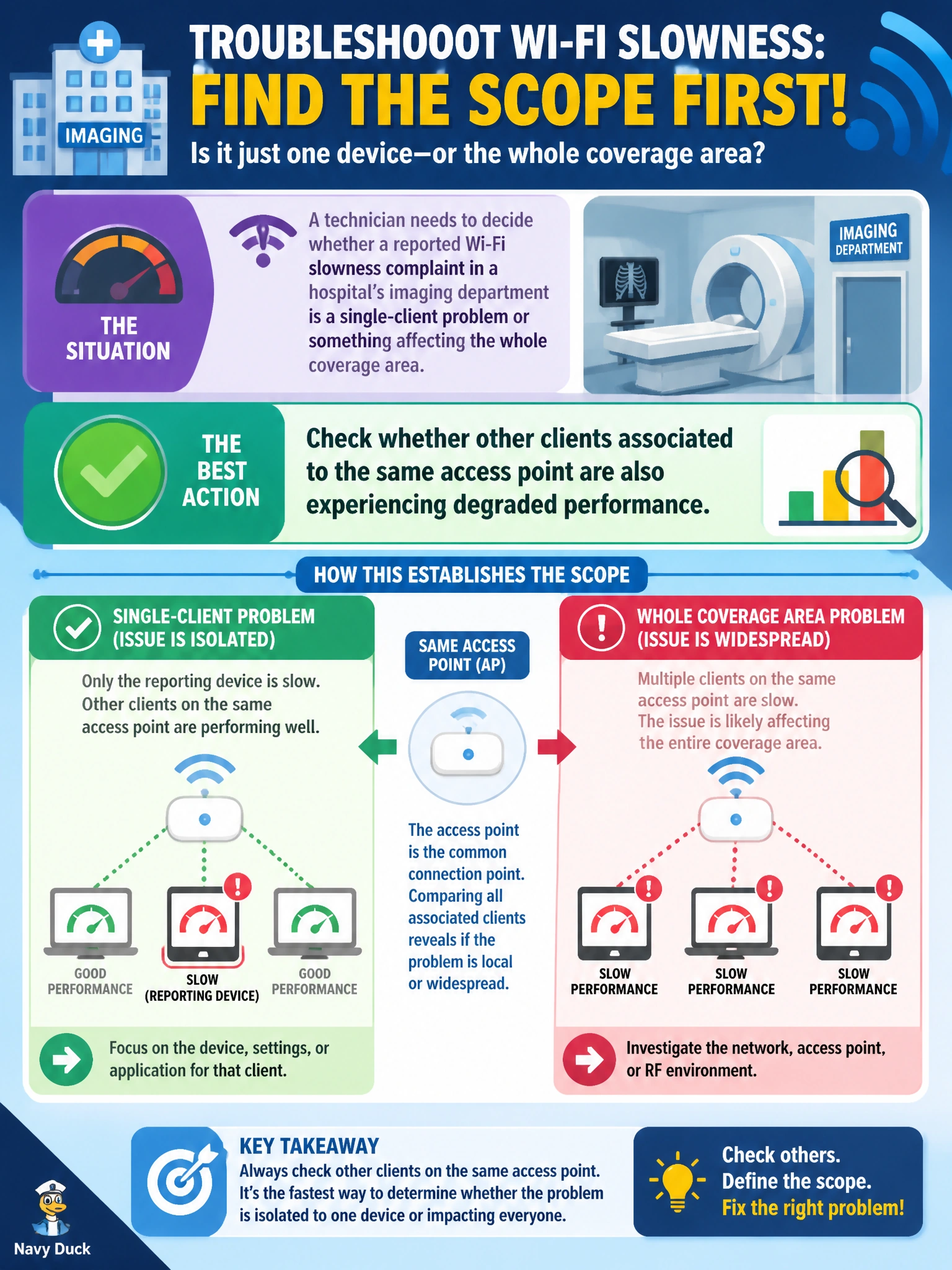
A technician needs to decide whether a reported Wi-Fi slowness complaint in a hospital's imaging department is a single-client problem or something affecting the whole coverage area. Which action best establishes that scope?
Select an answer to reveal the explanation.
Short Explanation
One phone call doesn't tell you the real blast radius, so go find out. If other people near that same AP are also crawling, this is bigger than one laptop; if they're fine, it probably is that one device or its link. Scoping is about checking, not guessing from who happened to complain.
Full Explanation
The number of complaints received is not a reliable measure of scope, because affected users often do not all report the problem, especially in a busy clinical area where staff may simply work around a slow connection instead of calling. The correct way to establish scope is to actively check other clients sharing the same access point or coverage cell to see whether they show similar symptoms, which distinguishes a client-specific issue from a shared radio, channel, or backhaul problem. Assuming single-client scope purely from call volume risks missing a broader RF or backhaul issue that is simply under-reported. Replacing the user's laptop before scoping wastes a swap and a support cycle if the real cause turns out to be shared, and it also removes the original device before its state can be examined. Restarting the wireless controller is a disruptive, campus-wide action that is disproportionate before scope has even been determined, and it could interrupt working clients on many other access points. A concrete step here is checking the AP's client list and recent performance metrics for other associated devices before deciding whether the fault is isolated or shared.