
Which sequence correctly reflects the recommended order for updating firmware on a campus access switch, from start to finish?
Select an answer to reveal the explanation.
Short Explanation
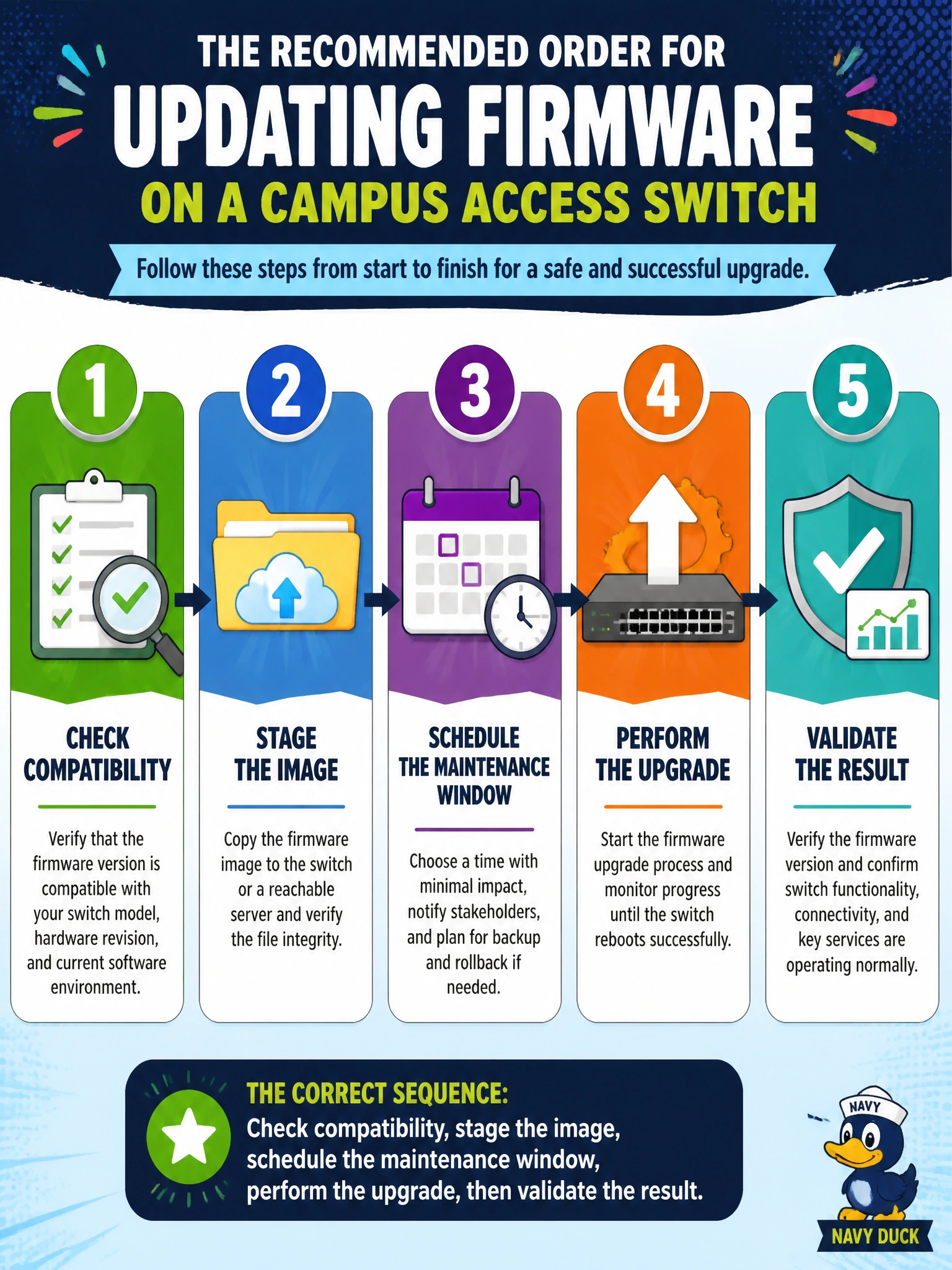
Firmware upgrades go smoothly when the steps happen in the order that actually makes sense: know it's safe, get it ready, pick a good time, do it, then confirm it worked. Reverse any of those and you're either validating something before you've done it, or scheduling a window for work you haven't confirmed is even compatible. The order isn't arbitrary — each step depends on the one before it.
Full Explanation
Checking compatibility first establishes whether the planned firmware is even appropriate for the hardware and current software before any other effort is spent; staging the image next moves the slow download step out of the eventual maintenance window; scheduling the maintenance window then sets an agreed time that limits impact and lines up stakeholder notification; performing the upgrade executes the actual cutover during that agreed window; and validating afterward confirms the result matches expectations before the change is considered complete. Each step in that sequence depends on the one before it having already happened correctly. Activating an image before checking compatibility risks installing something unsupported on the hardware, and doing so before scheduling a window means the cutover isn't happening at an agreed, low-impact time. Validating a result before the upgrade has even been performed is logically impossible — there's nothing yet to validate. Scheduling a maintenance window while skipping every other step ignores compatibility checking, staging, the actual upgrade, and validation entirely, none of which a scheduled window by itself accomplishes. A caveat: on a redundant pair, "perform the upgrade" itself decomposes into the one-member-at-a-time sequence covered separately, but the higher-level ordering here still applies to each member's individual upgrade. As an operational check, confirm each step's success criteria — the compatibility check passing, the image staged, the window confirmed with stakeholders — before moving to the next step.