
Before pushing a new firmware version to every access point across the hospital campus through Aruba Central, what staged approach reduces the risk of a widespread problem?
Select an answer to reveal the explanation.
Short Explanation
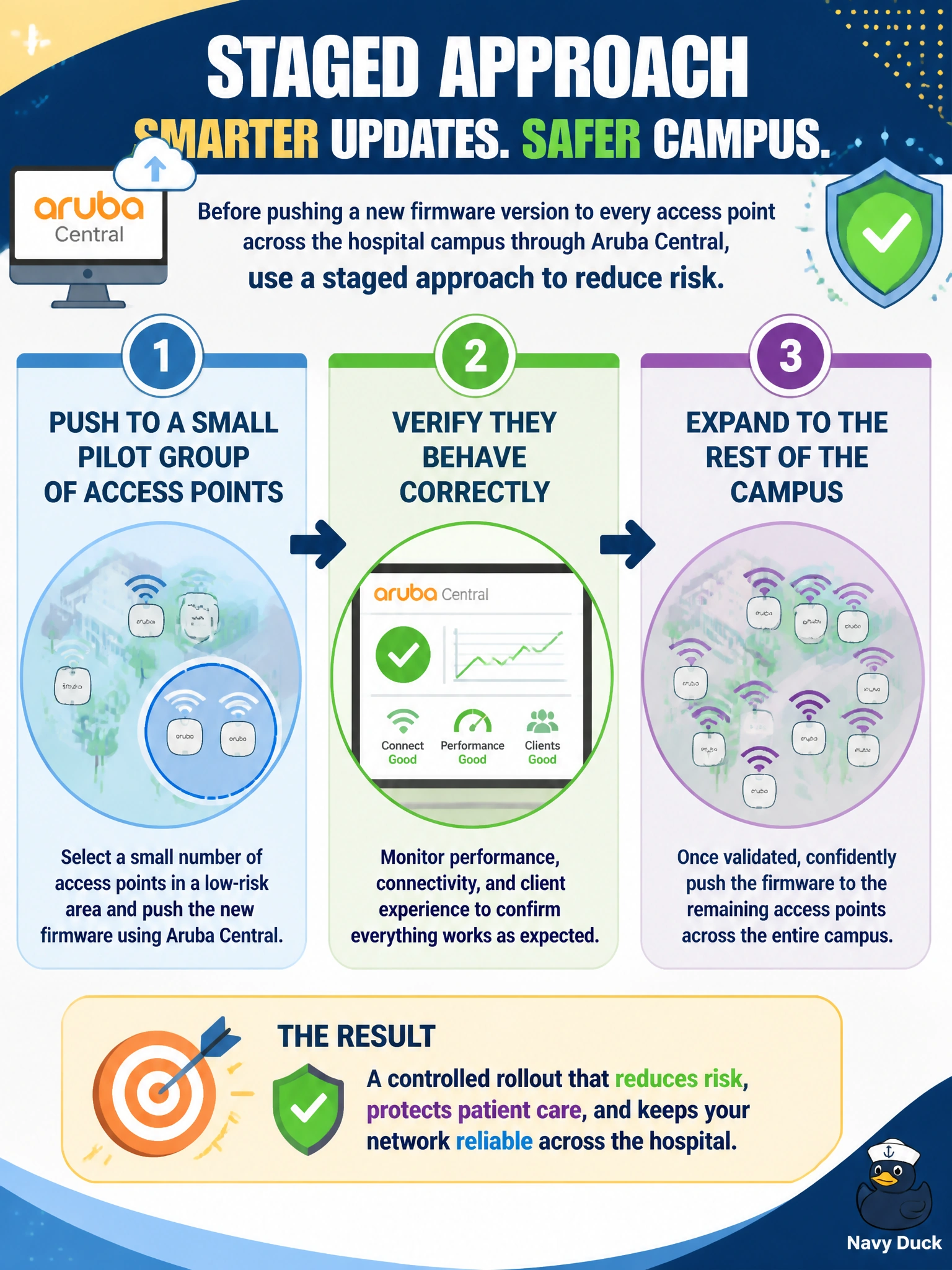
Rolling out firmware to hundreds of APs at once is like serving a new recipe to a whole cafeteria before tasting it yourself. Pushing it to a small pilot group first lets you catch a problem while it only affects a handful of access points instead of the entire hospital. Once the pilot group checks out, expanding to everyone else is a much safer bet.
Full Explanation
A staged rollout limits the blast radius of an undiscovered problem: pushing new firmware to a small pilot group first means any issue — a client-connectivity regression, an unexpected reboot loop — surfaces on a handful of access points rather than across the entire campus simultaneously, giving the technician a chance to catch and address it before wider exposure. Verifying pilot behavior before expanding also builds real-world confidence beyond whatever pre-release testing the vendor performed. Pushing to every access point at once with no prior testing means a single undiscovered defect in the firmware becomes a campus-wide outage instead of a contained one, which is the opposite of good change hygiene for equipment as widely distributed as Wi-Fi access points. Assuming Central's management of the rollout removes the need for verification confuses orchestration with validation — Central can distribute and schedule the update, but confirming the result actually behaves correctly is still the technician's responsibility. Updating only non-patient areas and never updating the rest leaves the majority of the campus permanently on outdated firmware, which isn't a staged rollout strategy at all — it's an incomplete one that accumulates unpatched risk over time. A caveat: a pilot group should be chosen to represent a realistic mix of AP models and traffic patterns, not just whichever APs are most convenient to reach. As an operational check, monitor client connectivity and AP status in the pilot group for a defined period before expanding the rollout further.