
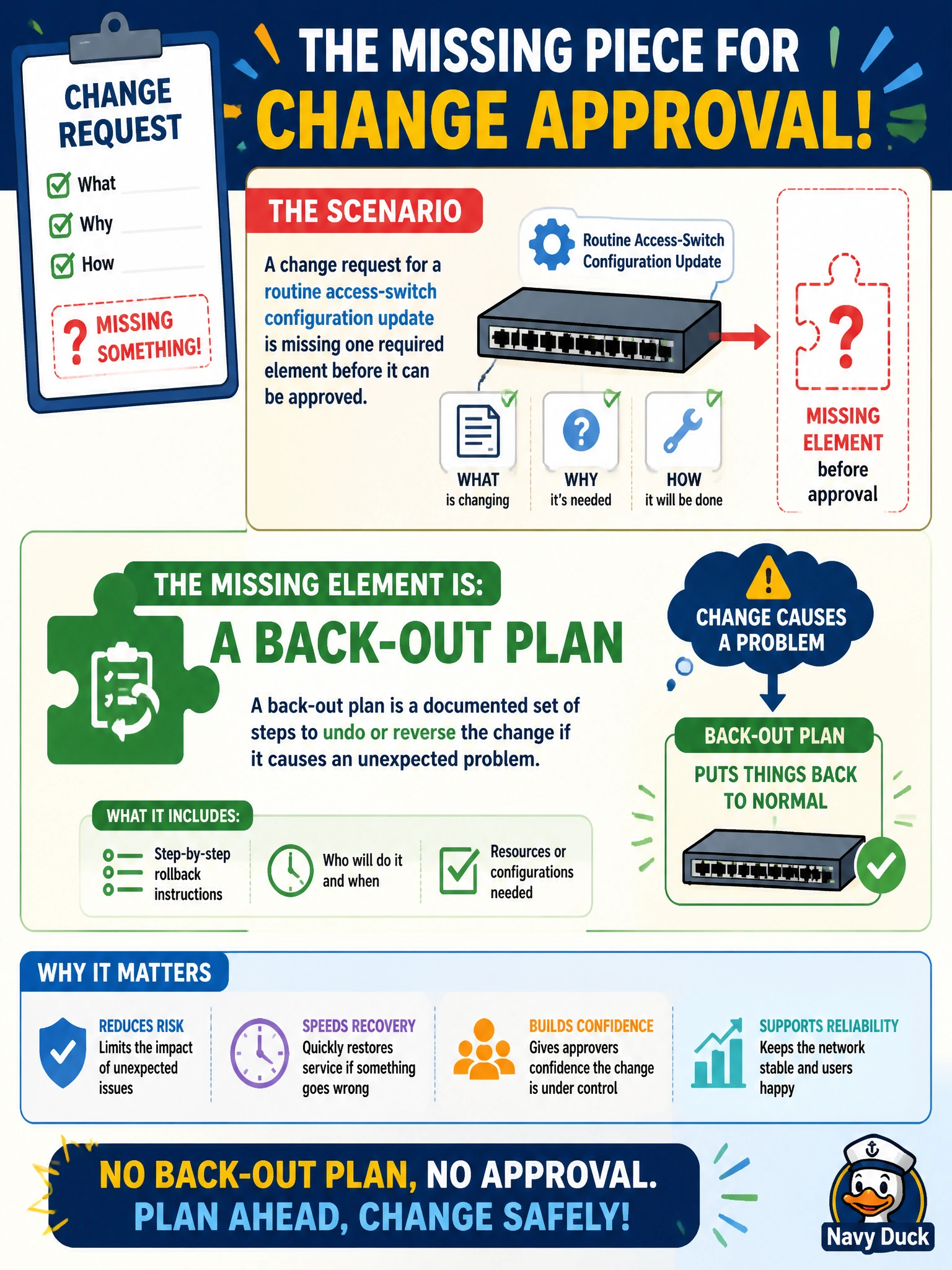
A change request for a routine access-switch configuration update is missing one required element before it can be approved: a plan for what to do if the change causes a problem. What is this missing element called?
Select an answer to reveal the explanation.
Short Explanation
Every planned change needs an exit door, not just an entrance. A back-out plan spells out exactly how to undo the change if something goes wrong, so the response to a problem is a rehearsed step instead of improvisation under pressure. Without one, a change request is only telling reviewers what will happen if things go right.
Full Explanation
A back-out plan documents the specific steps to reverse a change and return the system to its prior state if the change doesn't behave as expected — for example, restoring a saved configuration backup or reactivating a previous firmware partition — and change-control processes require it precisely because "the change worked" can't be assumed in advance. Having that plan reviewed and approved alongside the change itself means recovery is already thought through before anything is touched, rather than being worked out in real time during an active problem. A firmware compatibility matrix is a pre-change readiness check confirming an image is supported on given hardware; it doesn't describe how to undo a change once it's been made, so it doesn't fill the missing element described. A network diagram documents topology for reference and troubleshooting; it's valuable documentation but it's not a plan for reversing a specific change. A guest Wi-Fi passphrase policy governs an entirely separate area of network administration and has no relationship to recovering from a failed configuration change on an access switch. A caveat: a back-out plan is only as good as its accuracy — it should be written specifically for this change, not copied generically from an unrelated one. As an operational check, confirm the back-out plan's steps are realistic to execute within the same maintenance window as the original change.