
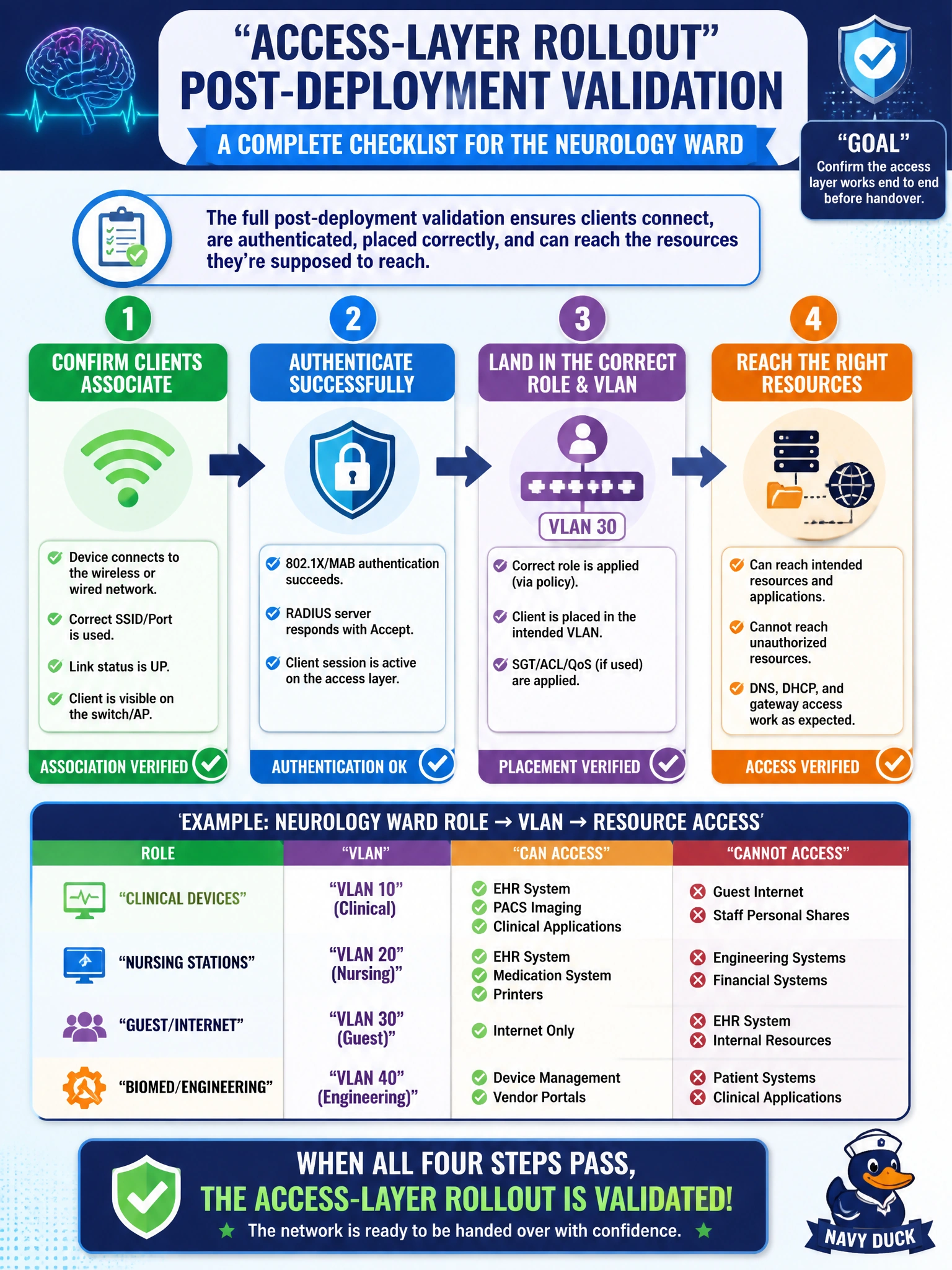
Before signing off on a newly built neurology ward and handing it over to clinical staff, the deployment technician wants a complete checklist confirming the access-layer rollout actually works end to end. Which sequence best captures a full post-deployment validation?
Select an answer to reveal the explanation.
Short Explanation
Signing off on a ward isn't just counting boxes — it's proving the whole chain works: a device connects, proves who it is, ends up in the right place, and can actually get where it needs to go. Skip any link, and the handover isn't really done.
Full Explanation
A complete post-deployment validation traces the full client experience end to end: association to the network, successful authentication through whichever method applies to that device, correct role and VLAN placement based on that authentication outcome, and finally confirmed reachability to the specific resources that device or user needs, whether that's an electronic health records server or a biomedical monitoring platform. Each of these is a distinct point of failure, and a rollout that looks fine at one stage can still fail at the next, so a genuine handover checks all of them rather than stopping at the first success. Confirming warranty registration is administrative housekeeping that has value for asset management but proves nothing about whether the network actually functions for clinical staff. Access point color has no technical relevance to network operation at all and is not a real deployment consideration. Matching the AP count to the purchase order confirms procurement accuracy, not that any of the delivered equipment is correctly configured or working; a technician could install the right count of APs and still have every one of them misconfigured. A thorough sign-off should include testing at least one representative device of each type on the ward, not just one sample laptop, since staff, guest, and biomedical devices each traverse a different part of this chain.