
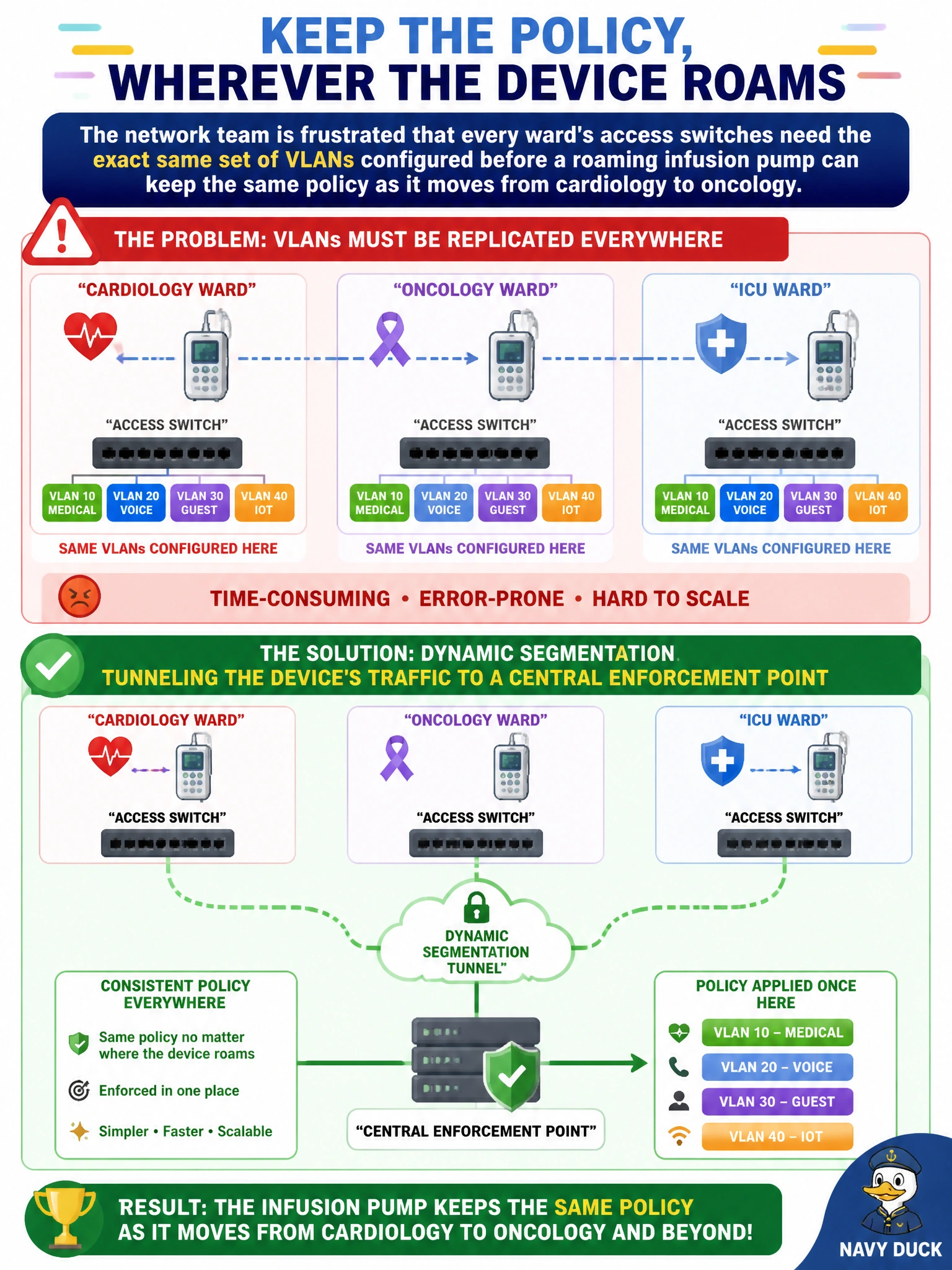
The network team is frustrated that every ward's access switches need the exact same set of VLANs configured before a roaming infusion pump can keep the same policy as it moves from cardiology to oncology. Which approach removes the need to replicate that VLAN everywhere the device might roam?
Select an answer to reveal the explanation.
Short Explanation
Instead of copying the same VLAN to every closet the pump might roam through, dynamic segmentation just tunnels its traffic home to one place that already knows the rules — no replication needed.
Full Explanation
Dynamic segmentation using a user-based tunnel solves precisely this replication problem: rather than requiring an identical VLAN to be provisioned on every access switch a roaming device might touch, the device's traffic is tunneled from wherever it associates back to a central point where policy is enforced consistently, so the local switch only needs to authenticate the device and hand its traffic off, not carry its full VLAN. This means adding a new ward no longer requires auditing every closet switch to confirm the pump's VLAN was replicated correctly. Simply adding more VLANs to every access switch is the opposite of a fix; it increases the exact configuration burden and drift risk the team is frustrated by. Disabling spanning tree on uplinks removes a Layer 2 loop-prevention safeguard and has no relationship to how or where policy is enforced for a roaming client, and doing so would introduce a real risk of a bridging loop. A larger DHCP scope only provides more available addresses on a given VLAN and does nothing to solve the need for that VLAN to exist everywhere the device roams. A practical way to confirm dynamic segmentation is doing its job is moving the tunneled pump between two wards that do not share the legacy VLAN locally and confirming its role and reachability stay identical throughout.