
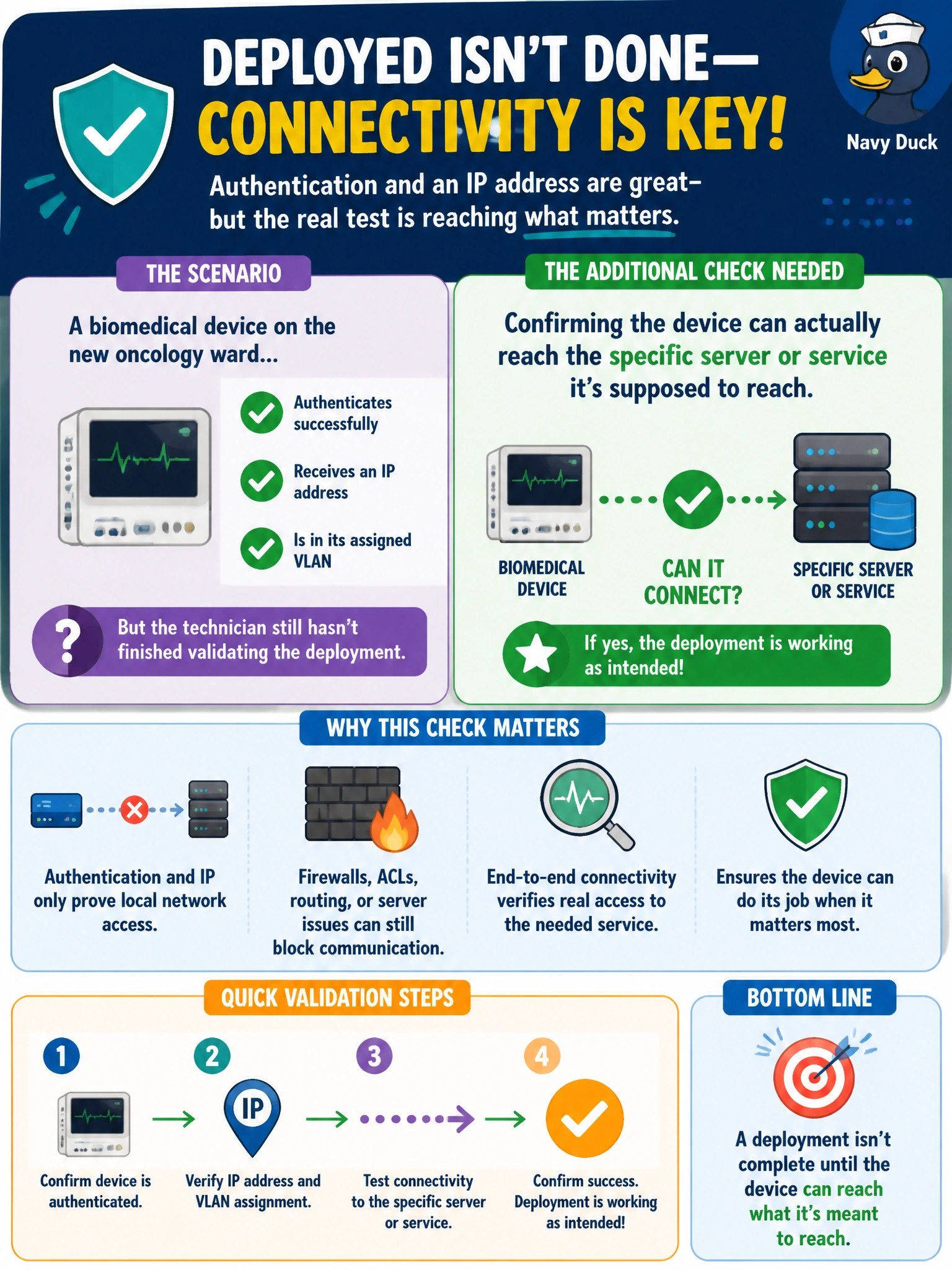
A biomedical device on the new oncology ward authenticates successfully and receives an IP address in its assigned VLAN, but the technician still hasn't finished validating the deployment. What additional check is needed to confirm the deployment is actually working as intended?
Select an answer to reveal the explanation.
Short Explanation
Getting an address and a seat isn't the same as being able to actually do anything from it. The last step is proving the device can reach what it's supposed to reach, not just that it associated and got an IP.
Full Explanation
Full deployment validation is a chain: association, authentication, correct role and VLAN, and finally end-to-end reachability to the specific destination the device needs, such as a biomedical monitoring server or a nurse-call gateway. A device can pass every earlier step and still fail here if an ACL is too restrictive, a route is missing, or the destination service itself is down, so reachability has to be tested explicitly rather than assumed once authentication and VLAN placement look correct. Re-checking the AP's channel plan addresses RF interference and coverage, which is a planning and optimization concern, not a confirmation that this specific already-connected device can reach its destination. Confirming full duplex on the switch port is a physical-layer sanity check useful during troubleshooting a slow or error-prone link, but it says nothing about whether the correct destination is reachable through firewall and routing policy. Reviewing the change-control ticket confirms the work was documented, which matters for operations and audit purposes, but documentation review does not itself prove the network behaves correctly. A concrete way to close this validation loop is attempting a reachability test, such as a ping or an application-level connection, from the device to its intended server and confirming it succeeds.