
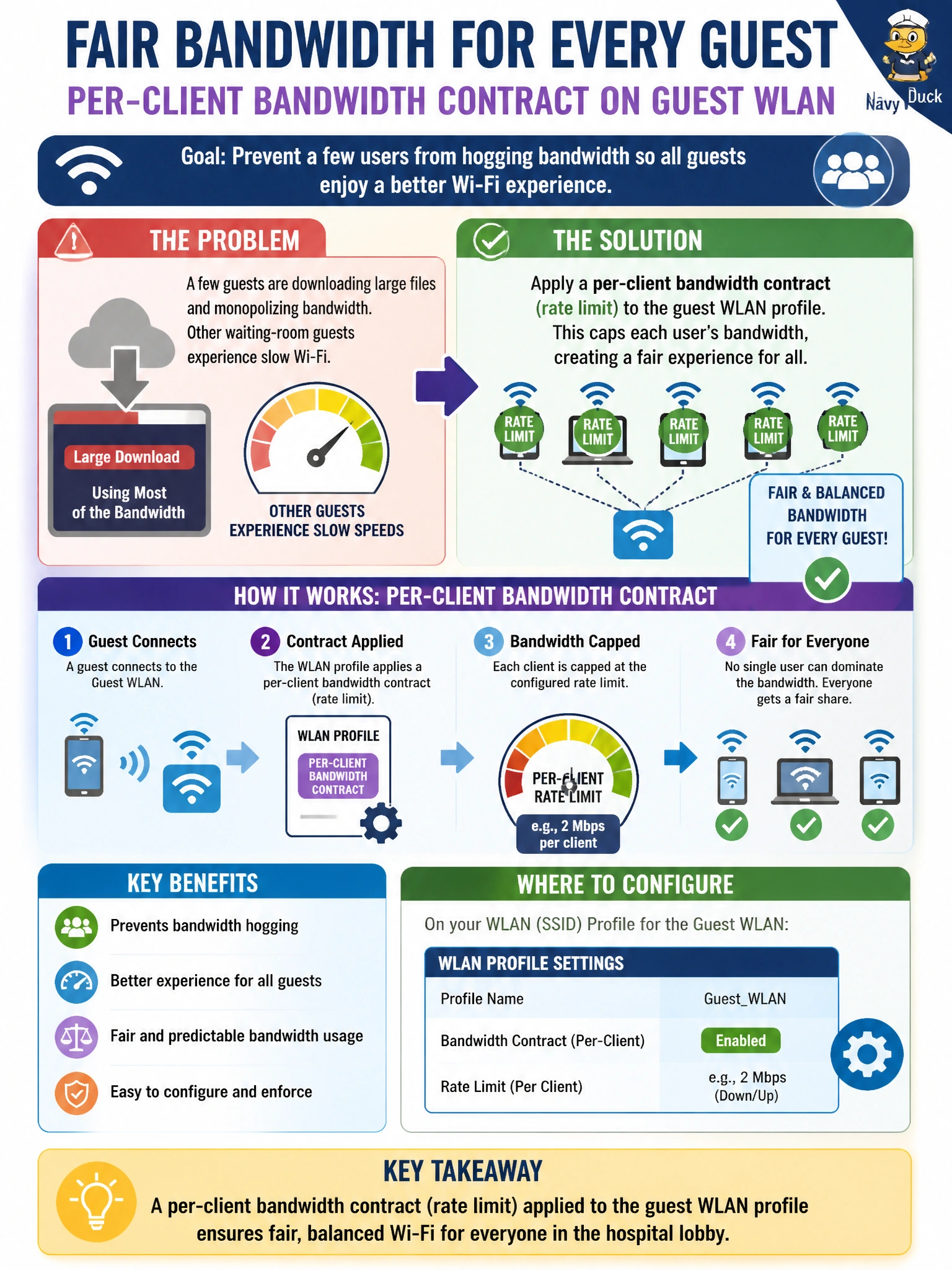
The guest WLAN in the hospital's main lobby is seeing a handful of visitors monopolizing available bandwidth with large downloads, slowing the network for other waiting-room guests. The design wants a fair, per-client cap on guest bandwidth usage. Which WLAN-level setting addresses this?
Select an answer to reveal the explanation.
Short Explanation
The problem isn't the channel or the signal — it's that a few devices are hogging more than their fair share. A bandwidth contract puts a per-client cap in place, so no single visitor's download can crowd out everyone else in the waiting room.
Full Explanation
A per-client bandwidth contract (rate limit) configured on the guest WLAN profile caps how much throughput any single associated client can consume, which directly solves the fairness problem of a few visitors' large downloads starving bandwidth for everyone else on the same SSID. Reducing channel width would degrade throughput for every client on that radio equally, punishing well-behaved guests along with the ones monopolizing bandwidth, rather than targeting the actual cause. Lowering broadcast power limits how many guests can associate or how far the signal reaches, but it does nothing to control how much bandwidth an already-connected client can consume — a smaller footprint doesn't create fairness among the clients that are still connected. Switching channels might reduce interference from neighboring networks, but it doesn't cap any individual client's consumption; the same handful of visitors could still consume just as disproportionate a share of the (now faster) channel. A caveat: bandwidth contracts are typically set per client, not per WLAN in aggregate, so the cap needs to be sized realistically against the lobby's actual internet circuit capacity and expected guest count. Operational check: with the contract applied, confirm a single test client's throughput is capped at the configured rate even when no other clients are competing for airtime.