
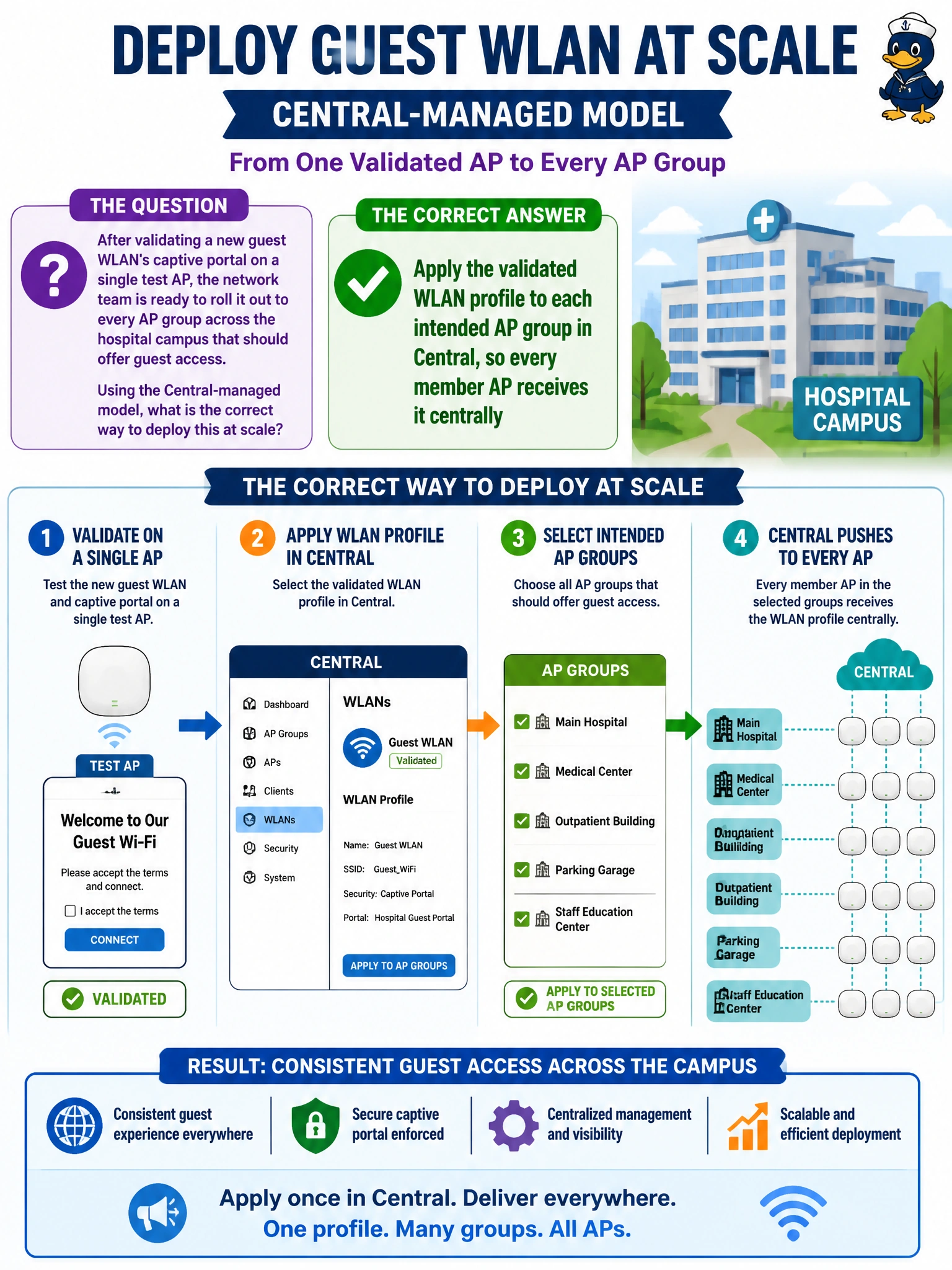
After validating a new guest WLAN's captive portal on a single test AP, the network team is ready to roll it out to every AP group across the hospital campus that should offer guest access. Using the Central-managed model, what is the correct way to deploy this at scale?
Select an answer to reveal the explanation.
Short Explanation
Once something's proven on one AP, the Central-managed model means you don't repeat the work — you just point the same, already-validated profile at every other AP group that needs it. One validated setting, applied everywhere it belongs.
Full Explanation
Once a WLAN profile has been validated, applying that same profile to each intended AP group in Central lets every AP belonging to those groups receive the configuration centrally and consistently — this is the deploy step of the provision-deploy-validate workflow, and it's exactly how a validated configuration scales out across a campus in the Central-managed model. Manually exporting and importing a configuration file per AP reintroduces the device-by-device labor the centralized model is designed to eliminate, and it risks human error or drift between APs that a group-based push avoids. Physically relocating every AP to copy a configuration by proximity isn't how wireless configuration is inherited at all — group membership and profile assignment determine configuration, not physical location relative to another device. Re-creating the WLAN by hand on each AP's local interface throws away the validated profile entirely and reintroduces exactly the configuration drift risk the question is trying to avoid, since no two manual entries are guaranteed to match. A caveat: rolling a validated WLAN out to additional groups should still be checked against each group's own AP models and radio capabilities, since not every AP group is guaranteed to be identical hardware. Operational check: after applying the profile to each group, confirm the guest SSID and captive portal behavior on a sample AP from every newly targeted group, not just the original test AP.