
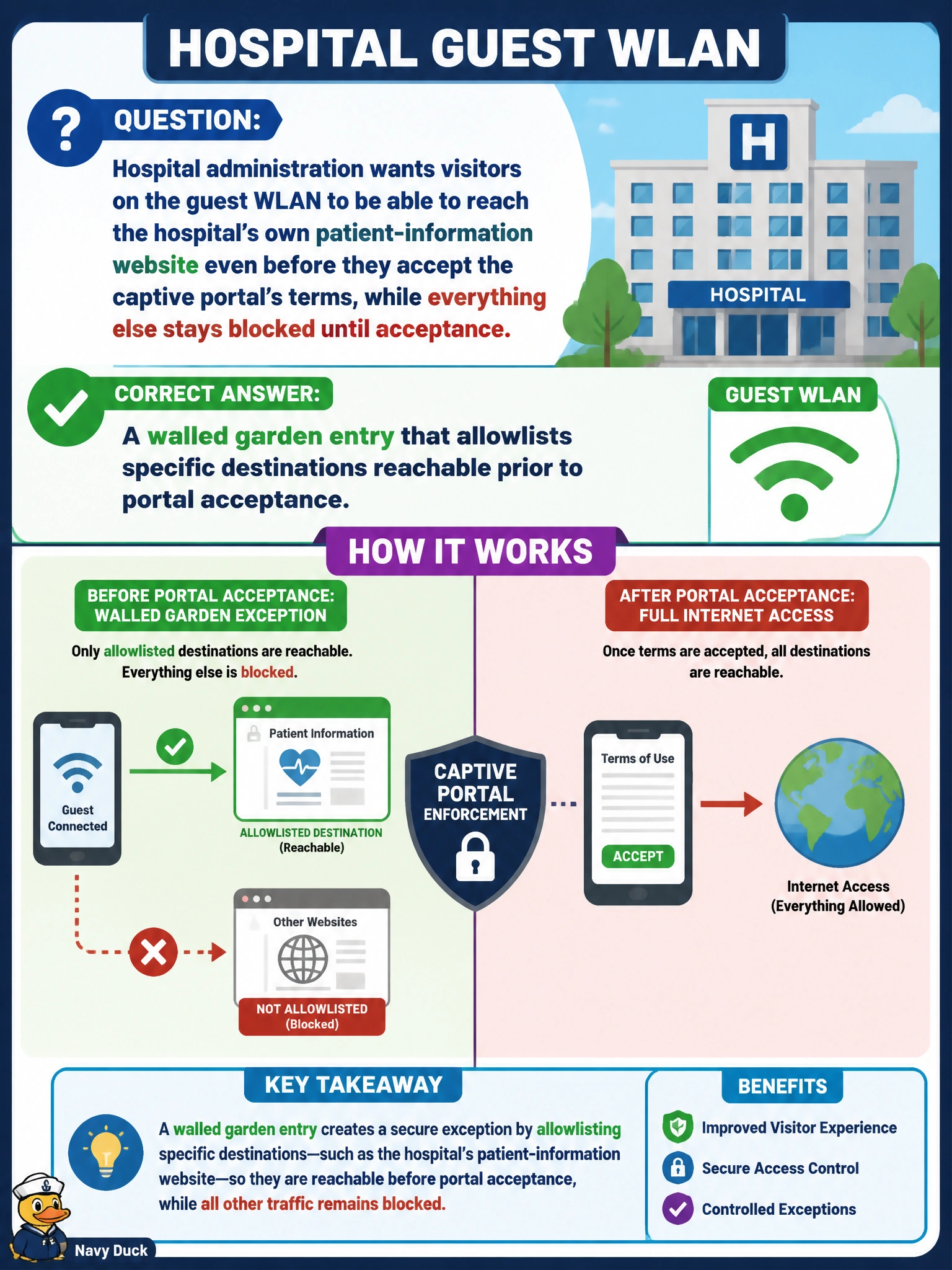
Hospital administration wants visitors on the guest WLAN to be able to reach the hospital's own patient-information website even before they accept the captive portal's terms, while everything else stays blocked until acceptance. Which captive portal concept enables this exception?
Select an answer to reveal the explanation.
Short Explanation
A captive portal doesn't have to be all-or-nothing — you can carve out a few exceptions before the gate opens. That carve-out is called a walled garden: specific destinations visitors can reach even before they click through the portal.
Full Explanation
A walled garden is a defined list of destinations that remain reachable to a client even before they complete the captive portal's acceptance step, which is exactly the mechanism needed to let visitors reach the hospital's patient-information site pre-acceptance while everything else stays gated. Setting the session timeout to zero doesn't create a selective exception — depending on the platform, this either has no meaningful effect on pre-acceptance access or simply breaks the timeout behavior; it isn't how selective allowlisting is achieved. Switching to open authentication removes the captive portal requirement for everyone and everything, which defeats the stated goal of still requiring acceptance for general access — it's a wholesale removal of the gate rather than a targeted exception to it. Placing the destination server on the same VLAN as guest clients affects Layer 2 reachability at most and has nothing to do with whether the captive portal's HTTP redirect and acceptance gate applies to traffic destined for that server. A caveat: walled garden entries are usually matched by IP or domain, so a site fronted by a CDN with rotating IPs can be tricky to allowlist reliably by IP alone. Operational check: from an unauthenticated guest device, confirm the patient-information site loads while a different external site is still redirected to the portal.