
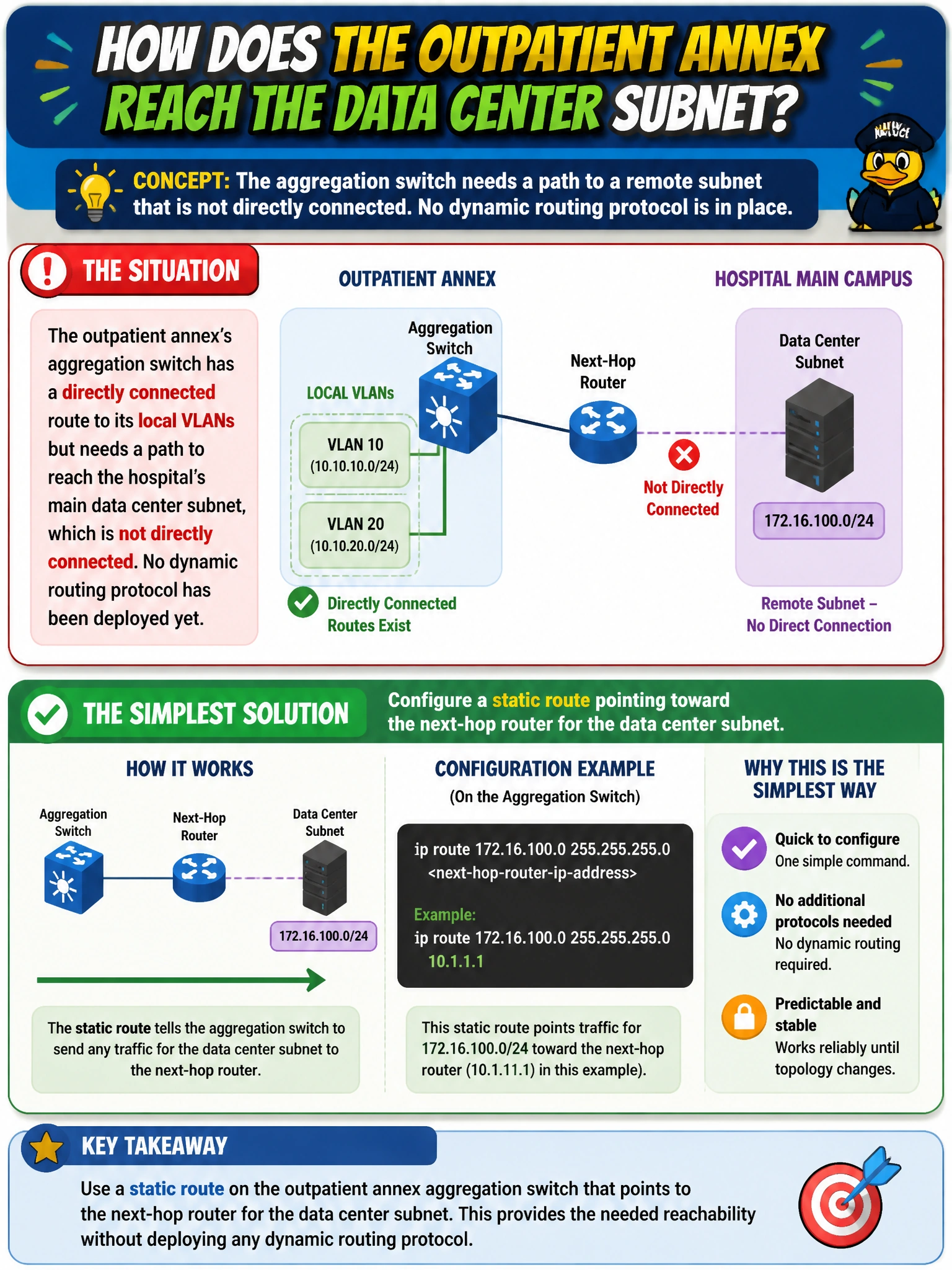
The outpatient annex's aggregation switch has a directly connected route to its local VLANs but needs a path to reach the hospital's main data center subnet, which is not directly connected. No dynamic routing protocol has been deployed yet. What is the simplest way to provide that reachability?
Select an answer to reveal the explanation.
Short Explanation
With no dynamic routing protocol running yet, someone has to just tell the switch where to send traffic it doesn't already know a path for. A static route is that manual signpost — 'to reach this subnet, go this way' — and it's the most direct fix when the destination isn't directly connected.
Full Explanation
A static route explicitly tells the switch which next-hop address to use for traffic destined to a specific remote subnet, which is the direct, minimal-configuration answer when no dynamic routing protocol is running and the destination is not directly attached — exactly the situation described. Adding the data center subnet as another VLAN on the annex switch is not valid; VLANs represent locally attached broadcast domains, and a remote subnet reachable only through another router cannot simply be declared as a local VLAN. LACP is a link aggregation protocol for bundling physical links into one logical interface between two directly connected devices — it has no capability to advertise routes or provide reachability to a remote subnet, since it operates below the routing layer entirely. A second native VLAN only changes how untagged frames are classified on a trunk; it creates no new reachability to a remote subnet and does not function as any kind of routing mechanism. Caveat: static routes do not automatically adapt if the network topology changes, so as the campus grows, a dynamic routing protocol becomes worth evaluating to avoid manually maintaining routes everywhere. Operational check: after configuring the static route, verify with a routing table lookup that the data center subnet appears with the expected next hop, and confirm actual reachability with a basic connectivity test.